Jordanian king’s EU tour to attract investment, enhance regional stability

Jordanian king’s EU tour to attract investment, enhance regional stability
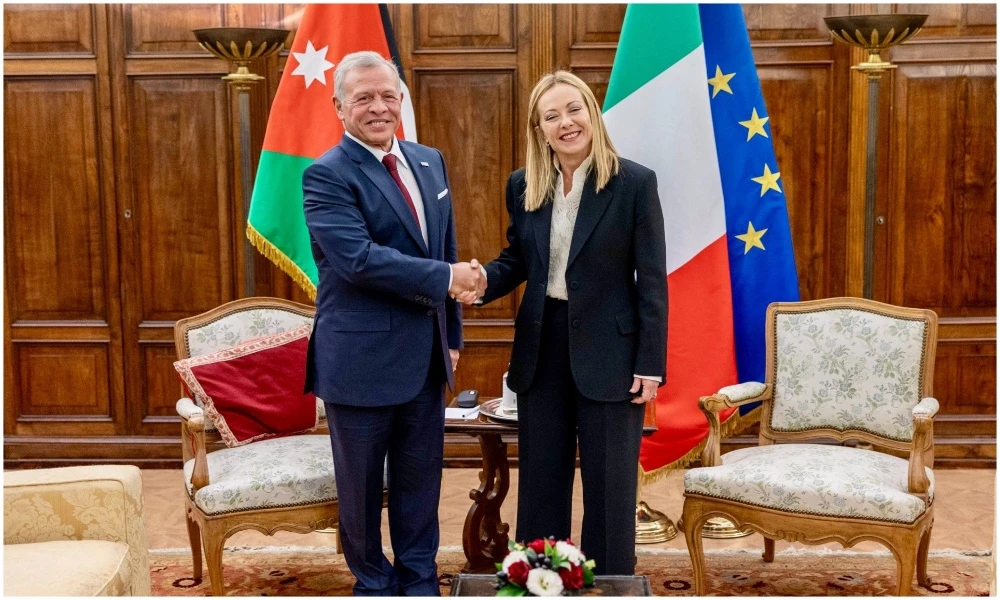
King Abdullah and Italian Prime Minister Giorgia Meloni met in Rome to stress the importance of implementing the Gaza ceasefire agreement. (Petra)
Short Url
Updated 15 October 2025
Follow

Jordanian king’s EU tour to attract investment, enhance regional stability

Jordanian king’s EU tour to attract investment, enhance regional stability
  • Ali Murad, the head of Eurocham, underscored the European market as vital for Jordan’s economy
  • He said that King Abdullah’s meetings aim to promote regional stability and development through economic and diplomatic cooperation

LONDON: King Abdullah II of Jordan is on a European tour to Italy, Hungary, and Slovenia to enhance the country’s economic, trade, and investment ties with the EU, while also opening new avenues for cooperation, the president of Eurocham said.

Ali Murad, the head of the European Chamber of Commerce in Jordan, said that King Abdullah’s meetings with European leaders will enhance Jordan’s role as a reliable regional partner and attract European investments in key sectors like technology, renewable energy, industry, and tourism.

Murad underscored the European market as vital for Jordan’s economy, emphasizing the need to enhance exports and expand access through new partnerships and tariff measures.

He told Petra news agency on Wednesday that King Abdullah’s meetings aim to promote regional stability and development through economic and diplomatic cooperation between Jordan and Europe.

Eurocham collaborates with Jordan’s public and private sectors to identify investment opportunities in green projects and innovative infrastructure, Petra added.

On Tuesday, the king and Italian Prime Minister Giorgia Meloni met in Rome to stress the importance of implementing the Gaza ceasefire agreement, urging all parties, including Israel and Hamas, to work together until the US-brokered deal is fully completed.

King Abdullah also emphasized the importance of efforts to preserve Christian religious sites in Jordan during a separate meeting on Tuesday with Pope Leo XIV at the Apostolic Palace in Vatican City, accompanied by Queen Rania.
Syrians furious at major hike in electricity prices

Updated 36 sec ago
Follow

Syrians furious at major hike in electricity prices

Syrians furious at major hike in electricity prices
DAMASCUS: In his workshop near the Syrian capital, Ghassan Aama is at a loss following a recent decision to massively hike electricity prices, even as much of the country continues to face extensive outages.
Last month, the energy ministry raised prices by at least 60 times compared to the previous tariff, sending shockwaves through a population already reeling from decades of sanctions and 14 years of war.
“We were surprised to see electricity prices rise, as our income is limited,” said Aama, a blacksmith.
“If the bills are high, we might not be able to make ends meet,” he added.
Aama already pays a subscription to a private generator so he can run his workshop — a common practice in the country’s whose electricity sector has been ravaged by the civil war, with power cuts reaching up to 20 hours a day.
“We are coming out of a war, and our homes are destroyed... we were hoping things would get better, not worse,” he added.

- Liberalization -

Since the toppling of longtime ruler Bashar Assad in December, Syria has slowly begun to emerge from decades of political and economic isolation.
The new Islamist authorities are hoping to attract funding and investments for reconstruction, which the World Bank estimated could cost more than $216 billion.
The government’s decision to hike tariffs is part of a policy of liberalization that the government seems to have adopted at the start of the year, said Jihad Yazigi, editor of economic publication The Syria Report.
“What they are doing, basically, is just trying to cut costs and to remove subsidies,” he added.
Contrary to what Assad claimed, Yazigi said the Syrian economy was “obviously not a socialist economy.”
It was “relatively liberal... and here (they) are liberalising further,” he said, as they also lifted subsidies on bread earlier this year.

- ‘No one will pay’ -

But having born the brunt of the country’s crippled economy for years, Syrians are struggling to accept yet another blow.
“After liberation, we expected people to return and reconstruction to take place quickly,” said Muhieddine Salam, a real estate agent.
“Now, if rent is $200 and the electricity tariff is between $200 and $400, what will I do?“
Vendor Alaa Mussa shared his frustration, arguing that “no one will pay, no one has the money.”
“Let them turn the electricity off, it would be better,” she told AFP.
“There are no jobs, and all factories are closed... (At first) everyone was happy, we thought money would start coming in, but no one expected this to happen.”
Syria previously announced major investment agreements with countries in the region to rebuild infrastructure.
It also announced major agreements with Qatar and Turkiye to supply it with gas for electricity production.
But these projects have yet to make a dent in the daily lives of Syrians.
Nine out of 10 people in the country live in poverty, and one in four is unemployed, according to the United Nations.
Many of them resort to informal, temporary jobs to survive, like Umm Al-Zein, 43, who sells bread on the street.
“I can barely afford to pay my son’s university tuition and my daughter’s private lessons for the high school exam,” she said.
“The electricity barely comes on for an hour, and if the electricity doesn’t come, the water doesn’t come either.
“We will be warming ourselves under blankets in the winter.”