Houthis confirm death of chief of staff in Israeli airstrike

Houthis confirm death of chief of staff in Israeli airstrike
People in Sanaa during a rally in condemnation of Israeli strikes on Yemen and solidarity with Palestinians, in Sanaa on September 26, 2025. (File/AFP)
Short Url
Updated 16 October 2025
Follow

Houthis confirm death of chief of staff in Israeli airstrike

Houthis confirm death of chief of staff in Israeli airstrike
  • Houthis confirm that their chief of staff, Mohammed al-Ghamari, was killed in an Israeli airstrike, along with his son and several companions

LONDON: The Houthis confirmed on Thursday the death of Major General Mohammed AbdulKareem Al-Ghamari, their chief of staff and one of the group’s most prominent military figures, following an Israeli airstrike.

An announcement from the group’s Armed Forces also reported the deaths of several of his companions and his 13-year-old son, Hussein, according to Houthi news agency SABA. 

Al-Ghamari had been previously reported wounded in the strike, but the group’s official statement on Thursday confirmed his death. 
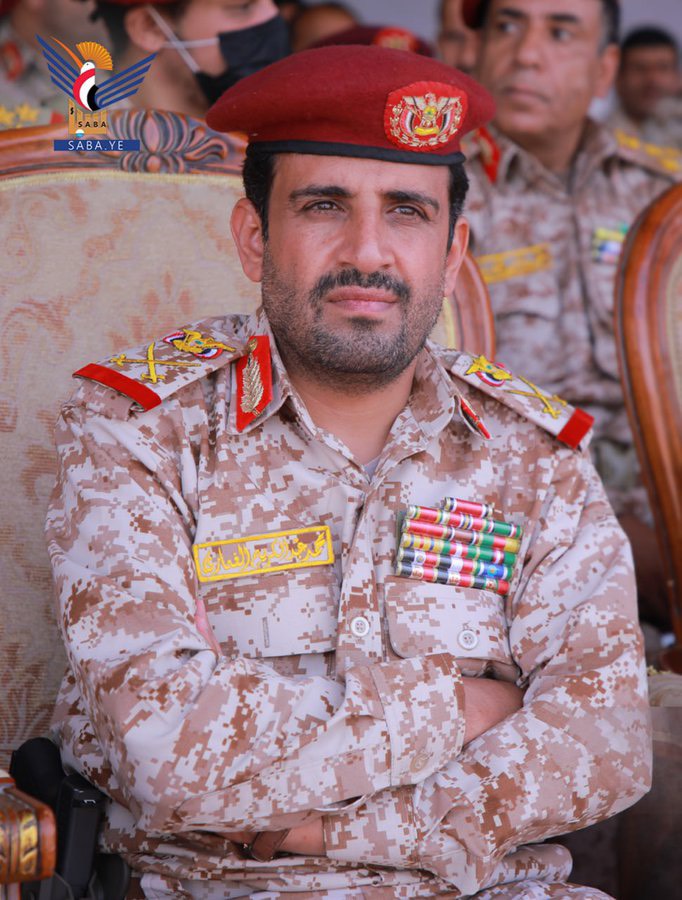


Major General Mohammed AbdulKareem Al-Ghamari. (SABA)

Israeli officials said in June that Al-Ghamari was the target of an airstrike.

Since the onset of Israel’s military operations in Gaza in October 2023, which have been widely condemned as acts of genocide, the Houthi movement in Yemen has escalated its retaliatory attacks on Israeli targets. 

Their actions have been framed as acts of solidarity with Palestinians under siege. 

In response, Israel has conducted multiple airstrikes on Houthi-controlled areas in Yemen, intensifying the regional conflict.
UN issues ‘stark’ warning on Kordofan

Trucks transport displaced people from El-Fasher. (Reuters)
Updated 8 sec ago
Follow

UN issues ‘stark’ warning on Kordofan

Trucks transport displaced people from El-Fasher. (Reuters)
  • Developments on the ground indicate clear preparations for intensified hostilities in Sudan, says Volker Turk

GENEVA: The UN has issued a “stark warning” over preparations for intensified fighting in Sudan’s Kordofan region, as it made a new call for an end to the violence.

The paramilitary Rapid Support Forces, who have been locked in conflict with Sudan’s regular army since April 2023, announced on Thursday that they had agreed to a humanitarian truce proposal made by mediators.
Following the RSF capture of El-Fasher in late October — the army’s last major stronghold in western Darfur — the paramilitaries appear to be shifting their focus eastward toward Khartoum and Kordofan.
UN human rights chief Volker Turk said traumatized and trapped civilians were being prevented from leaving El-Fasher.
“I fear that the abominable atrocities such as summary executions, rape, and ethnically motivated violence are continuing within the city,” he said in a statement.
And for those who do manage to escape, the exit routes have been the scenes of “unimaginable cruelty,” he added.
“At the same time, I issue a stark warning about events unfolding in Kordofan,” said Turk.
“Since the capture of El-Fasher, the civilian casualties, destruction, and mass displacement there have been mounting. There is no sign of de-escalation.
“To the contrary, developments on the ground indicate clear preparations for intensified hostilities, with everything that implies for its long-suffering people.”
The RSF has been accused of mass killings, looting, and sexual violence in El-Fasher.
Turk said that given the “cataclysmic violence” in the city, countries were on notice that without quick and decisive action, “there will be more of the carnage and atrocities that we have already witnessed.”
He said the provision of military support to sustain parties committing serious violations must stop.
“I repeat my plea for an immediate end to the violence both in Darfur and Kordofan. The international community requires bold and urgent action,” said Turk.
The fall of El-Fasher gave paramilitaries control over all five state capitals in Darfur, raising fears that Sudan would effectively be partitioned along an east-west axis.
Witnesses to the first days of the RSF’s takeover said civilians in El-Fasher were shot in the streets, targeted in drone strikes, and crushed by trucks,
Reuters spoke to people who fled to the city of Al-Dabba, more than 1,000 km away in northern Sudan, and one person who fled to the nearby town of Tawila.
One witness said he was in a group trying to flee intense shelling when RSF trucks surrounded them, and sprayed civilians with machine-gun fire and crushed them with their vehicles.
“Young people, elderly, children, they ran them over,” said the witness, who did not want to give his name for fear of retribution, speaking by phone from Tawila.