- Shadi Abu Sido says Israeli prison guards told him his family had been killed in Gaza war
- The Palestinian photojournalist was detained without trial under Israel’s Unlawful Combatants Law, severely beaten
KHAN YOUNIS, Gaza Strip: Shadi Abu Sido said his world shattered in Israeli detention when guards told him his wife and two children had been killed in the Gaza war.
“I got hysterical,” the Gaza Palestinian photographer said.
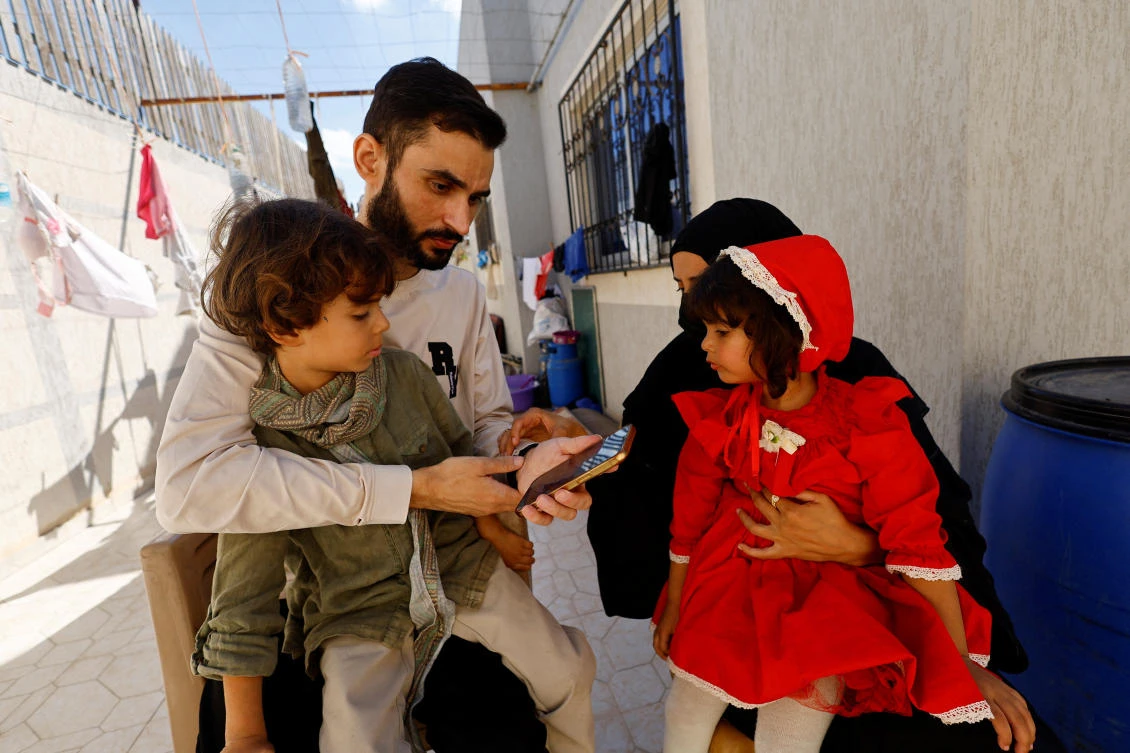
It wasn’t until his release on Monday, part of the US-mediated ceasefire deal between Hamas and Israel that halted two years of war, that he discovered his loved ones were alive.
His wife, Hanaa Bahlul, raced down the hallway of his family’s house in Khan Younis and leapt into his arms. He spun her in the air as they clung to each other. Abu Sido kissed his children’s cheeks again and again, murmuring “my love” as he held the daughter and son he thought he would never see again.
“I heard her voice, I heard the voice of my children, I was astonished, it cannot be explained, they were alive. I saw my wife and children alive. Imagine amid death — life,” he said.
Abu Sido, a photojournalist, said he was detained at Shifa hospital in the northern Gaza Strip on March 18, 2024.
He was among 1,700 Palestinians detained by Israeli forces during the devastating war in Gaza and released on Monday, along with 250 prisoners convicted or suspected of involvement in deadly attacks, in exchange for 20 Israeli hostages held by Hamas since its October 2023 cross-border assault.
DETAINED UNDER THE ‘UNLAWFUL COMBATANTS’ LAW
Bahlul said a lawyer from Addameer, a Palestinian human rights group, had told her Abu Sido was being held under Israel’s Unlawful Combatants Law — a form of administrative detention.
Omer Shatz, an Israeli international law expert at Sciences Po university in Paris, said the law allows Israel to limit access to lawyers, incarcerate people without charge or trial, and arbitrarily detain many Palestinians in Gaza.
According to Addameer, 2,673 Gazans are currently detained under this law.
The Israeli military said in a statement sent to Reuters that its detention policy was “in full alignment with Israeli law and the Geneva Conventions” on legal standards for humanitarian treatment in wartime.
Israel’s Justice Ministry did not respond to Reuters requests for comment.
In March 2024 the Israeli military said it raided Shifa hospital, accusing Hamas of operating from the premises. Hamas has denied Israeli allegations it had command posts underneath Shifa and other Gaza hospitals. Reuters could not independently verify the assertions of either side.
’A GRAVEYARD FOR THE LIVING’
Abu Sido said he was severely beaten, handcuffed, blindfolded and forced to kneel for long periods while in detention. His wrists looked raw during his meeting with Reuters, which he said had been caused by the shackles. Reuters could not independently verify the details of his account.
He was first held at Israel’s Sde Teiman military detention camp, then transferred to the Ofer military camp — which is in the Israeli-occupied West Bank — and later to Ketziot prison in Israel, according to his wife.
Bahlul said Abu Sido was arrested only for being “a journalist for a Palestinian institution.”
A spokesperson for the Israeli Prison Service said all inmates were held according to legal procedures and their rights upheld. “We are not aware of the claims described, and to the best of our knowledge, no such incidents occurred under IPS responsibility,” the spokesperson said.
The Israeli military statement said mistreatment of detainees was “strictly prohibited.” The military said that prolonged restraint was only allowed in “exceptional cases” with significant security risks, and denied that detainees were forced to remain in a crouching position.
An Israeli military official told Reuters in September that of around 100 criminal investigations related to the Gaza war, most concerned allegations of abuse or death of detainees in military custody. Two cases have led to indictments, and one soldier was sentenced to 17 months in prison.
Reuters previously spoke to released Palestinian prisoners who said they suffered abuses in Israeli detention.
Many of the Israeli hostages released by Hamas have also described torture, sexual assault, psychological abuse, and denial of food and medical care.
Amany Srahneh of the Palestinian Prisoners Society said conditions for Palestinian inmates deteriorated dramatically after Hamas’ October 7, 2023 attack, with reports of sexual assault, beatings, denial of medication, and food shortages.
She said conditions were even worse for Gaza Palestinians held in military detention.
Abu Sido said that prison was “the graveyard of the living. When I returned to Gaza, it was like my soul returned to my body. But when I saw the destruction..., how can I start again?“