Egypt raises fuel prices for the second time this year

Egypt raises fuel prices for the second time this year
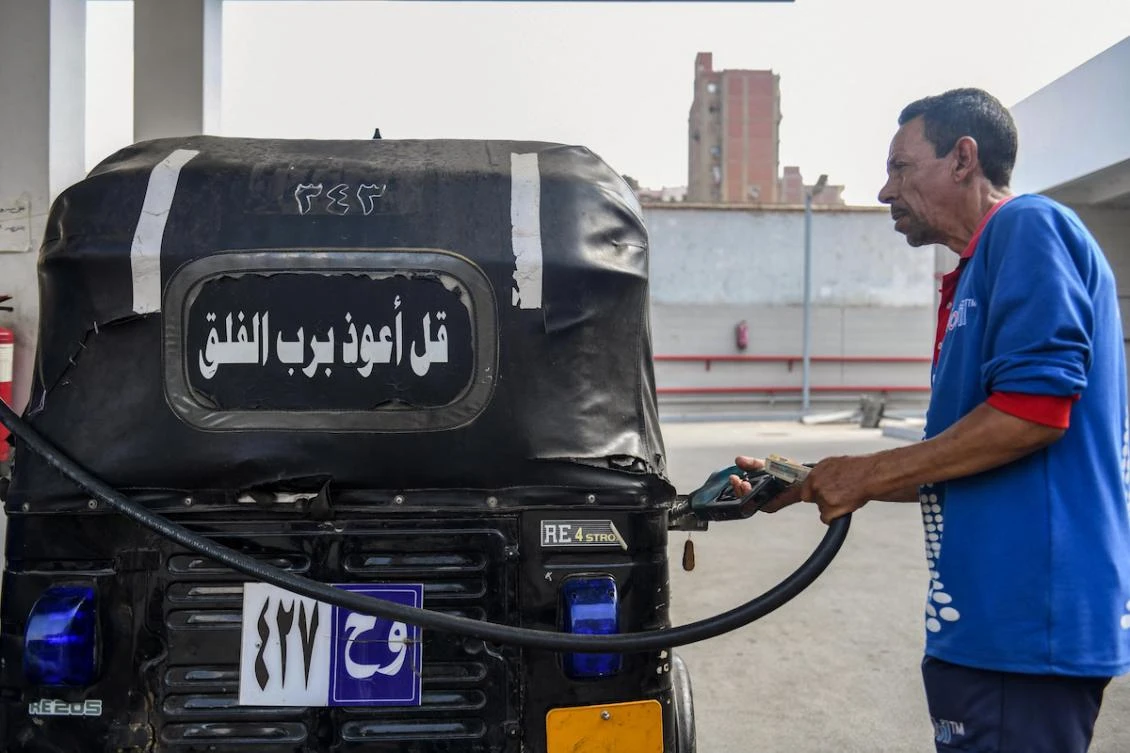
A worker fills the tank of a three-wheeled vehicle at a petrol station in Cairo on July 26, 2024. (FILE/AFP)
Short Url
Updated 17 October 2025
Follow

Egypt raises fuel prices for the second time this year

Egypt raises fuel prices for the second time this year
  • Egypt has increased fuel prices by around 12 percent, marking the second hike this year
  • The government announced the change on Friday, stating that prices will remain fixed for at least a year

CAIRO: Egypt increased fuel prices by around 12 percent on Friday, a step likely to drive up the costs of goods and services across the country. This is the second fuel price hike this year.
In a statement posted on Facebook, the Egyptian government gave no reason for the move but said fuel prices will remain fixed in the local market with no further increases for at least one year.
Egyptians have been grappling with soaring inflation as they navigate rising daily costs that reached another high last year. They included an increase in fuel prices, a hike in subway fares and a slide in the Egyptian pound against foreign currencies.
According to the latest data from the Central Bank of Egypt posted Oct. 8, Egypt’s annual urban consumer price inflation reached 11.7 percent in September— down from 12 percent in August and 13.9 percent in July.
Fuel prices last increased in April, rising between 11 percent and 14 percent on various fuel products.
At the time of a previous price hike in late 2024, the government said that raising prices was meant to “reduce the gap between the selling prices of petroleum products and their high production and import costs.”
According to the new prices taking effect on Friday, the cost of a liter of diesel — which is heavily relied on for public transport — increased from 15.50 pounds ($0.33) to 17.50 pounds ($0.37), while the price of the 92-octane gasoline rose to 19.25 pounds ($0.40) from 17.25 pounds ($0.36) and the 95-octane gasoline increased from 19 pounds ($0.40) to 21 pounds ($0.44).
The petroleum sector will continue running refineries at full capacity and provide incentives to its partners to boost production, reduce import expenses, and stabilize costs — with the aim of narrowing the gap between production costs and selling prices, said the government on Friday.
Earlier this year, the government raised the minimum monthly wage for both public and private sector workers to 7,000 pounds ($138), up from 6,000 pounds ($118.58).
The Egyptian economy has been hit hard by years of government austerity, the coronavirus pandemic, the fallout from Russia’s full-scale invasion of Ukraine, and most recently, the Israel-Hamas war in Gaza. The Houthi attacks on shipping routes in the Red Sea have slashed Suez Canal revenues, which is a major source for foreign currency. The attacks forced traffic away from the canal and around the tip of Africa.
Egypt previously reached a deal with the IMF to more than double the size of its bailout to $8 billion. The price hikes have been deemed necessary to meet conditions set by the International Monetary Fund for further assistance to the country.
In March, the IMF said it completed its fourth review of Egypt’s economic reform program approving a $1.2 billion disbursement for the North African country.
UN secretary-general warns that war in Sudan is ‘spiraling out of control’

UN secretary-general warns that war in Sudan is ‘spiraling out of control’
Updated 04 November 2025
Follow

UN secretary-general warns that war in Sudan is ‘spiraling out of control’

UN secretary-general warns that war in Sudan is ‘spiraling out of control’
  • UN chief offers stark warning about El-Fasher and calls for an immediate ceasefire in the two-year conflict

DUBAI: The United Nations secretary-general warned Tuesday that the war in Sudan is “spiraling out of control” after a paramilitary force seized the Darfur city of El-Fasher.

Speaking at a UN summit in Qatar, Antonio Guterres offered a stark warning about El-Fasher and called for an immediate ceasefire in the two-year conflict that’s become one of the world’s worst humanitarian crises.

“Hundreds of thousands of civilians are trapped by this siege,” Guterres said. “People are dying of malnutrition, disease and violence. And we are hearing continued reports of violations of international humanitarian law and human rights.”

He added that there also were “credible reports of widespread executions since the Rapid Support Forces entered the city.”

UN officials have warned of a rampage by the paramilitary Rapid Support Forces after it took over the city of El-Fasher, reportedly killing more than 450 people in a hospital and carrying out ethnically targeted killings of civilians and sexual assaults.

The RSF has denied committing atrocities, but testimonies from those fleeing, online videos and satellite images offer an apocalyptic vision of the aftermath of their attack. The full scope of the violence remains unclear because communications are poor in the region.

The RSF besieged El-Fasher for 18 months, cutting off much of the food and other supplies needed by tens of thousands of people. Last week, the paramilitary group seized the city.

Asked if he thought there was a role for international peacekeepers in Sudan, Guterres said it was important to “gather all the international community and all those that have leverage in relation to Sudan to stop the fighting.”

“One thing that is essential to stop the fighting is to make sure that no more weapons come into Sudan,” he said. “We need to create mechanisms of accountability because the crimes that are being committed are so horrendous.”

The war between the RSF and the Sudanese military has been tearing apart Sudan since April 2023. More than 40,000 people have been killed, according to UN figures, but aid groups say the true death toll could be many times higher. The fighting has driven more than 14 million people from their homes and fueled disease outbreaks. Meanwhile, two regions of war-torn Sudan are enduring a famine that is at risk of spreading.

“It is clear that we need a ceasefire in Sudan,” Guterres said. “We need to stop this carnage that is absolutely intolerable.”