Billionaire Bill Gates calls for climate strategy pivot ahead of COP30

Billionaire Bill Gates calls for climate strategy pivot ahead of COP30
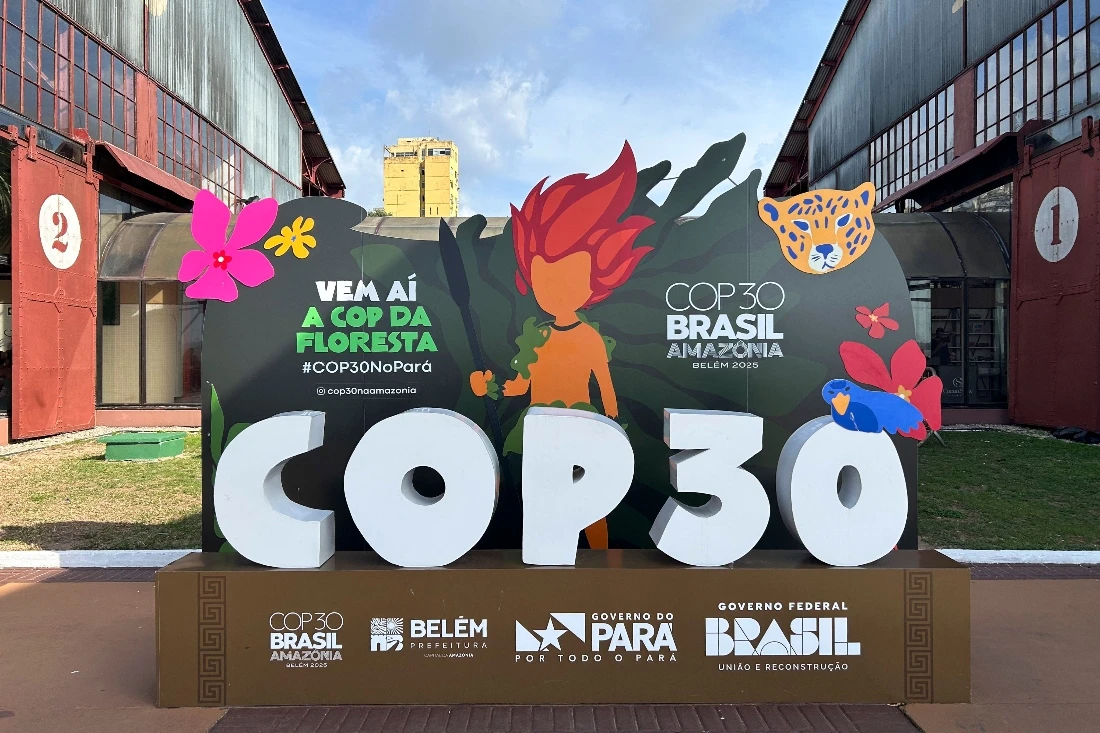
The COP30 logotype at Docks Station in Belem, Para state, Brazil. (AFP)
Short Url
Updated 28 October 2025
Follow

Billionaire Bill Gates calls for climate strategy pivot ahead of COP30

Billionaire Bill Gates calls for climate strategy pivot ahead of COP30
  • While climate change was serious, it was “not civilization ending,” Gates posted on his blog, continuing rather than focus on temperature as the best measure of progress, climate resilience would be better built by strengthening health and prosperity

LONDON: Billionaire investor and philanthropist Bill Gates called on world leaders on Tuesday to adapt to extreme weather and focus on improving health outcomes rather than temperature reduction targets ahead of the COP30 climate talks in Brazil.
COP30 will be held November 10-21 in the port city of Belem in Brazil’s lower Amazon region. Countries are due to present updated national climate commitments and assess progress on renewable energy targets agreed at previous summits.
The world has spent the last decade working toward the goals of the Paris Agreement, aiming to limit global warming to well below 2 degrees Celsius above the pre-industrial average by mid-century — something that remains well off-track.
While climate change was serious, it was “not civilization-ending,” Gates posted on his personal blog. He wrote that rather than focus on temperature as the best measure of progress, climate resilience would be better built by strengthening health and prosperity.
He called for a shift in focus toward improving human welfare, particularly in vulnerable regions, through investments in energy access, health care, and agricultural resilience.
These areas, he argued, offered more equitable benefits than temperature goals and should be central to climate strategies discussed at COP30.
Gates, who has invested billions to accelerate clean technology innovation through his climate-focused venture network, Breakthrough Energy, also challenged policymakers and donors to scrutinize whether climate aid was being spent effectively.
He urged them to use data to maximize impact, and called on investors to back companies developing high-impact clean technologies so they could more quickly lower costs.
He said direct deaths from natural disasters have fallen 90 percent over the last century to between 40,000 and 50,000 annually, largely due to better warning systems and more resilient infrastructure.
UN Secretary-General Antonio Guterres and the World Meteorological Organization last week urged countries to implement disaster warning systems to protect people against extreme weather.
The WMO said that in the past five decades, weather, water and climate-related hazards have killed more than 2 million people, with 90 percent of those deaths occurring in developing countries.
EU in last-minute talks to set new climate goal for COP30

EU in last-minute talks to set new climate goal for COP30
Updated 25 min 49 sec ago
Follow

EU in last-minute talks to set new climate goal for COP30

EU in last-minute talks to set new climate goal for COP30
  • EU ministers meet to try to pass new climate target
  • Bloc’s credibility at risk ahead of COP30 climate talks

BRUSSELS: EU climate ministers will make a last-ditch attempt to pass a new climate change target on Tuesday, in an effort to avoid going to the UN COP30 summit in Brazil empty-handed.
Failure to agree could undermine the European Union’s claims to leadership at the COP30 talks, which will test the will of major economies to keep fighting climate change despite opposition from US President Donald Trump.
Countries including China, Britain and Australia have already submitted new climate targets ahead of COP30.
But the EU, which has some of the world’s most ambitious CO2-cutting policies, has struggled to contain a backlash from industries and governments skeptical that it can afford the measures alongside defense and industrial priorities. EU members failed to agree a 2040 climate target in September, leaving them scrambling for a deal days before European Commission President Ursula von der Leyen meets other world leaders at COP30 in Belem, Brazil, on November 6.
“The geopolitical landscape has rarely been more complex,” EU climate policy chief Wopke Hoekstra told a gathering of climate ministers in Canada on Saturday, adding that he was confident the bloc would approve its new goal.
“The European Union will continue to do its utmost, even under these circumstances, in Belem to uphold its commitment to multilateralism and to the Paris Agreement,” he said.
The starting point for talks is a European Commission proposal to cut net EU greenhouse gas emissions by 90 percent from 1990 levels by 2040, to keep countries on track for net-zero by 2050.
Italy, Poland and the Czech Republic are among those warning this is too restrictive for domestic industries struggling with high energy costs, cheaper Chinese imports and US tariffs.
Others, including the Netherlands, Spain and Sweden, cite worsening extreme weather and the need to catch up with China in manufacturing green technologies as reasons for ambitious goals. The draft compromise ministers will discuss, seen by Reuters, includes a clause demanded by France allowing a weakening of the 2040 goal in future, if it becomes clear EU forests are not absorbing enough CO2 to meet it. Brussels has also vowed to change other measures to attempt to win buy-in for the climate goal. These include controlling prices in an upcoming carbon market and considering weakening its 2035 combustion engine ban as requested by Germany.
A deal on Tuesday will require ministers to agree on the share of the 90 percent emissions cut countries can cover by buying foreign carbon credits — effectively softening efforts required by domestic industries.
France has said credits should cover 5 percent, more than the 3 percent share originally proposed by the Commission. Other governments argue money would be better spent on supporting European industries than buying foreign CO2 credits.
Support from at least 15 of the 27 EU members is needed to pass the goal. EU diplomats said on Monday the vote would be tight and could depend on one or two flipping positions.
Ministers will try first to agree the 2040 goal, and from that derive an emissions pledge for 2035 — which is what the UN asked countries to submit ahead of COP30.