Countries’ new climate plans to start cutting global emissions, UN says

Countries’ new climate plans to start cutting global emissions, UN says
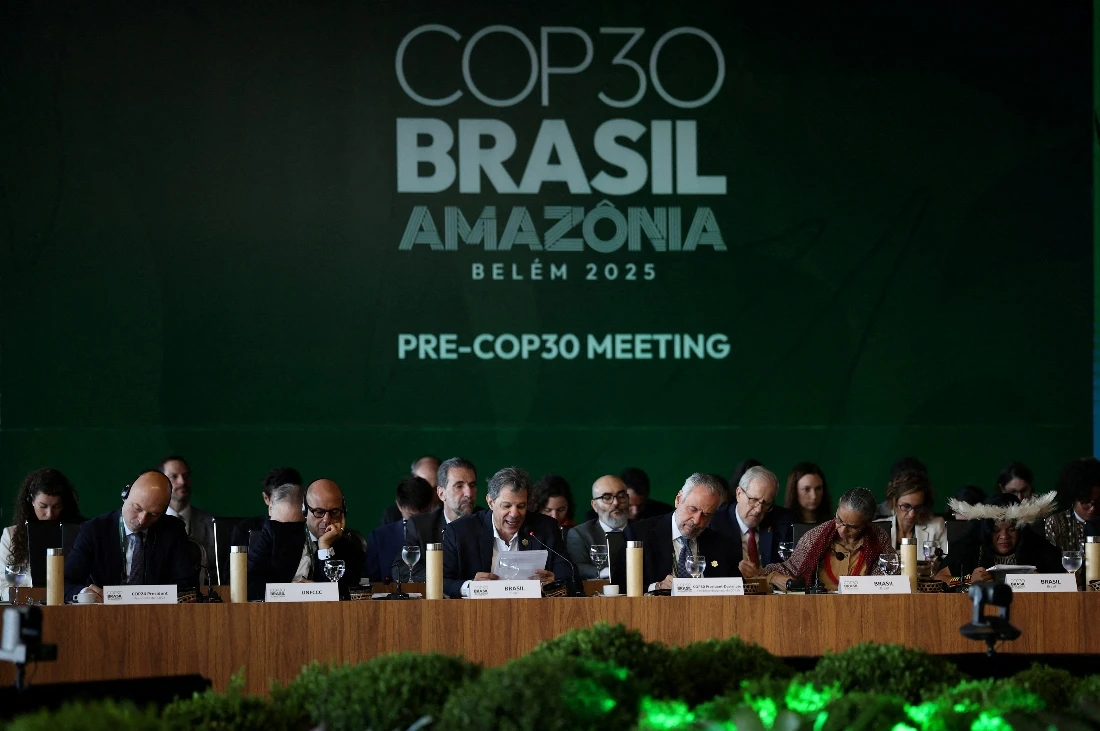
Brazil's Finance Minister Fernando Haddad speaks next to Simon Stiell, Executive Secretary of UN Climate Change (UNFCCC), and Brazil's COP30 President Andre Correa do Lago during the ministerial preparatory meeting (Pre-COP30), ahead of the COP30 Climate Summit, in Brasilia, Brazil. (Reuters)
Short Url
Updated 28 October 2025
Follow

Countries’ new climate plans to start cutting global emissions, UN says

Countries’ new climate plans to start cutting global emissions, UN says
  • The analysis by the United Nations’ climate change secretariat (UNFCCC) suggested that, if countries’ plans for tackling climate change are carried out, the yearly amount of planet-warming gases added to the atmosphere would decrease 10 percent by 2035
  • The calculation marked the first time the UNFCCC has forecast a steady decline in global emissions, which have consistently increased since 1990

BRUSSELS: The latest climate pledges by governments will cause global greenhouse gas emissions to start to fall in the next 10 years, but not nearly fast enough to prevent worsening climate change and extreme weather, the UN said on Tuesday.
The analysis by the United Nations’ climate change secretariat (UNFCCC) suggested that, if countries’ plans for tackling climate change are carried out, the yearly amount of planet-warming gases added to the atmosphere would decrease 10 percent by 2035, from 2019 levels.
The calculation marked the first time the UNFCCC has forecast a steady decline in global emissions, which have consistently increased since 1990.
The projected 10 percent cut is far short of the 60 percent emissions drop needed by 2035 to limit global warming at 1.5 degrees Celsius above pre-industrial temperatures — the threshold beyond which scientists say it would unleash far more severe impacts.
That shortfall adds pressure ahead of next month’s COP30 climate summit in Brazil for countries to step up their efforts – even as the United States rolls back climate policies under President Donald Trump.
“Humanity is now clearly bending the emissions curve downwards for the first time, although still not nearly fast enough,” UNFCCC head Simon Stiell said.
“It’s now for COP30 and for the world to respond and show how we are going to speed up,” Stiell said in a statement.
Many countries have been slow to submit more ambitious climate targets, amid economic and geopolitical challenges. The UNFCCC also published a detailed report of the 64 countries who met a September deadline to submit final climate plans, but those accounted for just 30 percent of global emissions.
To offer a more complete assessment, the UNFCCC said it had produced the global analysis, including targets countries have announced but not yet formally submitted, such as from China and the EU.
That assessment still includes uncertainties. For example, it included the 2024 US emissions-cutting pledge that Trump is expected to scrap, leaving the future US emissions trajectory unclear.
China, which now produces about 29 percent of annual global emissions, pledged last month to cut emissions by 7 percent to 10 percent from their peak by 2035, but did not say when that peak would happen. Some analysts suggested Beijing could deliver far more.
“China tends to under-commit,” said Norah Zhang, climate policy analyst at the research group NewClimate Institute, noting that the country met its 2030 target to expand wind and solar energy six years early.
Truckers defy death to supply militant-hit Mali with fuel

Truckers defy death to supply militant-hit Mali with fuel
Updated 3 sec ago
Follow

Truckers defy death to supply militant-hit Mali with fuel

Truckers defy death to supply militant-hit Mali with fuel
TENGRELA: Tanker driver Baba steeled himself for yet another perilous journey from Ivory Coast to Mali loaded up with desperately needed fuel — and fear.
“You never know if you’ll come back alive,” he said.
Even before they hit the road, the mere mention of a four-letter acronym is enough to scare Baba and his fellow drivers.
JNIM, the Al-Qaeda-linked Group to Support Islam and Muslims, known by its Arabic acronym, declared two months ago that no tanker would cross into Mali from any neighboring country.
Hundreds of trucks carrying goods from the Ivorian economic hub Abidjan or the Senegalese capital Dakar have since been set on fire.
The JNIM’s strategy of economic militant aims to choke off Mali’s capital Bamako and the ruling military junta, which seized power in back-to-back coups in 2020 and 2021.
The fuel blockade has made everyday life in the west African country all but impossible.
“By economically strangling the country, the JNIM is looking to win popular support by accusing the military government of incompetence,” Bakary Sambe from the Dakar-based Timbuktu Institute think tank said.
On top of that, Mali has a “structural problem of insecurity,” he added.
Despite it all, dozens of tanker truckers still brave the roads, driven on by “necessity” and “patriotism,” they say.
AFP spoke to several along the more than 300-kilometer (185-mile) road between the northern Ivorian towns of Niakaramandougou and Tengrela, the last one before the Malian border.

- Dying ‘for a good cause’ -

“We do it because we love our country,” Baba, whose name AFP has changed out of security concerns, said.
“We don’t want Malians to be without fuel,” added the 30-year-old in a Manchester United shirt.
Taking a break parked up at Niakaramandougou, five hours from the border, Mamadou Diallo, 55, is similarly minded.
“If we die, it’s for a good cause,” he confided.
Further north at Kolia, Sidiki Dembele took a quick lunch with a colleague, their trucks lined up on the roadside, engines humming.
“If the trucks stop, a whole country will be switched off,” he said, between mouthfuls of rice.
Two years ago, more than half of the oil products exported by Ivory Coast went to Mali.
Malian trucks load up at Yamoussoukro or Abidjan and then cross the border via Tengrela or Pogo, traveling under military escort once inside Mali until their arrival in Bamako.
Up to several hundred trucks can be escorted at a time, but even with the military by their side, convoys are still frequently targeted, especially on two key southern axes.
“Two months ago, I saw militants burn two trucks. The drivers died. I was just behind them. Miraculously they let me through,” Moussa, 38, in an oil-stained red polo T-shirt, said.
Bablen Sacko also narrowly escaped an ambush.
“Apprentices died right behind us,” he recalled, adding firmly: “Everyone has a role in building the country. Ours is to supply Mali with fuel. We do it out of patriotism.”


- ‘Risk premium’ -

But their pride is mixed with bitterness over their working conditions.
“No contract, no insurance, no pension. If you die, that’s that. After your burial, you’re forgotten,” Sacko said.
With monthly pay of barely 100,000 CFA francs ($175, 152 euros) and a small bonus of 50,000 CFA francs per trip, Yoro, one of the drivers, has called for a risk premium.
Growing insecurity has prompted some Ivorian transport companies to halt road travel into Mali.
In Boundiali, Broulaye Konate has grounded his 45-strong fleet.
“I asked a driver to deliver fertilizer to Mali. He refused. The truck is still parked in Abidjan,” he said.
Ivorian trucker Souleymane Traore has been driving to Mali for seven years but said lately “you take to the road with fear in your heart.”
He recently counted 52 burnt-out tankers on his way back to Ivory Coast and another six on a further stretch of road.
Malian Prime Minister Abdoulaye Maiga has referred to the fuel that manages to get through as “human blood,” in recognition of the soldiers and drivers killed on the roads.
Analyst Charlie Werb from Aldebaran Threat Consultants said he did not anticipate the fuel situation easing in the coming days but said the political climate was more uncertain.
“I do not believe JNIM possesses the capability or intent to take Bamako at this time, though the threat it now poses to the city is unprecedented,” he added.