Attack on key city in Sudan’s Kordofan region kills 40

Attack on key city in Sudan’s Kordofan region kills 40
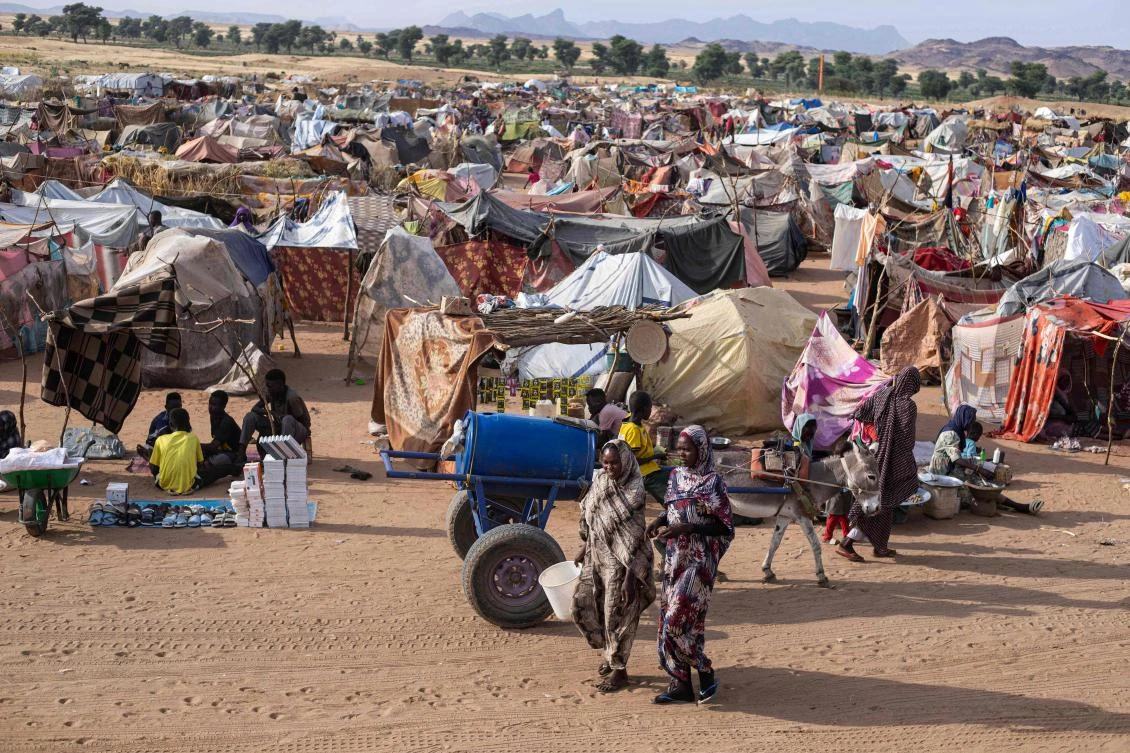
Above, displaced Sudanese who fled El-Fasher rest in the camp of Um Yanqur, located on the southwestern edge of Tawila, in war-torn Sudan’s western Darfur region on Nov. 3, 2025. (AFP)
Short Url
Updated 31 sec ago
Follow

Attack on key city in Sudan’s Kordofan region kills 40

Attack on key city in Sudan’s Kordofan region kills 40
  • UN statement did not specify what day the attack took place or who was behind it
  • The war in Sudan has spread to new areas in recent days, sparking fears of an even greater humanitarian catastrophe

PORT SUDAN: An attack on a funeral in the key city of El-Obeid in Sudan’s central Kordofan region killed 40 people, the UN said Wednesday, as paramilitaries looked poised to launch an offensive.

The United Nations’ humanitarian office did not specify when the attack took place or who was behind it, but said that the situation in the Kordofan region was continuing to worsen.

The war in Sudan, which has killed tens of thousands of people and displaced millions more, has spread to new areas in recent days, sparking fears of an even greater humanitarian catastrophe.

The paramilitary Rapid Support Forces (RSF), at war with the military since 2023, was preparing to launch an assault in Kordofan after capturing El-Fasher, the last army stronghold in the vast western Darfur region.

“Local sources report that at least 40 civilians were killed and dozens injured yesterday in an attack on a funeral gathering in El Obeid, the capital of North Kordofan State,” the UN’s OCHA agency said.

“Once again, OCHA calls for an immediate cessation of hostilities and for all parties to protect civilians and respect international humanitarian law.”

People forced to flee El-Fasher have described horrific abuse, including rape, at the hands of the RSF.

“The rapes were gang rapes. Mass rape in public, rape in front of everyone and no one could stop it,” mother of four Amira said from a makeshift shelter in Tawila, some 70 kilometers (43 miles) west of El-Fasher.

Doctors Without Borders (MSF) said more than 300 survivors of sexual violence had sought care from its teams in Tawila after a previous RSF assault on the nearby Zamzam camp, which displaced more than 380,000 people last spring.

“You’d be asleep and they’d come and rape you,” said Amira, using a pseudonym while speaking during a webinar organized by campaign group Avaaz.

“I saw with my own eyes people who couldn’t afford to pay and the fighters took their daughters instead. They said, ‘Since you can’t pay, we’ll take the girls.’ If you had daughters of a young age, they would take them immediately.”

Both sides in the war have been accused of committing atrocities.

US truce proposal

The fall of El-Fasher gave paramilitaries control over all five state capitals in Darfur, raising fears that Sudan would effectively be partitioned along an east-west axis.

The RSF now dominates Darfur and parts of the south, while the army holds the north, east and central regions along the Nile and Red Sea.

Sudan’s army-backed defense minister on Tuesday said the military would press on with its fight against the RSF after the security and defense council met to discuss a US proposal for a ceasefire.

“We thank the Trump administration for its efforts and proposals to achieve peace,” Hassan Kabroun said in a speech broadcast on state television, while adding that “preparations for the Sudanese people’s battle are ongoing.”

“Our preparations for war are a legitimate national right,” he said.

No details of the US truce proposal have been made public.

White House Press Secretary Karoline Leavitt told reporters on Tuesday that Washington wanted “to see this conflict come to a peaceful end, just as we have with so many others, but the reality is it’s a very complicated situation on the ground right now.”

‘Nightmare of violence’

The International Criminal Court on Monday voiced “profound alarm and deepest concern” over the reports from El-Fasher, adding that such acts “may constitute war crimes and crimes against humanity.”

Speaking at a forum in Qatar on Tuesday, UN Secretary-General Antonio Guterres called on the warring parties to “come to the negotiating table, bring an end to this nightmare of violence – now.”
Former Iraq PM Al-Maliki could heavily influence election despite troubled past

Updated 15 sec ago
Follow

Former Iraq PM Al-Maliki could heavily influence election despite troubled past

Former Iraq PM Al-Maliki could heavily influence election despite troubled past
Maliki, in his mid-70s, was pressured to step down in 2014 by an unusually broad array of critics
His political roots stretch back decades, shaped by opposition to Saddam Hussein’s authoritarian rule

BAGHDAD: Former Prime Minister Nouri Al-Maliki remains a potent force in Iraqi politics despite long-standing accusations that he fueled sectarian strife and failed to stop Islamic State from seizing large areas of the country a decade ago.
As leader of the influential State of Law, a Shiite Muslim coalition, he is seen as having enough clout to decide who will become Iraq’s next prime minister after a parliamentary election on November 11.
Maliki, in his mid-70s, was pressured to step down in 2014 by an unusually broad array of critics — the US, Iran, Sunni leaders and Iraq’s top Shiite cleric — after Islamic State’s rapid territorial gains in 2014.
His divisive years as premier were blamed by many Iraqis for fostering sectarian strife between majority Shiites and minority Sunnis, while chronic problems like joblessness, poor public services and graft were left to fester.

MALIKI SIGNED SADDAM’S EXECUTION ORDER
Yet despite the criticism, Al-Maliki — a shrewd political operator — staged a comeback in the years that followed, quietly building influence through ties to armed militias, the security services and the judiciary, analysts say.
His political roots stretch back decades, shaped by opposition to Saddam Hussein’s authoritarian rule and a long exile that forged his ideological convictions.
Sentenced to death under Saddam for his role in the outlawed Shiite Islamic Dawa Party, Al-Maliki spent nearly 25 years in exile, mostly in Syria and Iran, agitating for the dictator’s downfall.
Like many exiles, he returned to Iraq after Saddam’s fall — the end of a Sunni-led regime that had long oppressed Shiites and Kurds.
Maliki signed Saddam’s execution order in red ink, paving the way for masked gunmen to place a noose around his neck and pull a lever that quickly ended his life.
Maliki, a friend of Shiite power Iran, had fulfilled his life-long goal of wresting power from the country’s Sunnis, but his drive to entrench Shi’ite dominance proved his downfall.
He was blamed by Sunni leaders for not doing enough to crack down on Shi’ite militias and focusing instead on asserting authority over restless Sunni provinces such as Anbar in western Iraq.
Maliki, who served as premier from 2006-2014, denied that he has a sectarian outlook.
“I am not fighting in Anbar because they are Sunnis, as I have also fought Shi’ite militias. Al Qaeda and militias are one — they both kill people and blow them up. Both rely on perverts and deviants,” Al-Maliki told Reuters in 2014.

MALIKI’S POLICIES HELPED ALIENATE SUNNIS, CRITICS SAY
His term in office was marred by sectarian bloodshed and an anti-American and anti-government insurgency, and accusations that he marginalized Sunnis, one factor in the rise of Sunni Islamic State.
To detractors, the dour Al-Maliki threw down the gauntlet with stunning speed in 2011 when his Shi’ite-led government demanded the arrest of a Sunni Muslim vice president — seemingly moments after the departure of US troops in December of that year.
The move called into question Maliki’s commitment to any sort of democracy. The man who plotted from exile against Saddam for years now drew comparisons with his former enemy.
Critics say Maliki’s sectarian policies drove Sunnis into the arms of Islamic State.
Maliki left office reluctantly in 2014 after security forces crumbled and fled in the face of a lightning advance by Islamic State, which declared a medieval-style caliphate.
In 2015, an Iraqi parliamentary panel called for Al-Maliki and dozens of other top officials to stand trial over the fall of the northern city of Mosul to Islamic State.

MALIKI HAILS FROM POLITICALLY ENGAGED SOUTHERN IRAQI FAMILY
A little-known politician in Iraq before the US-led invasion, Al-Maliki was a compromise pick to lead a wobbly coalition government in 2006.
Initially seen as a Shiite Islamist, Maliki’s initial willingness to put aside sectarianism and quell violence was called into question in a leaked US government memo.
“Despite Maliki’s reassuring words, repeated reports from our commanders on the ground contributed to our concerns about Maliki’s government,” National Security Adviser Stephen Hadley wrote to President George W. Bush in the memo.
He went on to list problems including non-delivery of services to Sunni areas and the removal of Iraq’s most effective commanders on a sectarian basis.
Maliki was born in 1950 in Janaja, a southern village among date groves on the Euphrates, into a politically engaged family — his grandfather wrote poetry inciting rebellion against Iraq’s British occupiers and his father was a fervent Arab nationalist.
Maliki was briefly arrested in 1979 and then fled, narrowly escaping Saddam’s police. His family’s land was seized and dozens of his relatives were killed over the next decade. He did not see his home village again until after the 2003 invasion.
He became deputy head of the committee that purged former officials in Saddam’s widely feared Baath Party.