

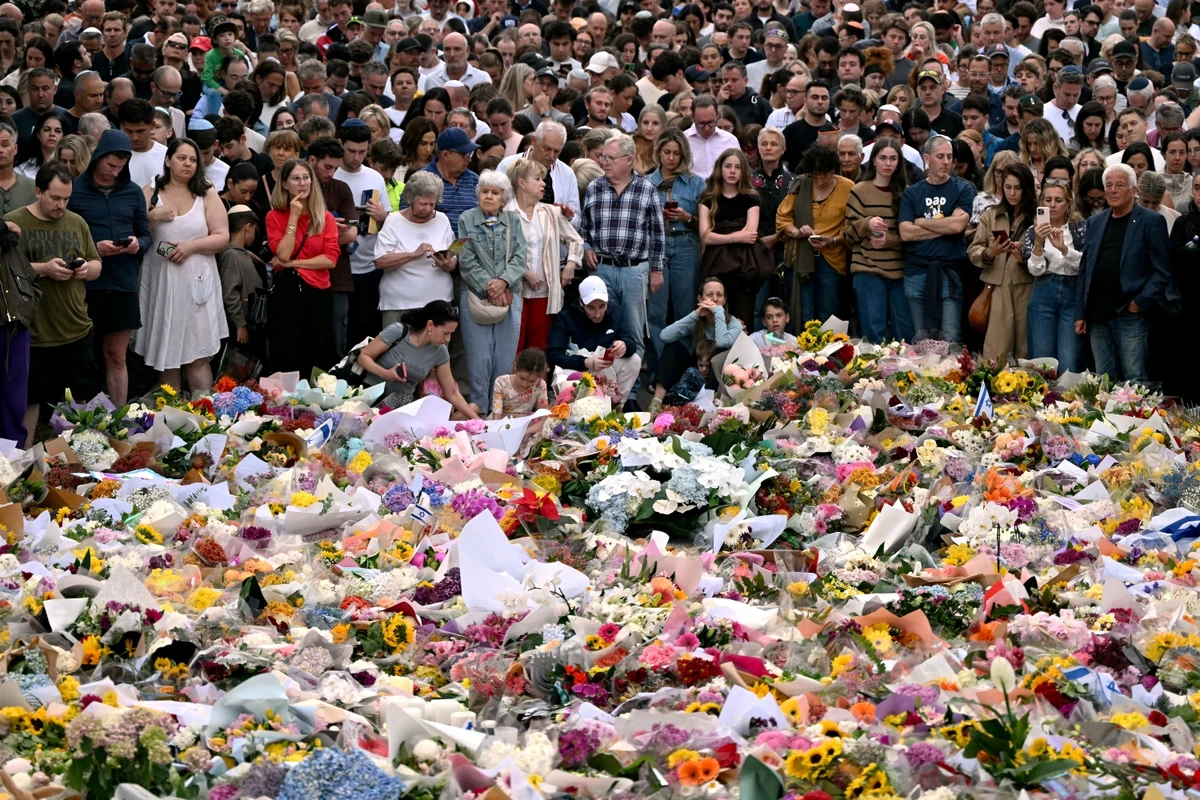

Tragedies are not meant to be moments for scoring political points. When acts of terrorism occur, responsible leaders seek to calm tensions, unite their societies, express solidarity with victims’ families and visit the injured as a public display of empathy. Sadly, this kind of leadership was conspicuously absent in the response of Israel’s prime minister to Sunday’s deadly attack in Australia.
Before the facts were known, Benjamin Netanyahu rushed to make politically motivated and demonstrably false claims. He initially asserted that the tragedy would have been far worse had it not been for a heroic Jewish Australian who disarmed the attacker. Within hours, evidence showed that the true hero was Ahmed Al-Ahmed, an Australian Muslim who was shot in the shoulder and hand while bravely wrestling the gun away from the assailant.
Instead of expressing gratitude to a man who saved lives, Netanyahu compounded his error by further politicizing the attack. Even before the motive behind the violence had been established, the Israeli leader publicly attacked Australian Prime Minister Anthony Albanese, linking the atrocity to Canberra’s decision — which was taken alongside France, the UK, Canada, Portugal and others — to recognize the state of Palestine.
Instead of expressing gratitude to a man who saved lives, Netanyahu compounded his error by further politicizing the attack
Daoud Kuttab
Reading from a letter he had sent to the Australian leader, Netanyahu accused Albanese of weakness and claimed, without evidence, that recognizing Palestinian self-determination had encouraged antisemitic violence. This assertion is not only unfounded but also deeply irresponsible. Nearly 80 percent of UN member states recognize Palestine, including four of the five permanent members of the UN Security Council. To suggest that such recognition fuels terrorism is to distort reality for political gain.
Albanese, by contrast, responded with restraint and statesmanship. Refusing to trade insults, he emphasized national unity and solidarity with Australia’s Jewish community during a moment of profound grief. When directly asked whether he agreed that there was a link between recognizing Palestine and the Bondi Beach attack, Albanese was unequivocal: “No, I don’t.” He added that most of the world continues to see a two-state solution as the only viable path to peace in the Middle East.
The missteps did not end there. Israeli officials, including figures associated with what is often described as a world-class intelligence apparatus, rushed, without evidence, to blame Iran for the attack. Subsequent findings pointed in a very different direction: Daesh symbols were reportedly found in the attackers’ vehicle and information emerged suggesting links to Daesh training in the Philippines. Any student of Middle Eastern politics knows that Sunni extremist groups such as Daesh are bitter enemies of Shiite-majority Iran. Yet the facts once again took a back seat to political narrative.
The Australia attack became yet another occasion to deflect responsibility, attack allies and spread misinformation
Daoud Kuttab
This was not always Israel’s approach. In the 1990s, following deadly attacks at home, then-Prime Minister Yitzhak Rabin famously argued that Israel must fight terrorism as if there were no peace process, while pursuing peace as if there were no terrorism. A similar sentiment was once expressed by Menachem Begin, the founder of Likud. Both leaders understood that grief should not be exploited to derail the pursuit of peace.
That wisdom appears absent today. For Netanyahu, every tragedy seems to present an opportunity, not for reflection or reconciliation, but for political maneuvering and the advancement of an antipeace agenda. The Australia attack became yet another occasion to deflect responsibility, attack allies and spread misinformation.
Terrorism is a scourge that must be condemned without qualification. Exploiting innocent blood to score political points, misidentifying heroes, falsely accusing governments and misrepresenting the facts only deepens divisions and dishonors the victims. Leadership is tested in moments of tragedy. In this case, the contrast between responsible statecraft and cynical politicking could not be clearer.
- Daoud Kuttab is an award-winning Palestinian journalist and former Ferris Professor of Journalism at Princeton University. He is the author of “State of Palestine Now: Practical and Logical Arguments for the Best Way to Bring Peace to the Middle East.”
X: @daoudkuttab


