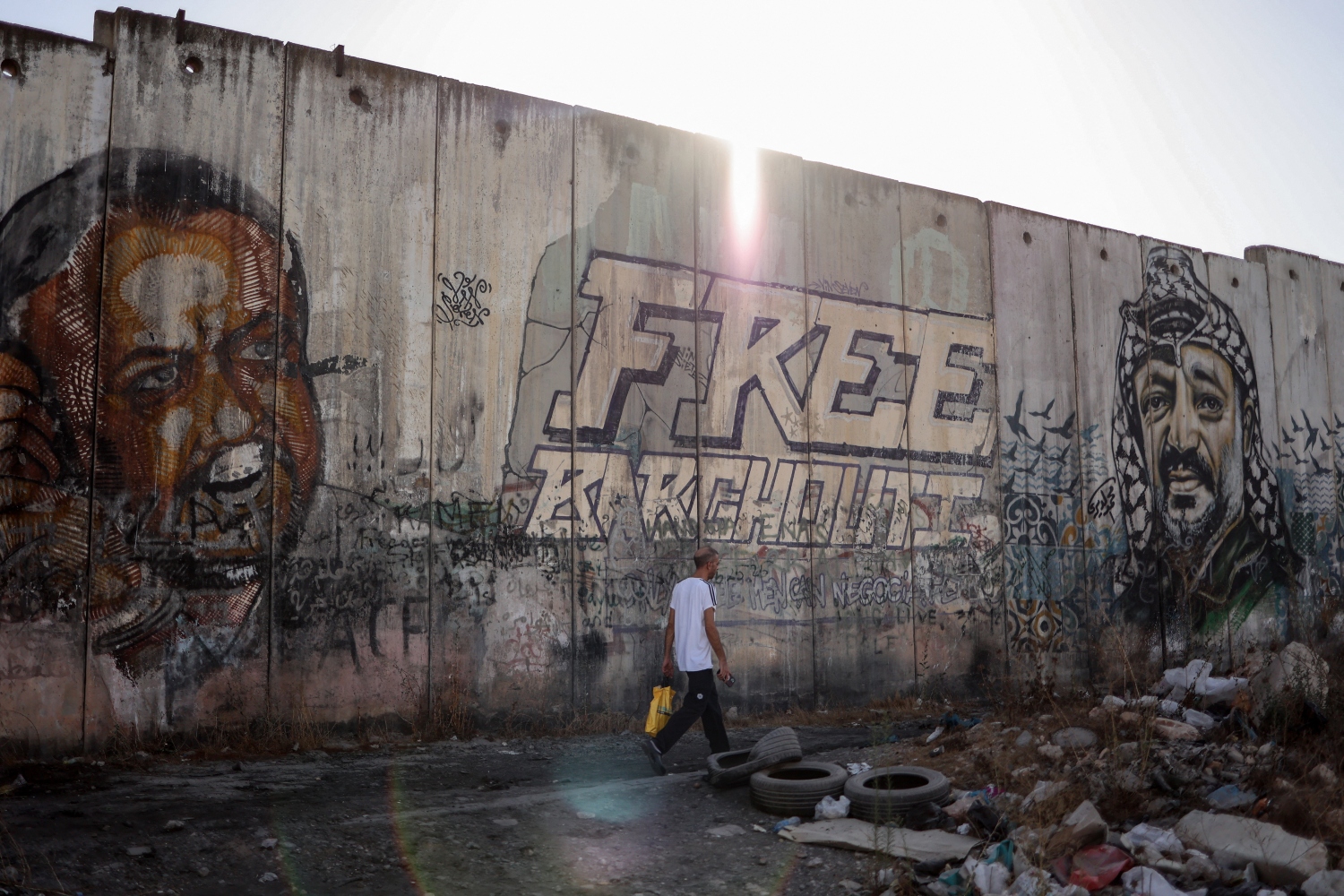

Every liberation movement has its heroes, and they are rarely without blemish. The growing demand to release from an Israeli jail the best-known Palestinian prisoner, Marwan Barghouti, should not be about what he did in the past, but what he could contribute to in the future — a much better form of Israeli-Palestinian relations than the present one.
There are those who question the extent of Barghouti’s 2002 conviction for orchestrating deadly attacks against Israelis during the second intifada, for which an Israeli military court sentenced him to five life sentences and an additional 40 years. This left hardly any doubt that the military court also shared the government of the day’s view that Barghouti should spend the rest of his life behind bars. Since then, his deteriorating health has become a grave source of concern; hence the merit of the appeal to release him on both humanitarian and political grounds; not about what he did or did not do in the past, but about what he could do to bring the Israeli–Palestinian conflict to a peaceful end.
Those who met Barghouti, in the heyday of the peace process in the aftermath of the Oslo Accords, testify that he did indeed aspire to see his people liberated from occupation and oppression, but through peaceful means. He came across as a true man of peace who believed in a historical compromise between the two peoples that would lead to a two-state solution. However, as a proud Palestinian, he will not accept any agreement without dignity, and only one that ensures Palestinians’ right to self-determination and not to occupation by other means.
Every liberation movement has its heroes
Yossi Mekelberg
The failure of the Oslo Accords to lead to the coveted peace based on a two-state solution ended in the horrific bloodshed of the second intifada. In due course, all of those who have been involved on both sides in that deadly violence should better reflect, take responsibility, apologize to their own people and each other, and find a way to reconcile, as there is no genuine path to peace without truth and reconciliation.
In the meantime, the task is to kickstart a peace process, and this cannot happen unless there are Israeli and Palestinian leaderships that are equally visionary and courageous enough to tell their own people that there is an alternative to a violent history that has caused only pain and suffering, and that this alternative will also entail difficult concessions. Such leadership, crucially, must enjoy a critical mass of public support, and no one among Palestinians in the Occupied Territories enjoys more widespread and cross-political and social support than Barghouti. Furthermore, he is also strongly supported abroad, with hardly any other viable candidate matching his international recognition. A recent survey among Palestinians in the West Bank and Gaza by the Palestinian Center for Policy and Survey Research revealed that Barghouti emerges as the most popular candidate to replace Mahmoud Abbas as president, decisively winning an election against Hamas leader Khalid Mishaal in a two-way contest and also in a three-way contest in which the current president Abbas was also a candidate.
It might sound counter-intuitive, but there is a tendency among the public to regard those who were in the thick of the armed resistance, or those on the other side who oppose them in the security forces, as best suited to lead their people from war to peace.
He came across as a true man of peace
Yossi Mekelberg
By all accounts, Barghouti possesses two qualities that make him essential to a future peace process with Israel: He supports a two-state solution, and he is a unifying force within Palestinian politics. One suspects that this is precisely why the current Israeli government is not interested in releasing him from jail, as they bitterly oppose a two-state solution. And as for Israeli Prime Minister Benjamin Netanyahu throughout his time in power, and even more so his extreme-right-wing allies, they thrive on the divisions in Palestinian politics. Moreover, the brutality with which Barghouti is treated by the Israeli prison service, and the recent grotesque visit by the Minister of National Security, Itamar Ben Gvir, to his cell to harass and humiliate him, is just another piece of evidence that this government is not interested in a partner for peace. After all, a peace process would require a revitalized and rejuvenated political life across the Occupied Territories, inclusive of all voices; for this, a revered leader is invaluable, and no one fits the bill better than Barghouti.
In the early days of my involvement in Track II negotiations in the aftermath of the Oslo Accords, I sat around the table and engaged in private conversations with former Palestinian prisoners who had spent a time in Israeli jails for acts that cost the lives of innocent people. It was not comfortable at the beginning, but they helped me gain two insights that have served me well since. First, those who committed these acts and, after deep and painful soul-searching became people of peace, deserve our respect, which is not in any shape or form an endorsement of what they did, but the recognition of their arduous journey to becoming peacemakers, positioning them best to become the messengers of peace. Second, for Israelis who served in the security forces and were either directly involved or facilitated the killing of innocent Palestinians, it is a lesson in humility, as they now must heed the words from the gospel of John the Apostle: “Let him who is without sin cast the first stone” — and after a century of conflict, there are not many of those.
Releasing Barghouti, as part of phase two of the peace plan, could help achieve its success and, by doing so, do justice to all those who have suffered from this conflict, and set foot on the path to resolving it and preventing future pain and bloodshed.
- Yossi Mekelberg is professor of international relations and an associate fellow of the MENA Program at Chatham House. X: @YMekelberg