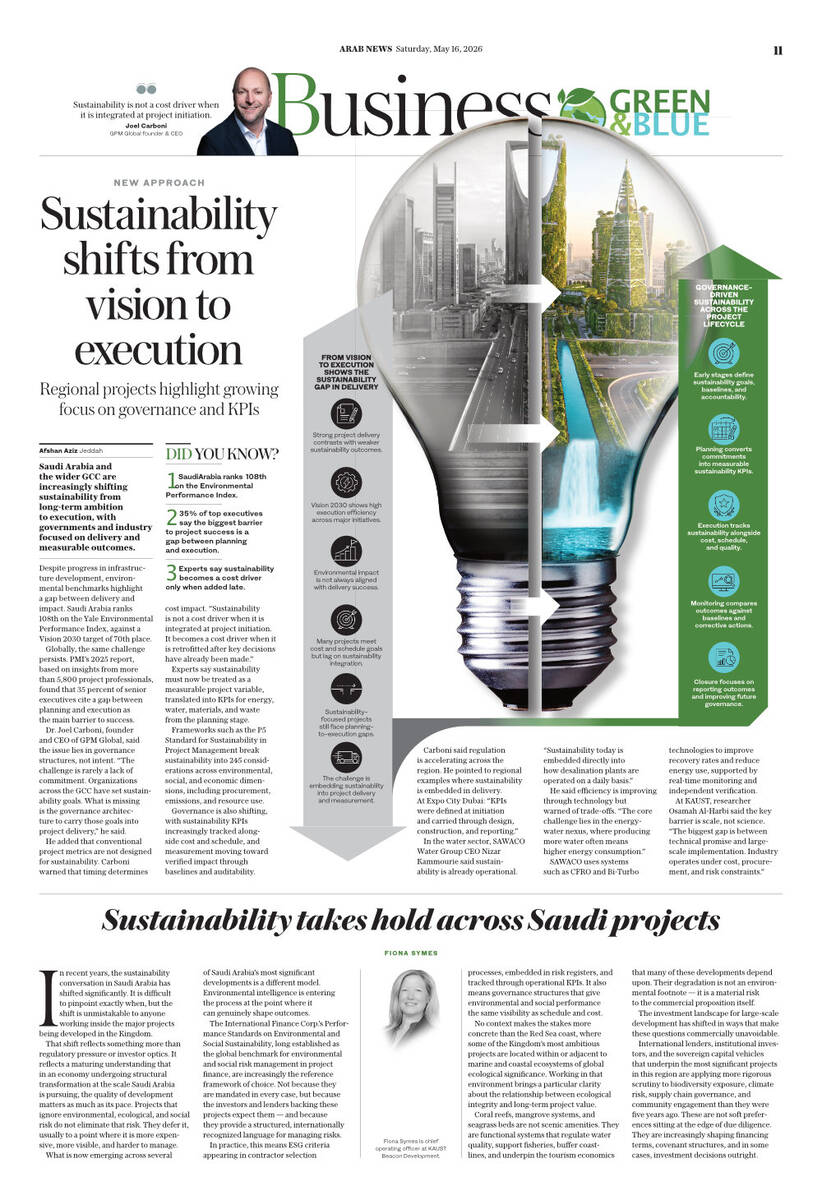

- New frameworks, technologies, and governance models are reshaping delivery
JEDDAH: Saudi Arabia and the wider GCC have placed sustainability at the center of long-term development agendas, with the focus now shifting from ambition to execution and from policy to implementation on the ground.
Despite strong delivery performance, environmental benchmarks still point to a gap between infrastructure output and sustainability impact. Saudi Arabia ranks 108th on the Yale Environmental Performance Index, compared with a Vision 2030 aspiration of reaching 70th place.
The gap is not unique to the Kingdom. Global project research from PMI’s 2025 report, based on insights from more than 5,800 project professionals, finds that 35 percent of senior executives identify the disconnect between planning and execution as the main barrier to success.
According to Dr. Joel Carboni, founder and CEO of GPM Global and author of the Global Standards for Sustainability in Project Management, the core issue is how sustainability is embedded into project delivery.
“The challenge is rarely a lack of commitment. Organizations across the GCC have set sustainability goals, aligned to national visions, and in many cases announced them publicly. What is missing is the governance architecture to carry those goals into project delivery,” he said.
He added that the gap becomes most visible during execution. “The most common challenges organizations face when trying to operationalize sustainability in projects across the GCC is that traditional project metrics, cost, schedule and scope, were never designed to carry sustainability accountability. Even senior executives often feel underprepared to navigate the intersection of climate risk, regulation, and delivery.”
Carboni said the problem is compounded when sustainability is introduced too late. “Sustainability is not a cost driver when it is integrated at project initiation. It becomes a cost driver when it is retrofitted after key decisions have already been made.”
The emerging consensus is that sustainability must be treated as a measurable project variable, not a reporting outcome. This requires translating corporate commitments into project-level KPIs on materials, energy, water, and waste from the planning stage.
Structured frameworks such as the P5 Standard for Sustainability in Project Management support this shift by breaking sustainability into 245 considerations across social, environmental, and economic dimensions. These include procurement, resource use, emissions, waste, and community impact — embedding sustainability directly into project design and delivery.
Governance during execution is equally important. Experts say sustainability KPIs must be tracked alongside cost and schedule in regular project reviews, with measurement systems moving toward verified impact through baselines, thresholds, and auditability.
Carboni said regulation is also tightening across the region. “The regulatory landscape is changing faster than most organizations have absorbed. In the UAE, for example, listed companies are now required to report under GRI standards, and climate laws extend emissions measurement to large businesses, with penalties for non-compliance. Organizations that build sustainability governance into standard project processes will meet future requirements without disruption. Those that treat it as a reporting exercise will struggle.”
He added that frameworks such as Green Project Management help bridge the gap between strategy and delivery by introducing governance structure where intent alone is insufficient.
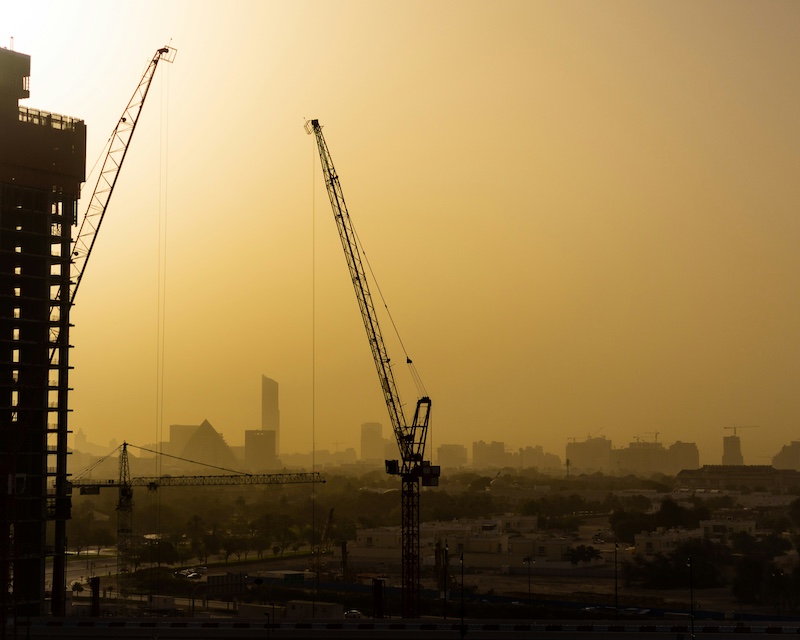
Regional examples show how this works in practice. Carboni pointed to Expo City Dubai as a case where sustainability was embedded from the outset.
“What distinguishes this project is not ambition but traceability. KPIs were defined at initiation and carried through design, construction, and reporting,” he said.
He also cited Saudi Arabia’s Neom water infrastructure program. “Sustainability commitments such as renewable-powered desalination and 100 percent wastewater recycling were established at project initiation and tracked through operational delivery,” he said, adding, “these are not enterprise-level aspirations; they are project-level commitments with measurable outcomes.”
In Saudi Arabia’s water sector, sustainability is already shaping day-to-day operations. Nizar Kammourie, CEO of SAWACO Water Group, said: “Sustainability today is embedded directly into how desalination plants are operated on a daily basis. We have deployed operational intelligence systems that continuously optimize pressure, flow rates and chemical usage in real time.”
He said efficiency gains are increasingly driven by advanced technologies that reduce energy use while improving output. “We have invested in advanced technologies which significantly enhanced water recovery and increase output while using less energy. These technologies enable us to produce more water from the same input, which is essential in this region.”
However, he noted persistent trade-offs. “The core challenge lies in the energy-water nexus, where producing more water often means higher energy consumption that must be carefully managed, and scaling innovation requires aligning operational priorities with financing models given the high upfront investment often required for advanced technologies.”
He added that reliability remains critical in water infrastructure. “Any new technology must meet very high standards of operational stability because water infrastructure is critical.”
SAWACO has adopted systems such as Counter Flow Reverse Osmosis, which enables brine reuse to improve recovery rates and reduce environmental discharge, as well as Bi-Turbo technology to boost efficiency and lower energy consumption. These are supported by real-time monitoring systems tracking energy use, recovery rates, and emissions, alongside independent verification of performance data.

Kammourie said sustainability must also be linked to economic value. He noted ongoing work on water credits based on verified efficiency gains to create a transparent mechanism for measuring sustainability performance.
“Sustainability is now a core design parameter influencing technology choices and operational strategies from the outset, reflecting a wider shift toward integrated infrastructure systems where desalination, energy, and distribution are planned together to improve long-term efficiency and resilience.”
At the research level, Osamah Al-Harbi, doctoral researcher at KAUST and future postdoctoral researcher at the Institute of Supramolecular Science and Engineering in Strasbourg, said innovation must respond to real environmental conditions.
“The most impactful innovations for Saudi infrastructure are the ones that improve performance under heat, water stress, corrosion, and scale. Lower-carbon construction materials, improved insulation systems, and advanced desalination membranes are key areas. The biggest gap is no longer scientific understanding. The real gap is between technical promise and large-scale implementation. Industry operates under cost, procurement, and risk constraints, which can slow adoption even when better technologies exist.”