



ISLAMABAD: Pakistan’s state minister for crypto and digital assets, Bilal Bin Saqib, said on Saturday that blockchain technologies and digital assets should be evaluated through both technical and Shariah perspectives, days after one of the country’s most influential Islamic scholars questioned the permissibility of cryptocurrency under Islamic law.
The comments followed a meeting with Mufti Muhammad Taqi Usmani, whose recent fatwa argued that cryptocurrency does not qualify as legitimate wealth under Islamic jurisprudence and therefore cannot be used to validly purchase goods.
Usmani’s intervention comes as Pakistan presses ahead with an ambitious push to regulate and expand its digital assets sector through the newly established Pakistan Virtual Assets Regulatory Authority (PVARA), licensing rules for virtual asset service providers and efforts to integrate blockchain-based finance into the country’s formal economy.
“Today, I had a constructive discussion with Mufti Taqi Usmani Sahib on digital assets and the ongoing conversation around their Shariah status,” Bin Saqib wrote on X.
“I shared that blockchain, digital assets, stablecoins, and tokenized real-world assets represent a broad spectrum of technologies and use cases,” he said. “As such, they merit careful technical assessment alongside rigorous Shariah examination, rather than being viewed through a single lens.”
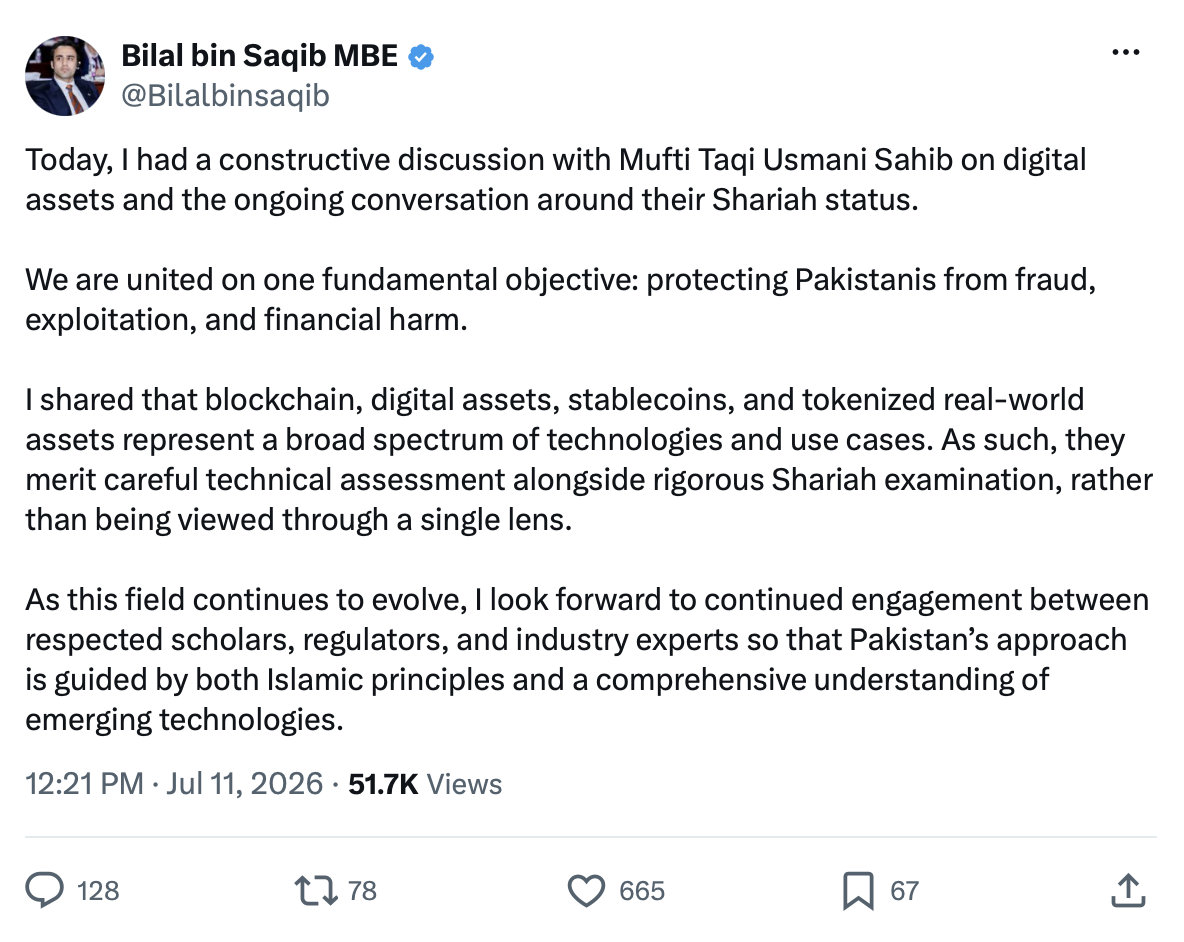
Bin Saqib said he and Usmani were united on the need to protect Pakistanis from fraud, exploitation and financial harm, adding that he looked forward to continued engagement among Islamic scholars, regulators and industry experts so the country’s approach would be guided by both Islamic principles and a comprehensive understanding of emerging technologies.
Pakistan has emerged as one of the region’s most active supporters of regulated digital assets, with the government establishing PVARA under the Virtual Assets Act, opening a public consultation on licensing regulations, and seeking to position the country as a hub for blockchain-based finance and tokenized assets.
Prime Minister Shehbaz Sharif has also directed authorities to fast-track a regulatory framework for the sector.
Islamic scholars globally remain divided on cryptocurrencies.
While Usmani and several other prominent scholars have argued that cryptocurrencies do not satisfy key Shariah requirements, others have concluded that at least some digital assets, particularly Bitcoin, may be permissible under certain conditions if they avoid prohibited elements such as excessive uncertainty, gambling and interest.





