- The title essay on “baby universes” stands out because it shows Hawking thinking at the edge of what we can know, exploring the possibility that black holes could connect to new regions of spacetime or even new universes
Author: Stephen Hawking
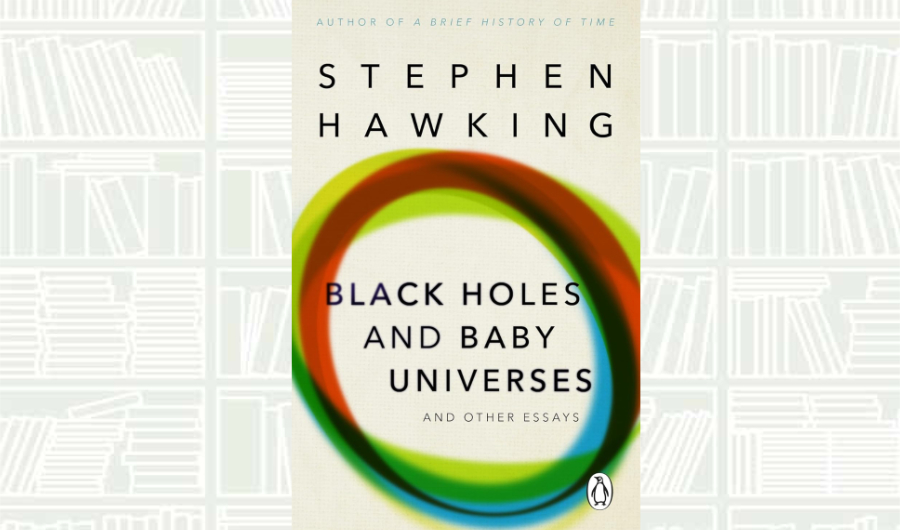
In his 1993 book “Black Holes and Baby Universes,” Stephen Hawking offers a collection that feels part memoir, part science lesson, and part invitation to wonder about questions that are still unresolved.
Instead of building one long argument, the book moves through essays that connect Hawking’s personal life to the ideas that made him one of the most influential scientific thinkers of the modern era.
A major theme of the collection is how a life can shape a mind. His essays on childhood and his time at Oxford and Cambridge are surprisingly grounded, showing early uncertainty, ambition and the social reality of trying to fit into elite academic spaces.
The most emotionally direct section is his writing about ALS (Lou Gehrig’s disease) and the shock of being diagnosed at 21.
Rather than making it sentimental, Hawking frames the diagnosis as a turning point that sharpened his focus and made the pursuit of big questions feel urgent.
The strongest parts of the book, though, are the science essays that manage to be accessible without being shallow.
Hawking explains black holes as real physical objects with consistent rules; how they can form from collapsing stars, why their gravity is so extreme, and what makes them such a testing ground for physics.
The title essay on “baby universes” stands out because it shows Hawking thinking at the edge of what we can know, exploring the possibility that black holes could connect to new regions of spacetime or even new universes.
One essay I kept returning to is “Is Everything Determined?” Hawking’s view is essentially that the universe may be governed by deterministic laws, but we still have to live as if we have free will.
In everyday terms, even if everything is determined, it might as well not be, because we can’t actually calculate or prove the outcomes of all events. Therefore, choices, responsibility and meaning still matter.
In my opinion, “Black Holes and Baby Universes” is the kind of book that makes you feel both smarter and smaller at the same time. Even when an essay gets dense, Hawking’s voice is confident enough that you trust him to pull you back to the big idea.
The book can work best for readers who want science that feels human; ideas explained clearly, but also tied to the real life of the person brave enough to chase them.