



LAHORE: Most artists work with paint, clay or stone. Pakistani sculptor Sajid Amiri works with industrial wire mesh, layering, cutting and stitching the material by hand to create strikingly lifelike portraits that have earned him international recognition and commissions from collectors abroad, including Saudi Arabia.
Originally from Skardu in Pakistan’s northern Gilgit-Baltistan region, Amiri studied painting at the prestigious National College of Arts (NCA) in Lahore before discovering the artistic potential of wire mesh during a university assignment that encouraged students to experiment with unconventional materials.
Unlike traditional painters, Amiri creates depth not with color but by layering sheets of wire mesh. As light passes through each layer, it creates different shades and tones, allowing him to sculpt highly detailed portraits without using paint or graphite.
“The work of white mesh started with an assignment. Gradually, by experimenting on it, it reached here,” Amiri told Arab News.
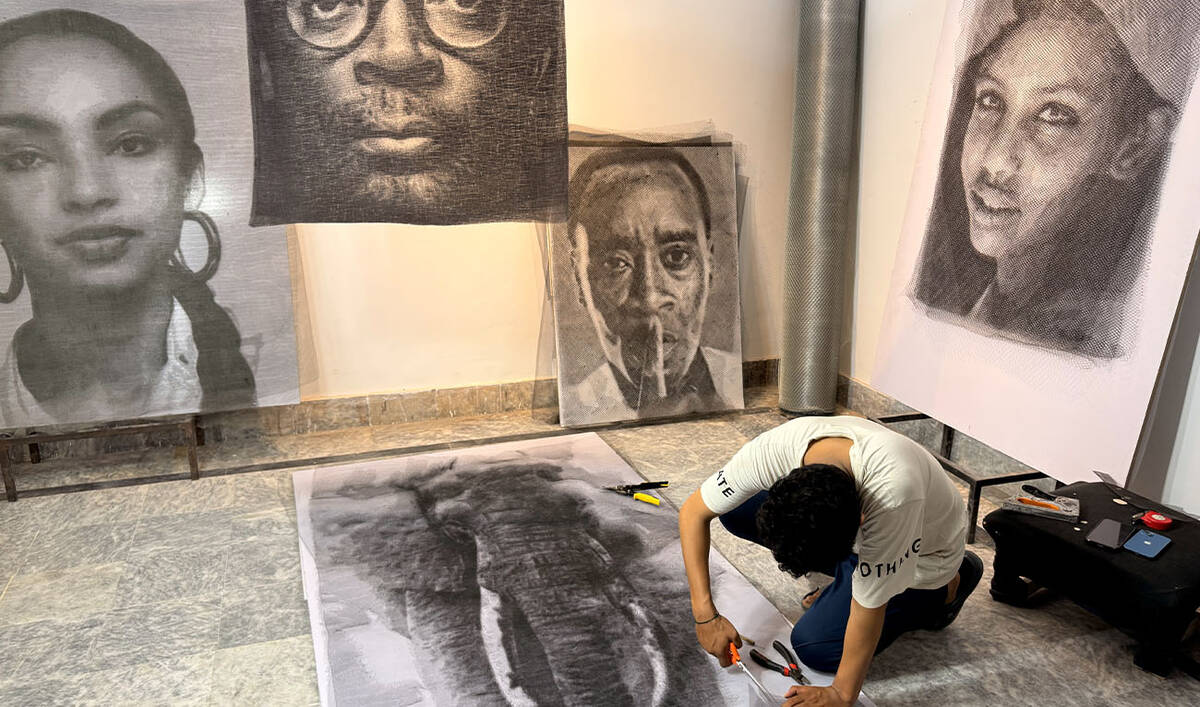
Pakistani artist Sajid Amiri works on a canvas made from industrial wire mesh, surrounded by his completed wire-mesh portraits, at his studio in Lahore, Pakistan, on July 13, 2026. (AN Photo)
“Initially, my major was painting. In NCA, there is an assignment. In this assignment, there is a part where we have to work with different mediums. At that time, I picked up a mesh. Gradually, these things evolved.”
His earliest attempts were far from perfect, but he believed the material had enormous creative potential. Over the years, he refined the technique entirely through trial and experimentation.
“When I started this work in NCA, the starting element was quite raw, and it was not that good. But as an artist, I knew that it could evolve. So, I evolved it by experimenting on it.”
Amiri initially believed he had pioneered the technique himself, having never encountered similar work before. It was only after sharing his creations on social media that he discovered two artists elsewhere in the world working with wire mesh in a comparable way.
The idea behind his signature style came from observing stacked sheets of wire mesh in the NCA studio. He realized that layering the material produced natural gradations of light and shadow, much like the tonal effects artists create with graphite pencils.
“The concept of jali [wire mesh] was that at that time there was a senior in NCA who used to work with them. I saw that she had a pile of them. I saw that there were shades in it, one jali on top of another.”
Instead of applying pigment, Amiri controls the transparency of the wire mesh, using additional layers to darken areas and create the illusion of depth.
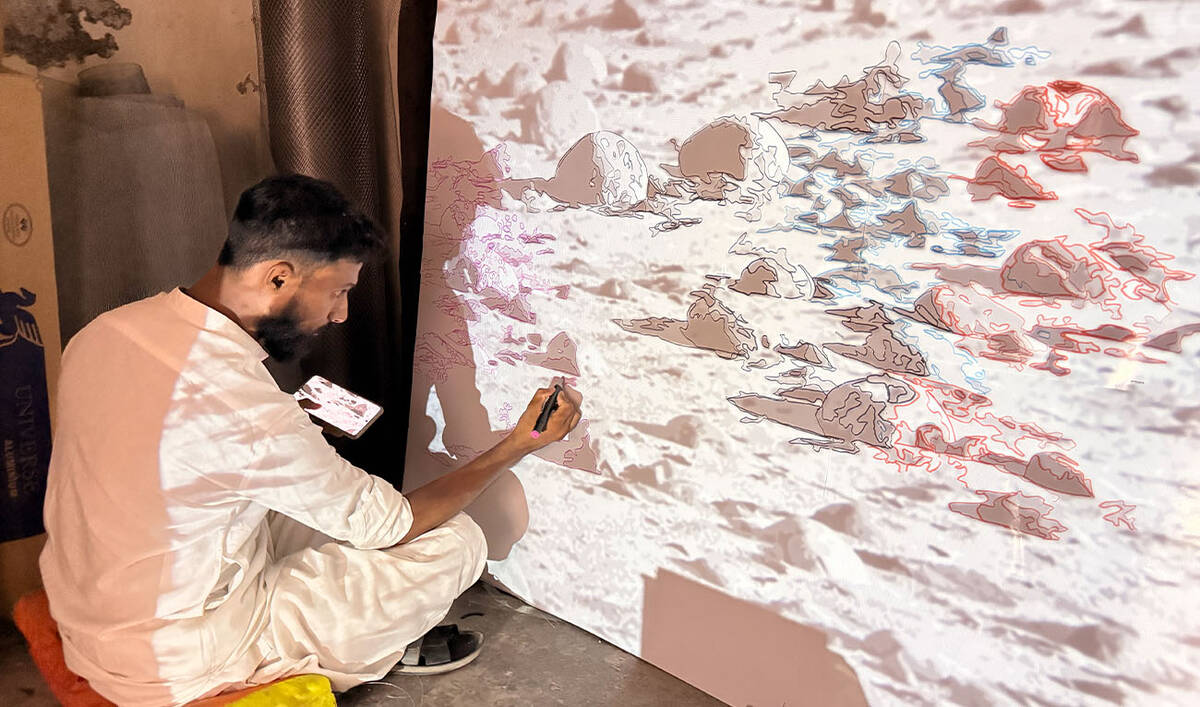
Pakistani artist Sajid Amiri works on a canvas at his studio in Lahore, Pakistan, on July 13, 2026. (AN Photo)
“Let’s say there is a jali on top of a window. When it becomes transparent, you will be able to see it easily. But if you put a lot of jalis on top of it, it will become dark. Now it will not be transparent. Basically, I take out the light from it, that is, I sculpt it.”
Every piece is handcrafted without machinery, making the process labor-intensive and time-consuming. Because of the limitations of the material, Amiri’s sculptures are typically produced at a minimum size of three feet and start at around PKR250,000 ($890).
“There is a lot of hard work in it. There is no machinery in it. Even we stitch and cut each thing with the wire mesh.”
Amiri’s work has been exhibited in galleries across Pakistan, while international collectors regularly commission custom pieces through social media. Amiri is also preparing for a solo exhibition.
Among his most technically demanding overseas commissions was a request from a client in Saudi Arabia to create portraits of King Salman bin Abdulaziz Al Saud and Crown Prince Mohammed bin Salman. Recreating the intricate folds and texture of the traditional Saudi headscarf entirely with wire mesh required exceptional precision.
“I made this portrait on an order from a client in Saudi Arabia. Basically, it was a little difficult because I had to build the texture of the scarf using a wire mesh. It took a lot of time because there was a lot of detail in it. It took me about 15 days.”
The finished work exceeded both the artist’s and the client’s expectations.
“He liked it a lot. He wasn’t expecting it. Even we weren’t expecting it. It was very realistic.”
Beyond Saudi Arabia, Amiri has produced commissioned works for clients in several countries. One of his personal favorites remains a portrait of Indian Assamese singer Zubeen Garg, which gained widespread attention after he shared it on social media.
As he continues pushing the boundaries of a medium more commonly associated with construction than fine art, Amiri says his work is still evolving:
“Right now, I am experimenting more on this, because there is no place where I can learn from. So, I am working on this with different experiments.”





