
For more than a century, citizenship has been one of the foundations of the international order. It determines which state is responsible for protecting an individual, which government guarantees their rights and which country must ultimately provide them with security.
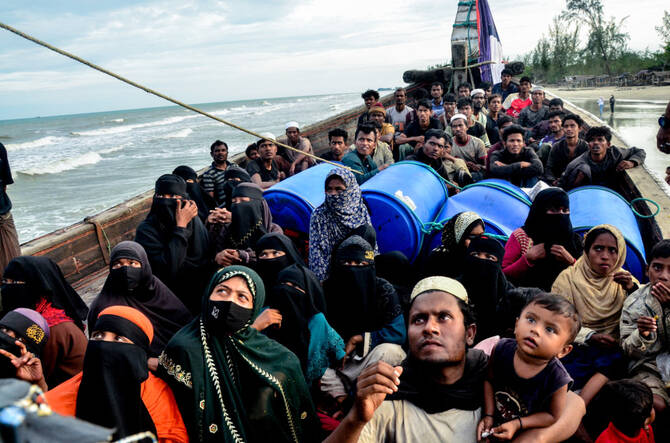
The Rohingya crisis is usually understood as demonstrating what happens when people are denied citizenship. But it points toward a potentially much larger problem.
Increasingly, citizenship itself is no guarantee of protection.
Across a growing number of conflicts, people possess passports and nationality, but live under states that cannot, or sometimes will not, provide basic security. Civil wars fragment territorial authority. Governments lose control of regions. Institutions collapse. In extreme cases, the state itself becomes a source of violence against those it is legally supposed to protect. This creates a fundamental problem for an international system built around the assumption that states protect their citizens.
Myanmar provides an extreme warning.
The Rohingya were effectively excluded from the country’s citizenship framework through the 1982 Citizenship Law, leaving generations at risk of restrictions on movement, education, employment, and political participation. The consequences became devastatingly clear in 2017 when military operations drove hundreds of thousands of Rohingya across the border into Bangladesh.
Statelessness undoubtedly made the Rohingya uniquely vulnerable. But focusing exclusively on their lack of citizenship risks missing the broader lesson.
Myanmar’s crisis did not stop with the Rohingya. Since the 2021 military coup, millions of Myanmar citizens belonging to numerous ethnic and religious communities have experienced displacement, conflict, and political repression despite possessing citizenship.
The problem for these populations is fundamentally different from Rohingya statelessness. Yet both reveal weaknesses in the same underlying assumption: that membership of a state necessarily provides meaningful protection.
When the state itself collapses, fragments, or turns against sections of its population, citizenship can become little more than a legal designation. This distinction between legal citizenship and effective protection is becoming increasingly important.
Consider Sudan. Its citizens possess nationality, yet the civil war has produced one of the world’s largest displacement crises. Millions have been forced from their homes as competing armed forces struggle for control. For those trapped in areas where institutions have collapsed, the existence of formal citizenship offers limited practical protection.
Haiti presents another variation of the same problem. Citizens remain legally members of a sovereign state, but weakened institutions and the expansion of armed gangs have left many communities without reliable state protection.
These cases are obviously different from Myanmar and should not be treated as equivalent. But together they expose a growing gap between the legal concept of citizenship and the practical capacity of states to fulfil the responsibilities associated with it.
That gap matters because the modern international system is overwhelmingly organized around states.
Armed gangs have left many without state protection.
Dr. Azeem Ibrahim
International law generally assumes governments exercise authority over their populations. Passports identify individuals according to nationality. Refugee law determines protection partly through whether individuals can safely rely upon their country of origin. Diplomatic protection is exercised through states.
The system, therefore, works reasonably well when governments function. It becomes much less effective when they do not. This may become an increasingly important challenge because many contemporary conflicts no longer end with decisive victories or rapid political settlements. Instead, they produce prolonged fragmentation.
Governments may retain seats at the UN while exercising little authority over parts of their territory. Armed organizations establish parallel administrations. Millions of people can find themselves legally citizens of one state while effectively living under entirely different political authorities.
Myanmar increasingly resembles this model. The military authorities retain control of central institutions and international representation, while ethnic armed organizations and resistance forces exercise varying degrees of authority elsewhere. The result is not simply a contest over who governs. It raises a deeper question about what citizenship means when sovereignty itself becomes fragmented.
A passport can identify the state to which someone belongs. It cannot ensure that the state can reach them. This is why the Rohingya experience should be understood as more than an exceptional story of statelessness. Their persecution demonstrated the catastrophic consequences when a state deliberately removes a population from its political community.
Today’s proliferating state failures demonstrate the other side of the same problem: Citizenship can also lose much of its protective value when governments lack the capacity to fulfil their obligations.
International policymakers, therefore, need to think beyond the binary distinction between citizens and stateless people. The more important question is whether individuals enjoy effective protection.
That does not mean diminishing the importance of citizenship. On the contrary, restoring citizenship remains fundamental to any durable solution for the Rohingya. Legal nationality provides rights, political membership and protection against arbitrary exclusion.
But citizenship must mean more than documentation. For the Rohingya, any future restoration of nationality would have little meaning without freedom of movement, physical security, property rights, political participation, and equal protection before the law.
The same principle applies more broadly. The international community has spent decades developing legal frameworks intended to reduce statelessness. It has devoted comparatively less attention to what happens when people possess citizenship, but the institutions required to make that citizenship meaningful disappear.
That challenge is likely to become more pressing. Protracted conflicts, political fragmentation, and state weakness are producing growing populations whose legal status and lived reality increasingly diverge.
The Rohingya remain among the clearest examples of what happens when citizenship is deliberately denied. But their experience also contains a warning for everyone else.
The international order has long assumed that every individual ultimately belongs to a state and that the state provides the first line of protection. In the 21st century, the greater danger may not simply be that millions of people have no citizenship. It is that millions more may discover that the citizenship they possess no longer protects them.
- Dr. Azeem Ibrahim is the director of special initiatives at the New Lines Institute for Strategy and Policy in Washington. X: @AzeemIbrahim