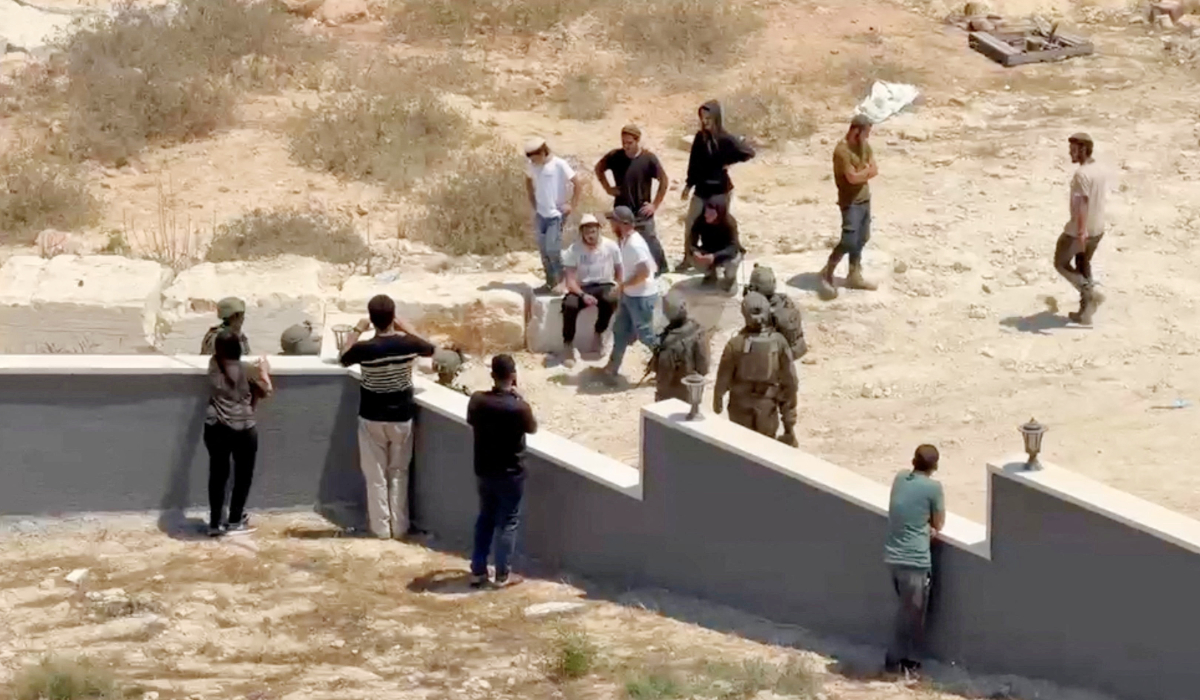

What is happening in the West Bank should no longer be dismissed as a collection of isolated incidents involving a handful of unruly settlers. The pattern has become far more serious: armed settler groups are attacking Palestinian communities, establishing unauthorized outposts, besieging homes and attempting to force Palestinians from their land, while Israeli soldiers are repeatedly present at the scene and, in too many cases, fail to protect those under attack. The recent events in Qusra offer perhaps the clearest illustration yet of a system in which the boundary between settler violence and state policy is becoming increasingly difficult to distinguish.
For nearly a week, settlers have surrounded Palestinian homes on the outskirts of Qusra, south of Nablus, leaving families trapped inside. Reports from the village describe repeated attacks while Israeli soldiers were present in the area. In one incident, Israeli troops clashed with settlers as they attempted to dismantle an outpost erected directly in front of Palestinian homes. The army described the outpost as illegal, yet the confrontation itself revealed the extraordinary reality: Palestinians were being besieged by Israeli settlers while the Israeli military, rather than simply protecting the residents, was struggling to remove the people carrying out the siege.
This is not merely a security failure. It raises a much more fundamental question about the nature of power in the West Bank: Who actually exercises authority?
The comparison with militias operating outside formal state structures in countries such as Iran, Iraq, Lebanon and Yemen is therefore worth considering — although the situations are not identical. In those countries, governments have often claimed that armed groups operate independently of the state, even when those groups enjoy political protection, resources, influence or varying degrees of state support. The central problem in each case is the existence of an armed actor capable of imposing its will outside of normal state institutions.
In the West Bank, however, the problem may be even more disturbing because settler groups do not simply operate in a vacuum beyond the state’s reach. They operate within an environment created and administered by the occupying power. They live in settlements that receive state services and security protection, while Palestinians remain subject to military rule. Recent reporting has highlighted how the Israeli government’s settlement policy and the far-right coalition’s dependence on settler constituencies have contributed to an environment in which violence can be used as an instrument of territorial expansion.
The UN has warned that settler violence has become a major driver of Palestinian injury and displacement.
Hani Hazaimeh
A government that genuinely cannot control a militia faces a problem of state weakness. A government that possesses the capacity to control an armed group but repeatedly tolerates its actions — or whose policies encourage the group’s objectives — faces a problem of political will. The West Bank increasingly looks like the latter.
The UN has warned that settler violence has become a major driver of Palestinian injury and displacement. The Office for the Coordination of Humanitarian Affairs reported that demolitions, settler violence and related access restrictions are displacing an average of 17 Palestinians, including eight children, every day in 2026. The UN human rights office has also warned that settler violence and actions amounting to the ongoing annexation of Palestinian territory have worsened, while settlement activity has reached unprecedented levels.
The numbers are important but the geography tells an even more compelling story. Violence is not occurring randomly. It is increasingly concentrated around Palestinian communities whose land is strategically valuable to the settlement enterprise. Settlers establish outposts, restrict access, attack farmers and shepherds, destroy property and intimidate residents. Once Palestinians leave, the land becomes easier to control. Violence thus risks becoming not merely an expression of extremism but a mechanism for changing facts on the ground. That is why the Qusra siege should alarm the international community.
The disturbing question is not simply why settlers attacked Palestinian families. It is how they could maintain a siege for days in an area saturated with Israeli security forces.
This development deserves close international scrutiny. If the answer to settler violence is simply to reorganize which Israeli institution administers settlers, without addressing the impunity that has allowed the violence to flourish, then the problem is being administratively rearranged rather than solved.
There is also an uncomfortable hypocrisy in the international debate about militias.
When an armed group in the Middle East operates independently of a recognized government, Western governments are quick to describe it as a destabilizing militia, a terrorist organization or a threat to state sovereignty. They demand that the government concerned disarm it, arrest its members and restore the monopoly of legitimate force.
If armed civilians terrorize a population, seize land and impose their own authority, the international community should demand accountability regardless of the identity of the perpetrators. If soldiers stand by while this happens, their role must also be investigated. And if government ministers promote policies that facilitate the expansion of settlements or weaken the ability of Palestinians to remain on their land, those policies deserve the same scrutiny.
Unchecked settler violence is not simply a Palestinian-Israeli issue. It undermines the possibility of a political settlement, erodes the authority of the Palestinian leadership, fuels radicalization and makes the prospect of a viable Palestinian state increasingly remote. The more territory is taken through intimidation, the more difficult it becomes to reverse the process through diplomacy.
And this is precisely why the world should stop treating every settler attack as an isolated criminal episode.
The UN has warned that settler attacks have become a leading driver of Palestinian displacement in 2026, particularly among Bedouin and herding communities in Area C.
The West Bank does not need another generation of armed groups, whether they carry the flag of a political movement, a militia, or a settlement outpost. It needs the rule of law. And the rule of law cannot be selective.
• Hani Hazaimeh is a senior editor based in Amman.
X: @hanihazaimeh