
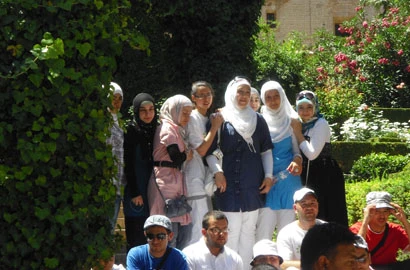
- During a recent Mediterranean cruise on Silversea Cruise Line’s S.S.
- Silver Wind, we opted for a shore excursion to Spain’s most popular tourist destination: Granada and the grounds of the Alhambra.
Our tour was organized by Silversea, which proudly applies the same degree of five-star service to its shore excursions as it does to services and amenities offered aboard its elite fleet of “floating luxury hotels.” We certainly found this to be true during our visit to Alhambra, and in the excellent restaurant reserved for us for private luncheon later in the day.
The city of Granada rose to fame when the Arabs (in the West, commonly referred to as the “Moors”) selected the area to create a trading settlement early in the 13th century. Soon after, a fortress complex — named Qal’at Al-Hamra — (literally the “red fortress”) — was built on a high plateau that offered the Moorish emir splendid views of the emerging city — not to mention a nice vista to spot and defend against attackers.
Created originally as a refuge in the event Granada came under siege, the high walls of the Alhambra eventually housed a fortress, a small “medina” (market) and several stunningly appointed palaces. Designed to reflect the imagined beauty of Paradise, the Alhambra is a complex of gardens, fountains, streams, a palace, and a mosque — all within imposing, tessellated walls surmounted by 13 massive and strategically located towers. The Alhambra is a proud testament to Arab culture in Spain as well as the skill of Muslim, Jewish and Christian builders.
Alhambra derives its name from the color of the locally dug red clay from which the walls of the enclave are made. A more poetic explanation comes from Muslim scholars who claim that the construction of the Alhambra fortress was done “by the light of torches,” which thereby gave the walls their crimson coloration. (In fact the walls were whitewashed during the time of the Granada Emirate.)
Begun in 1238 by the Muslim ruler, Mohammed El-Ahmer, work on the Alhambra complex was completed by his son Muhammed II. Successive generations of Muslim leaders continued to enhance existing buildings and add new ones.
Completed toward the end of Muslim rule by Yusuf I (1333-1353) and Muhammad Sultan, (1353-1391), the last buildings to be constructed at Alhambra reflect the culture of the tertiary stages of the Nasrid Emirate.
The compound was also a place where artists and intellectuals took refuge as Spanish Christians moved into the region. By 1527, when Andalusia fell to invaders, Muslims were finally compelled to abandon the 142,000 square meters that comprise the enclave.
Today, the Alhambra is the showcase of Islamic architecture, landscape design, and interior design, and one of Spain’s best-known tourist attractions.
When attempting to describe the many pleasures of a visit to the Alhambra, it is difficult to know where to begin.
There’s the surrounding park, Alameda de la Alhambra, which in the spring is suffused with wildflowers and grasses growing in orderly fashion amid geometrically shaped groves of roses, oranges, and myrtles.
There’s the Alameda’s most famous feature: An eight-kilometer network of gravity-fed, stone-lined streams that cascade water from terraced fountains and pools.
And, of course, there is the Alhambra Palace: Many of the rooms in the palace were originally equipped with hot and cold running water and pressurized water for showering. Additionally, bathrooms were open to the elements to allow in light and air. Bear in mind: These innovations came into being literally centuries before Europeans began to equip their homes with indoor plumbing.
Among the other features of the Alhambra are the Sala de la Justicia (Hall of Justice), the Patio del Mexuar (Court of the Council Chamber), the Patio de Daraxa (Court of the Vestibule), and the Peinador de la Reina (Queen’s Robing Room), all which feature similar architectural styles and décor.
These buildings in the so-called Upper Alhambra also feature indoor bathrooms, year-round bedrooms, and rooms whose cross-ventilation make them ideal for sleeping during warm summer nights. Visitors to these buildings can also experience an acoustically unique “whispering gallery,” labyrinths, and vaulted sepulchers.
Decoration throughout the Alhambra consists of Arabic inscriptions and geometrical patterns imbedded within arabesques. Along the walls, usually up to shoulder height, are ceramic tiles — many featuring Arabic inscriptions.
The palace complex is designed in the Mudéjar style, which is characteristic of western elements reinterpreted into Islamic forms and largely popular during the Reconquista, a period of history in which the Christian kings conquered Spain.
The Alhambra’s most westerly feature is a strongly fortified pinnacle called the Alcazaba, which means “the citadel.” A less-defensible fortified wall encloses the remainder of the buildings on the Alhambra plateau. The thirteen watchtowers largely served a military function, however many towers were erected merely because they overlooked breathtaking views of the countryside.
There is also the Puerta de la Justicia (Gate of Judgment), a massive horseshoe archway surmounted by a square tower and used by the Moors as an informal court of justice. Visitors to this edifice are sometimes surprised to see, carved above the exterior gate, the Hand of Fatima, with fingers outstretched as a talisman against the evil eye. Less known by many Mideast experts is the fact that the Hand of Fatima is also a symbol of authority; this symbol — painted or carved — is frequently visible within the building.
Among the outlying buildings associated with the Alhambra, the foremost is the Palacio de Generalife, or simply the Generalife. (In Arabic, Jennat Al-Arif, “Garden of Arif,” or “Garden of the Architect.”)
The Generalife probably dates from the end of the 13th century, but has been restored several times. However, the gardens at this villa, with their clipped hedges, grottos, fountains, and cypress avenues, are said to fully retain their original Moorish character.
In the century following the Christian invasion, Alhambra suffered from neglect and was on the verge of falling into total ruin. This may have indeed been its fate, were it not for a fortuitous visit from a famous American writer.
In 1829, while touring Europe, novelist Washington Irving — best known for his horror classic, The Legend of Sleepy Hollow — visited the Alhambra and was inspired to write a collection of romantic adventure stories entitled “Tales of the Alhambra”. (In a letter sent home to a friend from his teak-vaulted bedroom in the Palace, Irving wrote that the Alhambra was “a most picturesque and beautiful city, situated in one of the loveliest landscapes that I have ever seen.”)
Irving’s lavish praise of the Alhambra, and the huge success of his book of “Moorish” stories, transformed Granada and its environs into Europe’s most visited cities. The influx of money from tourists also facilitated the restoration of the compound’s woefully neglected buildings, towers, courtyards, ponds, and gardens.
After spending several delightful hours touring Alhambra, we were grateful to board our coach for lunch at the fabulous Ruta del Veleta restaurant in neighboring Granada.
Silversea, which always treats its passengers like royalty, discovered this gem of a restaurant several years ago. Ever since, Silversea has relied on the Ruta del Veleta to feed (sumptuously) all of its Alhambra-bound shore excursions. The restaurant, which was founded in 1976 as a simple roadhouse, has evolved into a delightful gourmet retreat patronized by discerning Granadans.
Located in the hamlet of Cenés de la Vega, about 6 kilometers (about 3.5 miles) northwest of Granada’s city center, Ruta del Veleta has six dining rooms of various sizes, each decorated with a mix of English and Andalusian furniture and decorative ceramics.
: