
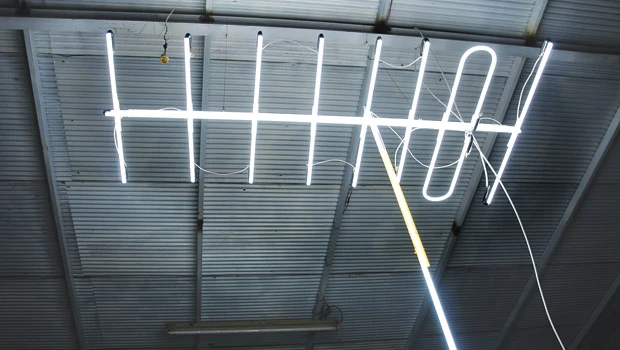
- "A boy stands on the roof of his old traditional house in a small village in south-eastern Saudi Arabia.
- One night, he raises his television’s antenna to the sky, searching for a signal from beyond the borders with Yemen or from Sudan via the Red Sea.” With these words, Stephen Stapleton, the curator of the “Edge of Arabia” exhibition, describes Saudi artist, Ahmed Mater, who opened his first solo exhibition two weeks ago in London.
Stapleton’s words also apply to Mater’s daily life and art and his ongoing attempts to explore and expand his work beyond the borders of art and psychology. He does that by utilizing his own life experiences to artistically express ideas that are relevant to society as a whole.
His work made him one of the most established Saudi artists on the art scene, with two of his works being added to the British Museum collections. Mater also launched his first book, which summarizes his art experience through the eyes of artists and critics.
Mater’s exhibition, which opened on Oct. 11 at London’s Vinyl Factory in Soho, will continue to run until Oct. 30. He is exhibiting around 40 works, encompassing photography, calligraphy, painting, installation and video. They include nine from his series, “Illumination,” which was his first introduction to the Western audience and was part of the British Museum’s exhibition, “Word into art,” in 2006. His artwork, “X-Ray 2003,” was part of that series, and was later bought by the museum.
In the “Illumination” series, Mater explores the theme of spirituality and identity. The X-rays represent people from Mater’s everyday life as a general practitioner in a hospital in Abha. Those X-rays are situated within an embellished and carefully decorated frame to look like a page in an old Islamic manuscript. For him, the series combine Islamic traditions with scenes from everyday life. Some of them feature two X-rays facing one other within the embellished frames as if they are engaging in a dialogue.
The idea of dialogue is another theme that runs in Mater’s work. For him, reaching out to others is essential. This idea is further illustrated very clearly through his artwork, “Antenna,” which is fitted with neon lights. The first impression the viewer gets from this work is of a window opening into new worlds through the transmissions captured by that antenna.
Another work in the exhibition takes the artist to another direction and moves away from the daily routine toward a philosophical stand. His work “Evolution of Man,” explores the dangerous dependence on oil through successive scenes starting with a petrol pump that transforms into a scene of a man committing suicide. Alternatively, it can be looked at from the opposite direction, and in both cases, the message is clear.
In a corner of the exhibition, people watched as Mater started on a performance of his project, “Yellow Cow,” where he dyed a live cow using saffron. In an adjacent room, a whole line of dairy products bore the “Yellow Cow” trademark. He explained that the yellow cow is an illustration of the consumer culture that is engulfing all that is sacred and revered in our lives.
Alongside the exhibition, Mater also signed copies of his book, which was launched in the UK market last week and will be distributed in Saudi Arabia soon. The book is sponsored by Saudi Research and Marketing and Jadwa Investment.
He acknowledges that his book brings with it “greater responsibility.” He added that the book “opens discussions for future generations. The experts who participated in this book are amongst the most important writers in the art world. I read the articles more than once… and I am happy with their interpretation of my work. However, what I am most concerned about is for this book to inspire others.”