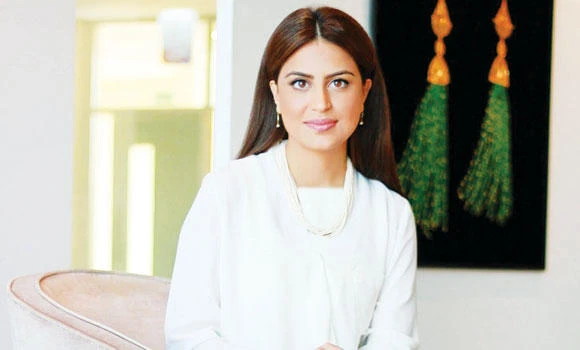
Despite her specialization in business administration and her work in a strategic Bahraini bank, Bahraini artist Amina Al-Abbasi, a member of the Bahrain Arts Society, wanted to achieve a childhood dream to be a full-time artist. She harnessed all her potential for it, and developed her style, blending between the present and the past. Her paintings were inspired by traditional themes of the Arab culture, which she presented in a modern way that earned her the admiration of her audience.
When did you discover your talent?
Art has always been my salvation to break the routine since I was in school, and even when I worked in a strategic bank in Bahrain. I did not expect to become an artist and manage my work myself. I discovered my love for art since childhood, but there is someone who gave me confidence in my work and the motivation to display them and establish my own project — my husband. In the beginning, I was drawing at home, I gave away my paintings as gifts and did not think of displaying them. When I participated in a group exhibition in Bahrain, I noticed the demand for my work, which helped me to gain confidence. From there, I turned into a professional artist, I left my job in the banking sector, and began working on my artistic project two years ago, because I noticed that my art gave me self-sufficiency, morally and materially, it was better than my work at the bank. Finally, I opened my own gallery, “Amina gallery.”
Tell us about the nature of your artwork.
The pairing/combination between the past and present is what most people liked about my work. So, I was keen to produce something that makes the old new and the boring elegant. It is amazing to see people attached to their roots and history, despite the impact of globalization in our thoughts and our living style. So, I focused on highlighting contemporary art mixed with a traditional touch. I am always keen on women’s appearances in many of my paintings because they are the icon of strength, maturity and beauty. Please note that I hide facial features in the paintings because I do not like to personalize them. Also, the facial features obscure the basic ideas in painting; their focus is on the features, and it fades on traditional clothing or jewelry, for example, or the whole idea. Art serves as a psychological treatment, and may help to overcome depression. For me, it is a disinfectant for thoughts and ideas.
What are the steps taken by a professional artist before implementing his/her work?
First, it is necessary to be sure of the idea, meditation and research, and the feeling of desire to implement the work. Working on a painting, in my opinion, is a challenge of the imagination, where you start dueling between fantasy and the artist, and ending with a beautiful panel that may not be the same basic idea, but an enhanced one.
What are the exhibitions you have participated in?
• The opening of the exhibition “Amina Gallery” in Riyadat Mall in Bahrain.
• “Loud Art” in Alkhobar.
• Solo exhibition in Maison BO-M, Riyadh.
• “Noor Dubai” under the patronage of Sheikh Mohammed bin Rashid Al-Maktoum, in collaboration with Christie’s, Dubai.
• Solo exhibition in Doha “Souq Waqif Art Center”.
• The annual Bahraini artists exhibition at the Bahrain National Museum.
Painters and artists are often accused of being chaotic and disorganized in their workshops and lives in general, does this apply to you?
Acknowledged, but only when it comes to art and painting. It does not apply to my life and the way I deal with things. I am organized and I don’t like chaos. My methods in the workshop can be chaotic, but my paintings are not.
What do your works include?
I wanted to publish my paintings in different ways, and I initially thought to print them by laser technique on the covers of cellular devices and smart phones. The principle which I sought was “wander and the artwork is in your fist.” This is in addition to printing some of my paintings on pillows and on some household items. I am still in the process of experimenting the use of my paintings in different forms, and I have noted strong demand for these artworks.
Tell us about your collaboration with Harrods in London.
The famous London department store Harrods was looking for a product that had in it the eastern and the Gulf heritage in particular, due to the large number of visitors from the Gulf. They contacted me to buy some of my products, including cellular phone covers that carry pictures of my paintings, as well as pillows with my paintings printed on them. These products are currently presented all over the Gulf countries and cities.
What are the projects you aspire to implement in the future?
International exhibitions to introduce people to the rich history of the Gulf, and reflect the natural image of working, ambitious Gulf women.
—
Email: [email protected]
Amina Al-Abbasi: Connecting past with present