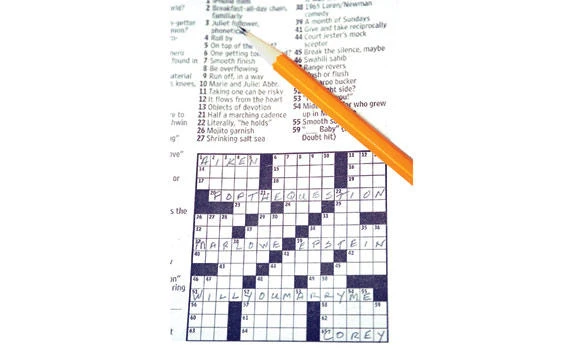
When Merl Reagle was a boy, he liked to build things, mostly out of Tinker Toys. But as a first-grader in 1956, he discovered words and realized that they, too, could be building tools. He arranged the names of kids in his class on a sheet of grid paper, with one name connecting to another. It looked like a crossword puzzle, and with it Reagle became what he calls “a word nerd.”
“For some reason, it’s been eternally fascinating how words can interlock so well in English,” Reagle said.
Reagle grew up to create crosswords for large newspapers, including The Washington Post, and to write 17 books on the puzzles.
At age 6, he thought he had invented the crossword. But the puzzle has a much longer history.
In 1913, Arthur Wynne, an editor at the New York World, was asked to create a game for the newspaper’s comics section. He came up with white squares arranged in a diamond-shaped grid. Below was a list of definitions. He instructed readers to fill in the squares with words that matched the definitions. The World published this “word-cross” on Dec. 21, 1913 — 100 years ago this Saturday.
Readers loved it, and other newspapers began copying what soon was called the crossword.
In 1921, Wynne stepped down as crossword editor and the job went to Margaret Petherbridge, who gradually came up with rules for creating crosswords. Every letter had to be part of a word going across and one going down. Puzzles had to use English words that were at least three letters long. And the mix of blank squares and filled-in squares had to be symmetrical. (That means the pattern had to look the same whether the puzzle was held upside down or right side up.)
Constructors, or people who create crosswords, still follow these rules and a few more.
Reagle said he became aware of published crosswords by the time he was 8. He started buying magazines that included puzzles.
“When I was about 10 or 12, Highlights for Children started running these really interesting crosswords,” Reagle said.
Crosswords provide a century of fun