Edwin Hubble once said, “Equipped with his five senses, man explores the universe around him and calls the adventure science”. We move about our everyday lives using the many different sciences senselessly but it’s integrated in our everyday behavior. We learn subjects in school, we learn lessons from life, we think, we believe and we imagine of a world beyond our imaginations and as the nagging question of “what if” almost every day. Man is inquisitive by nature, children are more so, as parents and mentors, we all play a part in helping children find the answers they seek. In today’s world, scientific laws matter, math, chemistry, physics, engineering… all these different sciences have a world of their own and school curriculums cover many of the basics. But what if, just what if, it’s not enough? The first school curriculums appearing in Al Hijaz started off with Al-Sawlatiyyah Al-Hindiyyah School in Makkah, the first school for boys, more than a hundred years ago and Al Nasefeya and Dar Al Hanan schools in Jeddah for girls have evolved many times over, yet the basics were all taught, science, language and religion for the eager pupils to enjoy. Through time, the emphasis on these three major topics is still as important as it was with the appearance of the first school curriculums. But there’s one thing that is clear, there is less time for fun in learning nowadays and more focus on grades. Learning is supposed to be fun, it’s supposed to help the young bright minds expand their imagination, break barriers and with the help of learning, get better grades eventually.
We live in a tech savvy world that controls many aspects of our lives, yet they’re all based on the different sciences mainly engineering. Merely standing in place is a subtopic of what gravity is, physics, as the hours go by through the day, there’s math, the car taking us from one place to the other, there’s engineering and so on and so forth. Many schools and school teachers have gone out of their ways to think outside of the box and make learning fun again. With the help of new resources now widely available, it’s a new way of teaching the next generation. Many after-school programs are available around the Kingdom, to help their students pave their way forward in life. Institutes are opening, specialized centers are popping up, classes are accessible for many age groups and one industrial wngineer is also among those whose sole intent is to help broaden young children’s horizons to new aspects. Eng. Isam Henaidy is the managing partner for Engineering for Kids, a special engineering camp providing hands on activities that encourage creativity and innovation by introducing science, technology, engineering and math concepts for kids between the age of 4-16.
Eng. Isam’s love for experiments in the engineering field as a young boy lead him to obtain a degree in industrial engineering from the United States. His love was inherited by his children as he would sit with them watching YouTube videos of how to build straw rockets, this helped bridge a gap between what students are learning and how that can apply into reality. Engineering for Kids is a US education franchising company which Isam found extremely exciting to bring back to Saudi Arabia. “There aren’t many fun activities for children to enjoy in the Kingdom except for malls, amusement parks, arcades and restaurants. Bringing EFK here has helped the curious minds, helped them see that science can be fun and cool, it’s not only about school work, and it’s more than that. I was born and raised in the US and I was a boy scout, surrounded by exciting activities that involved learning so much about nature, elements, creativity and using my imagination to help myself earn badges. Through many programs, I was able to gain a lot as a child that impacted me as an adult. There’s nothing more fun than using tools, getting your hands dirty and building something using your own bare hands,” said Isam.
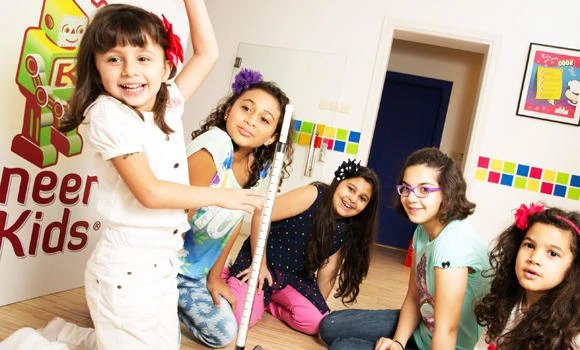
EFK is an after school program teaching unique skills using LEGOS, video games, liquids, bolts and wires, plants and solutions and much more. Eng. Isam granted Arab News an insight in to what EFK is and how he wants to help children grow more.
Since opening EFK in the Kingdom, how was the first impression of parents inquiring about the program?
Since bringing the franchise to the Kingdom two years ago, at the beginning it was a bit difficult to convince parents especially of the young ones that we’re teaching them basics of engineering through experiments. They found it shocking and questionable that how such a young child could really understand, once they see their children combine their imaginations and creativity together and are able to produce and succeed in an experiment first hand, they understood that it is possible. Age is a number, imagination is limitless and ageless. It took some time but they eventually saw that EFK is educational and helpful when it comes to their children’s abilities.
How are the participants divided and what classes can they enroll in?
Boys and girls who enroll into the program are divided according to age. We have the junior engineer for 4-6-year-olds, there’s the apprentice engineer for 7-10-years-old and master engineer for 11-16-year-old. Our curriculums cover over 20 fields of engineering from electric engineering, aerospace engineering, mechanical engineering, civil engineering, environmental engineering, software and robotics and so much more. Each level is designed to suit the abilities of each age group and the difficulty of the experiments.
All of our programs are inquiry-based, hands-on, and are fun learning activities that offer designing and constructing rockets, bridges, building and programming robots, and creating electronic video games as examples. There are no prior knowledge requirements for a specific participant; we offer them the basics from the start of each program. We change the programs every 3 months.
Can anyone join the EFK team or are there specific educational background requirements?
We have so many volunteers and instructors here at EFK, we have only two requirements, the first is that they should love playing with kids as well as having the patience to work with them and second is that they have to love these types of scientific experiments. Many of our instructors, both male and female, either working full time or part-time are engineering students, they also benefit from their involvement in the experiments. We also have many parents come in and join their children in their classes; either to observe their young ones at work or even join them. We also have parents/kids classes for the families to enjoy and spend quality time with their young ones. We have a monthly mommy and me or daddy and me classes for them; the response has been very gratifying for all.
The stigma is, cooking is for girls while engineering is for boys. You’re breaking the stigma here. How has EFK progressed since first opening two years ago?
It’s gone beyond my expectations, it’s such a beautiful sight to see these young kids engulf themselves in their experiments and get to discover new prospects for their futures. If you like it, then you’re welcome. This is what I’m trying to do, engineering isn’t specific to one gender, and it’s a science that accepts any gender. You’d be very surprised how excited young girls are when the enter EFK. If we’re talking percentages, I’d say 40 percent girls and 60 percent boys. It’s very exciting to see.
Within the two years, EFK has expanded to a number of schools in the Western, Central and Eastern regions and created after-school programs for the schools’ pupils. After integrating EFK’s curriculums, a study conducted in the United States has concluded that students’ attendance improved, grades were up and they’re more interested in science than before the integration, I believe that this will help the students of these schools as well. There’s no better way to learn than to get your hands dirty in learning.
What has been your favorite experiment conducted so far in EFK?
Personally, I’ve always been fascinated with aerospace engineering. Anything that had to do with airplanes, helicopters and rockets, you’ll find me engrossed in its dynamics. There’s one specific and very popular experiment as well that I just love, it’s called straw rockets. It teaches the basics of aerodynamics; all you need is a special straw, some play dough, tape, a pair of scissors and paper. At first you need to design your own rocket on paper, the fuselage, the nose cone and wings then moving on, we help the students create their designs and experiment on the rocket launcher. They get to learn about air pressure, weight, friction and other aspects of rocket engineering and during the launch of their rockets, they get to judge the success of the rockets by how high it can go. It’s fun to see how their minds work; they go back to their blueprints, change and fix up their rocket to aim higher. We help them by explaining how rocket science works and why this rocket didn’t go up that high or that one did and so on and so forth. That’s got to be one of my top favorite experiments.
Did you expect EFK to be this successful in such a short time?
To be honest, no. I was hesitant because not many understood the idea of Engineering for Kids, some would come and compare EFK to an arcade in a mall somewhere, trying to figure it on a financial point of view for example. Our surprise came after word got out and people started inquiring more and understanding better the concept of EFK, the number of kids grew profoundly within the first few months. So yes I believe it’s a success, a surprising one, but nonetheless successful.
The great astrophysicist and cosmologist Neil DeGrasse Tyson once said “There’s as many atoms in a single molecule of your DNA as there are stars in the typical galaxy. We are, each of us, a little universe.” Children are inquisitive by nature and can be molded from a very young age, steering them in the right direction with the help of institutes such as EFK is one great and profoundly beneficial way to ensure that the future is going to be a bright one for our young ones. For more information on Engineering for Kids, you can contact them on 0555034156 or visit them at Noble Stationary on Prince Sultan Rd, Jeddah, KSA.
—
Email: [email protected]
Learning can be fun, and one Saudi engineer proves it