Nowadays being perpetually busy, juggling from one appointment to another while simultaneously answering a tweet and talking on the phone is the sign of a successful life. Why are we living at such a dizzy pace? What is happening to the world today?
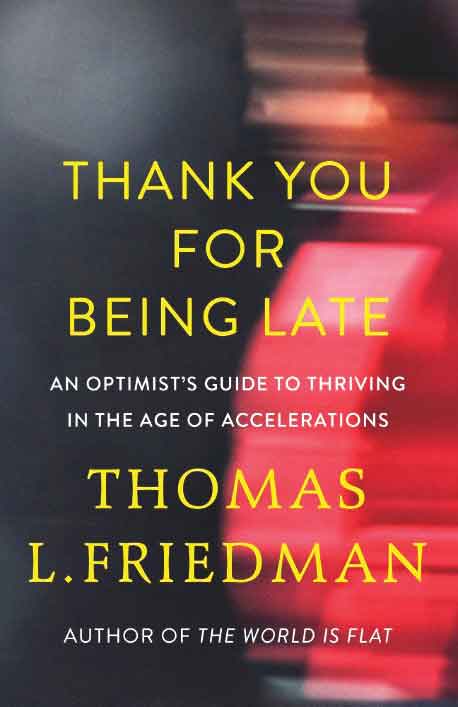
This book, the seventh written by Thomas Friedman, exposes the tectonic movements that are driving the economy and reshaping the workplace, geopolitics and communities. Accelerations in technology and globalization began the same year Steve Jobs took the stage at the Moscone Center in San Francisco on Jan. 9, 2007, to present the first iPhone.
“The moment that Jobs introduced the iPhone turns out to have been a pivotal junction in the history of technology — and the world,” writes Friedman. “Because not just the iPhone emerged in 2007 — a whole group of companies emerged in and around that year.”
At the same time, a microblogging company called Twitter was gaining in popularity. Change.org, the most popular social mobilization website, was established. Amazon released the Kindle and Intel, the world’s largest chipmaker, introduced non-silicon material, paving the way for a new generation of faster and more energy-efficient processors.
As mainframes gave way to desktops, to laptops and to smartphones with mobile applications, technology got more user-friendly; today’s smartphones can be accessed by young children and the illiterate. Key changes in technology were triggered around 2007, one of the greatest leaps forward in history.
“It suffused a new set of capabilities to connect, collaborate and create throughout every aspect of life, commerce, and government,” Friedman writes. “Suddenly there were so many more things that could be digitized, so much more storage to hold all that digital data, so many faster computers and so much more innovative software ... and so many more organizations and people who could access those insights, or contribute to them, anywhere in the world through their hand-held computers — smartphones.”
Craig Mundie, a supercomputer designer and former chief of strategy and research at Microsoft, believes that we have reached a stage when the rate of change eventually exceeds the ability to adapt and causes “dislocation” whereby the whole environment is changing so quickly that everyone starts to feel they cannot keep up.
“Indeed, there is a mismatch between the change in the pace of change and our ability to develop the learning systems, training systems, management systems, social safety nets, and government regulations that would enable citizens to get the most out of these accelerations and cushion their worst impacts ... It now constitutes probably the most important governance challenge across the globe,” writes Friedman.
A thousand years ago progress was slow. If you lived in the 12th century, your basic life was not all that different than if you lived in the 11th century. By 1900, it was taking 20 to 30 years for technology to bring about change. Nowadays, that time window has shrunk so that from the time a new technology is introduced, it takes from five to seven years to observe a noticeable change.
Successful multinationals, such as General Electric (GE), are always on the lookout for new technology. They also hire the best talents from all over the world. It used to take two years to build an engine part; nowadays it takes only a week with the help of three-dimensional, computer-aided software, a 3-D printer filled with a fine metal powder and a laser device that literally builds the piece out of the metal powder in front of your eyes.
“Mobility gives you mass market, broadband gives you access to the information digitally, and the cloud stores all the software applications so you can use them anytime, anywhere and the cost is zero,” Hans Vestberg, former CEO of the Ericsson Group, is quoted as saying in Friedman’s book.
Individuals and companies are able to shape the world around them in unprecedented fashion and with less effort than ever before. Uber, the world’s largest taxi company, owns no cars. Facebook, the world’s most popular media owner, creates no content. Alibaba, the most valuable retailer, has no inventory and finally Airbnb, the world’s largest accommodation provider, owns no real estate.
There has never been a better time to innovate and set up businesses all around the world and yet, a research study by the University of Oxford’s Martin School concluded in 2013 that 47 percent of American jobs are at high risk of being taken by computers or even robots within the next two decades.
The Dutch chess grandmaster, Jan Hein Donner, was asked how he would prepare for a chess match against a computer, like IBM’s Deep Blue. He answered that he would bring a hammer!
Undoubtedly, progress in software and artificial intelligence is not only replacing blue-collar jobs but also white-collar jobs.
“We have no choice but to learn to adapt to this new pace of change. It will be harder and require more self-motivation and that reality is surely one of the things roiling politics all over the world today, particularly in America and Europe,” writes Friedman.
No job is secure and if you want to retain your position in a company, you have to strive for perfection on a daily basis and take nothing for granted. Zach Sims, the founder of Codecademy, is quoted as saying that “you have to know more, you have to update what you know more often, and you have to do more creative things with it… That recursive loop really defines work and learning today. And that is why self-motivation is now so much more important.”
Byron Auguste, a former economic adviser to US President Barack Obama, the co-founder of Opportunity@work, which is planning to help one million more Americans work and learn, argues that in the agrarian economy, land was an asset; in the industrial economy it was physical capital; in the services economy it was intangible assets, such as methods, designs, software and patents. In today’s knowledge economy, human capital will be an asset so the focus should be on talent, skills, tacit know-how, empathy, and creativity which are very much undervalued.
“In sum, in an age of extreme weather, extreme globalization, extreme rapid change in the job market, extreme income gaps, extreme population explosions in Africa that are destabilizing Europe, extreme deficits, extremely low interest rates, and extremely unfunded pension liabilities, we need to get extremely innovative in our politics. We need a dynamic, hybrid politics ... that can strengthen work-based safety nets, to catch those for whom this world is becoming too fast. I am also talking about a politics that can unleash accelerated entrepreneurship, innovation, and growth to sustain those safety nets,” concludes Friedman.
With his usual vitality, wit and optimism, Friedman believes that we have the capacity to solve the serious social problems caused by the accelerations of technology, globalization and environmental problems. However, we should never stop making human connections.
When Friedman asked US Surgeon General Vivek Murthy what the biggest disease in America today is, he immediately replied: “It’s not cancer. It’s not heart disease. It’s isolation. It is the pronounced isolation that so many people are experiencing that is the great pathology of our lives today.”
Whenever we have some time to pause, we must always try and reach out to each other. Technology can make us more productive, more secure and lift people out of poverty if we keep on addressing and responding to a human being’s basic longing for a job, a home, and good health.
—
Email: [email protected]