
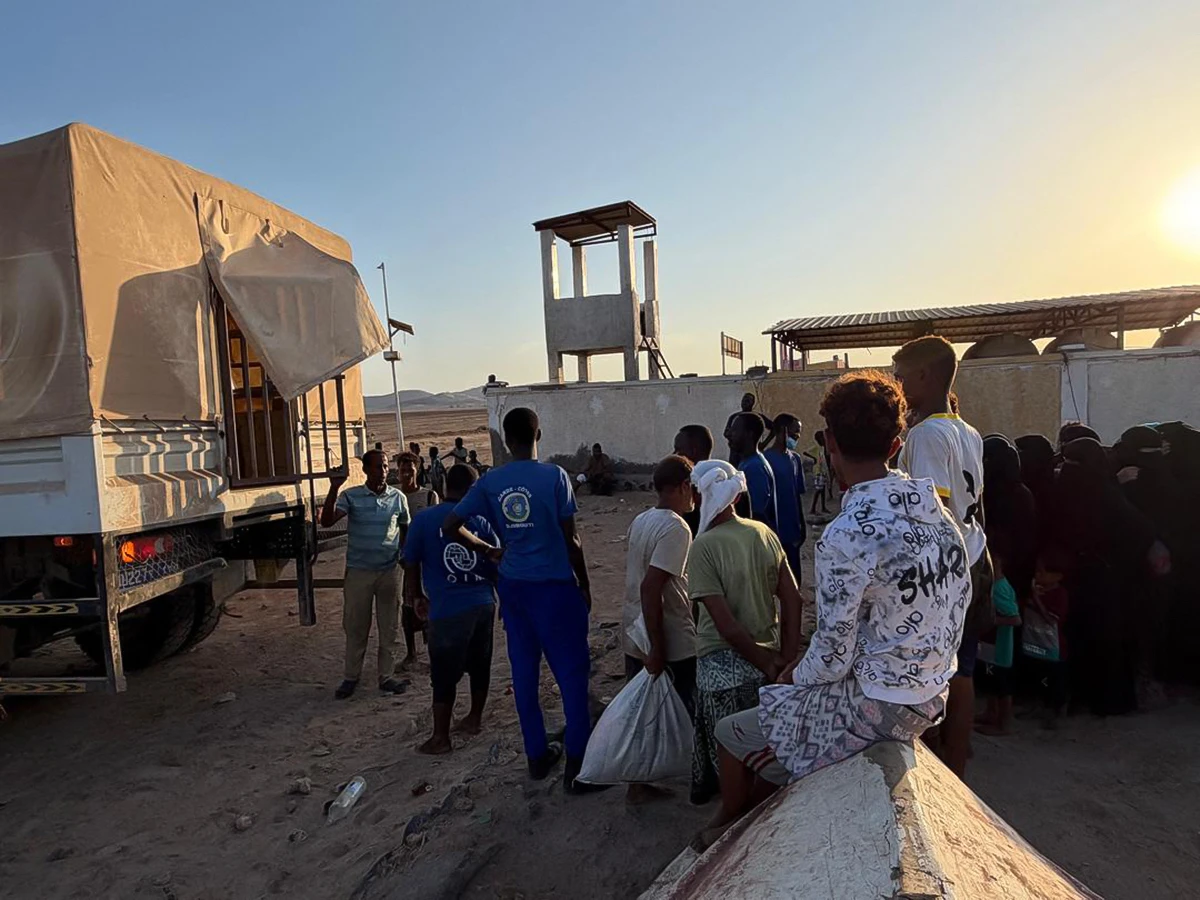

The latest influx of Yemenis into Djibouti, amid the rapidly unfolding events along Yemen’s western coast, is neither the first of its kind nor merely a passing humanitarian emergency brought about by the current conflict. Rather, it is part of a long history of movement, migration and human interaction between the two shores of the Bab Al-Mandab Strait.
Djibouti may be small in geographical size and limited in economic resources, but it has always shown great generosity in embracing the people of neighboring countries and considerable wisdom in responding to regional crises and global upheavals. Despite the immense security, economic and social burdens imposed by successive waves of displacement, Djibouti has never abandoned its humanitarian responsibilities, nor has it closed its doors to those seeking safety and refuge.
When discussing the displacement of our Yemeni brothers and kin to Djibouti during times of conflict, modern history records several successive waves. Among the most notable was the influx of 2015, following the outbreak of the Yemeni crisis and the escalation of armed conflict. Before that came the 1994 war, commonly known as the War of Secession, as well as the events of Jan. 13, 1986, in southern Yemen.
The peoples of the region have long provided one another with shelter and support in times of adversity
Dya-Eddine Said Bamakhrama
Movement between the two shores, however, has never been driven by war alone. Throughout history, the region has witnessed continuous Yemeni migration from across the country. People would cross the sea in simple wooden boats, covering the short distance between the two shores within a matter of hours and arriving in Djibouti, Africa’s gateway opposite the Bab Al-Mandab Strait.
Nor has migration flowed in only one direction. Movement between the shores of the Red Sea and the Bab Al-Mandab has always been reciprocal. When Somalia’s state institutions collapsed in the early 1990s, forcing hundreds of thousands of Somalis to flee their homes, they sought refuge in neighboring countries, while many also crossed the sea to Yemen, where they found safety and a welcoming humanitarian haven on the opposite shore.
The peoples of the region have thus long provided one another with shelter and support in times of adversity, receiving their neighbors whenever all other paths were closed and crises became unbearable. As movement between the two shores continued, customs and cultures blended, social ties became deeply intertwined and bonds of kinship and marriage developed. Intermarriage and human integration consequently became an enduring and natural reality, renewed by the continuity of life across this region.
The sea ceased to be a barrier separating peoples and instead became a bridge for communication, mutual understanding and the exchange of benefits, shaping a shared human memory between its two shores.
On every occasion, Djibouti has shared whatever it possesses, despite its limited resources and capabilities
Dya-Eddine Said Bamakhrama
Any discussion of migration in this region must also recall one of the greatest chapters in Islamic history: the first and second migrations of the companions of Prophet Muhammad to the land of Abyssinia. Fleeing religious persecution, they were received, sheltered and honored by the Negus, who refused to surrender them to those who intended them harm.
Those migrations established timeless humanitarian principles: protecting those who seek refuge, supporting the oppressed and honoring the newcomer. These values have remained alive among the peoples of the Red Sea’s two shores, passed down from one generation to the next and renewed whenever adversity befalls one of the region’s communities.
Returning to Djibouti’s humanitarian role, a former Djiboutian minister of the interior once told me that, during the influx of our Yemeni brothers and sisters in 2015, the number of arrivals exceeded 30,000. As external assistance was slow to arrive, the country’s limited resources came under mounting and severe pressure.
Faced with these difficult circumstances, the minister considered temporarily suspending the reception of those arriving by sea. President Ismail Omar Guelleh responded with profound compassion: “Your brother is standing at your doorstep in need of your help. Do not close your door to him; God will grant us the means to assist them.”
Those words were not merely an administrative directive for dealing with a temporary emergency. They were a sincere expression of a nation’s conscience and the embodiment of the values in which Djibouti — its leadership and its people — firmly believes: that a neighbor must never be abandoned in times of hardship and that humanitarian duty rises above limited means and the calculations of circumstance.
The entire Djiboutian people then mobilized to provide assistance, relief and shelter to their Yemeni brothers and sisters. At the forefront of these efforts was First Lady Kadra Mahamoud Haid, providing a powerful demonstration of the deep historical and fraternal bonds between the two peoples.
History also records the positive role played during that period by the sisterly Kingdom of Saudi Arabia and its aid agency KSrelief. Among the agency’s earliest initiatives was the establishment of a shelter for displaced persons in the Djiboutian city of Obock, the country’s gateway overlooking the Bab Al-Mandab Strait. This initiative helped strengthen Djibouti’s capacity to receive displaced people and provide them with care and protection.
Displacement to Djibouti has not been limited to Yemenis. Whenever conflict or humanitarian disaster has struck the region, the country has received displaced people and refugees from Somalia, Ethiopia, Eritrea and other neighboring states.
On every occasion, Djibouti has shared whatever it possesses, despite its limited resources and capabilities. It understands that neighborliness is not merely a matter of borders drawn on maps but an ethical and humanitarian responsibility — a shared destiny imposed by geography and affirmed by history.
Nations are not measured solely by the size of their territory, the extent of their wealth or the number of their inhabitants. They are also measured by the positions they take in times of hardship and by their willingness to stand up for human dignity when all other avenues have been exhausted. From this perspective, Djibouti has repeatedly demonstrated that it is a nation great in its actions, enriched by the values of its people and steadfast in its commitment to its regional environment.
By virtue of the highly strategic location with which God has endowed it, Djibouti’s destiny has been to serve as a gateway between Africa and the Arabian Peninsula and to stand at the heart of one of the world’s most vital maritime corridors. Yet Djibouti has chosen to make this location — beyond its political and economic importance — a bridge of fraternity and solidarity, an oasis of security and stability, and a haven for those whose own homelands can no longer offer them safety.
God willing, Djibouti will remain small in geography but great in its positions: welcoming those who seek refuge, assisting those afflicted by adversity and safeguarding every person’s right to security and dignity. In doing so, it will continue to stand, in every sense, as the conscience of the Horn of Africa and the southern Red Sea basin.
Dya-Eddine Said Bamakhrama is Ambassador of the Republic of Djibouti and Dean of the Diplomatic Corps in the Kingdom of Saudi Arabia.
X: @dya_bamakhrama


