
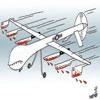

What else new is there to say about America's drone war? The subject, debated to the point of litany, has already crystallized into a consensus: This type of extrajudicial killing is now out of hand. Yet the United States, like a driver behind the wheel of a car with faulty brakes, can't stop.
This consensus was reinforced earlier this week when two separate reports, released by Amnesty International and Human Rights Watch, documented dozens of civilian deaths in drone strikes in Yemen and Pakistan, contradicting the administration's claims that the strikes have been "surgical" and "contained," with rare civilian casualties. Moreover, the drone debate was scheduled to reach the United Nations, whose officials in the past had attacked America's "lack of transparency" in the matter.
In Yemen, for example, Human Rights Watch found that, out of six selected strikes it investigated, that took place since 2009, at least 57 of the 82 people killed were civilians, including a pregnant woman and three children who perished in a September 2012 attack. And in Pakistan, Amnesty International investigated nine drone strikes in Waziristan between May 2012 and July 13 and found that more than 30 civilians were killed in four of the attacks. The country's prime minister, Nawaz Sharif, a vocal critic of the drone campaign, who met with President Obama in the White House last Wednesday, made clear his objections.
Make no mistake about it, the drone war, though clearly reduced in scale, remains as deadly as all-out war. Just because a drone singles out one individual and pinpoints him for summary execution - often with ghastly collateral damage to civilians -- does not make it a weapon less lethal than a Hellfire 100-pound missile that demolishes a building on top of its residents. When the individual chosen for this kind of targeted killing, often a suspect terrorist, turns out not to have been one, and when the drone ends up killing innocent civilians whose only crime was to have been in the vicinity, the US has a major problem on its hands -- and not merely a moral one.
Consider, if you wish, the reaction of the survivors on the receiving end, left to pick up body parts, left consumed by their rage and frustration. Is it too improbable to assume then that some of these folks, say the brothers, fathers, cousins of the victims, may be easily recruited as footsoldiers for an organized terrorist group, or equally easily transformed into lone-wolf operators, incensed at an enemy so distant, so aloof, so untouchable that he leaves you with a sense of impotence at the very central knot of your humanity?
In their 2010 book, Laws, Outlaws and Terrorists, Gabriella Blum and Philip Heyman, both professors at Harvard University, put it well: "The political message [sent out by drone strikes] emphasizes the disparity in power between the parties and reinforces popular support for the terrorists, who are seen as David fighting Goliath. Moreover, by resorting to military force rather than to law enforcement, targeted killings might strengthen the sense of legitimacy of terrorist operations, which are sometimes viewed as the only viable option for the weak to fight against a powerful empire."
Beyond the moral and tactical flaws of the drone campaign, consider its dubious legality. In a word, targeted killing is very simply against the laws of war, for outside the context of armed conflict, that is outside a combat zone, resorting to military force is clearly unlawful. No wonder that extrajudicial execution, which is what drones are employed to do, has generated a rising level of worldwide condemnation. It is not seen — not by a stretch — as the antiseptic war that Washington portrays it as being. Consider further, as a case in point, a report released last week by Ben Emeron, a UN human rights investigator, who estimated that 2,200 people were killed in drone strikes over the last decade in Pakistan alone. Of those casualties, Emerson reported, 400 were civilians and 200 others were "probable noncombatants." Forgive me, but this sharply contradicts what President Obama claimed in a speech last May, that drones were used "only" against people who posed a "continuing, imminent threat to the United States."
Sad but true: President Obama has unleashed more lethal force, and thus caused more deaths, in his "war on terror," than his clueless predecessor had done.
And Obama was the president who we had assumed, given his capriciousness of intellect and progressive vision of world affairs, would rank above all other recent presidents in the gray landscape of American politics.
We were wrong. He failed us in Palestine, where he knuckled under to Israeli dictates; he failed us in Syria, where his policy is in disarray; he failed us in the Islamic world — a world he addressed in a passionate speech from Cairo in June 2009 —- where his drone campaign is seen as imperial hubris; and he failed us, well, elsewhere around the world, whose peoples' expectations of his performance as "leader of the free world" have not been met — not by far.
And that failure has not been a momentary failure of agility in executing American foreign policy, here and there, now and then, but a consistent failure of nerve in every case. A failure that borders on drabness. All the pity.


