
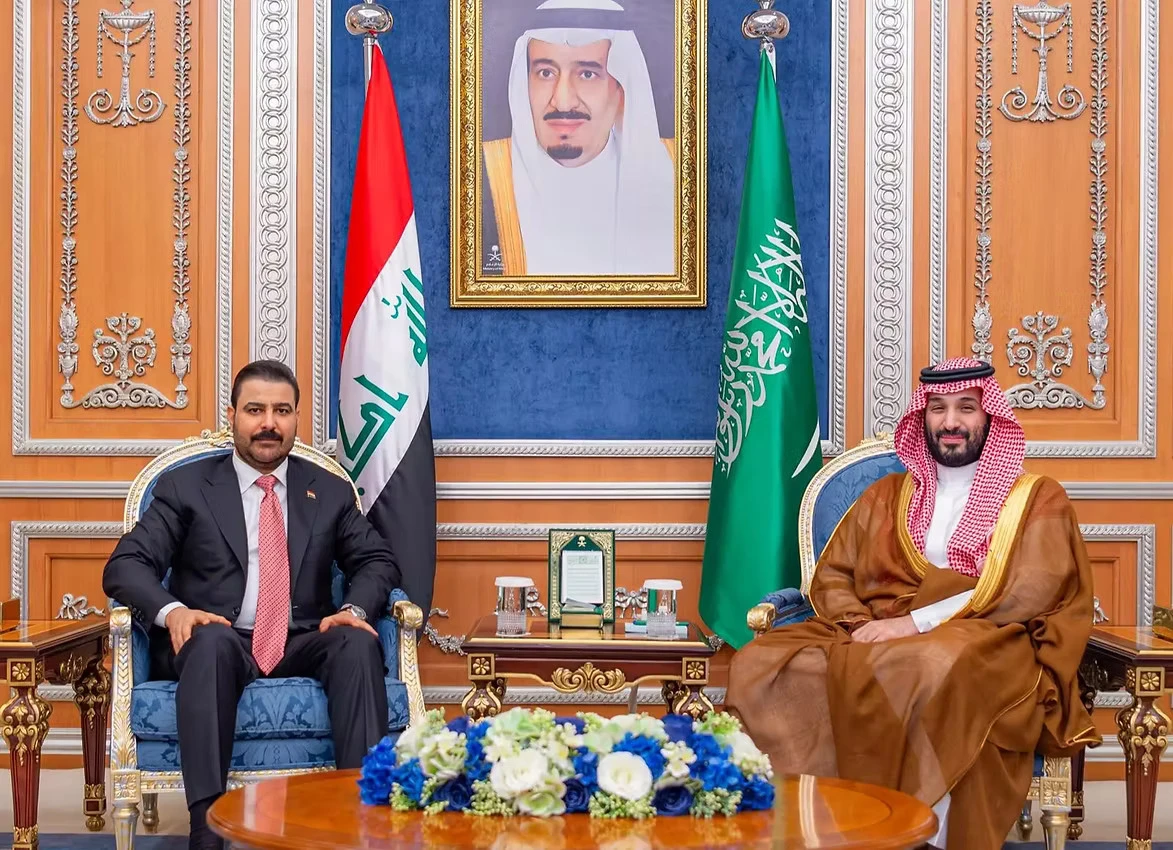

Saudi Crown Prince Mohammed bin Salman received Iraqi Prime Minister Ali Faleh Al-Zaidi at Al-Yamamah Palace in Riyadh on Oct. 14, just days after an attack on King Khalid International Airport and amid repeated Houthi strikes on vital Saudi civilian facilities. The Houthis have targeted five airports across the Kingdom, leaving several people dead and injured, including Saudi nationals and foreign citizens.
Al-Zaidi condemned the attacks, describing them as “a threat to regional security and stability,” according to the Saudi Press Agency. He also reiterated that Iraq would “not allow its territory to be used as a launchpad for any attacks or actions that undermine the security of the Kingdom and other countries in the region.”
For his part, the crown prince reaffirmed the Kingdom’s commitment to developing cooperation between the two countries, “particularly by strengthening coordination on security matters.”
According to sources I spoke to, the talks in Riyadh were positive, with indications that “there is potential to build on this visit and pursue greater cooperation in the coming period,” particularly on “security and economic matters.”
Al-Zaidi’s approach places cooperation with Saudi Arabia within a broader vision of regional security
Hassan Al-Mustafa
This atmosphere suggests a mutual desire to strengthen relations between Riyadh and Baghdad. However, the outcome will depend on the institutional arrangements and practical steps that follow the visit. Al-Zaidi faces domestic challenges from certain factions, particularly over combating corruption and bringing weapons under the exclusive control of the state. These efforts form part of his broader drive to strengthen government institutions and make them more independent of the sectarian and partisan power-sharing system that has undermined Iraq’s political process for many years.
Coinciding with his visit, Al-Zaidi published an article in Asharq Al-Awsat, the sister paper of Arab News, titled “Iraq and Saudi Arabia: Toward a Stable Regional Order,” in which he argued that “Iraq’s security and Saudi Arabia’s stability are not separate issues.”
He linked Iraqi sovereignty to the country’s ability to safeguard its interests and manage its foreign relations, calling for Iraq to be kept out of regional conflicts and for its role as a bridge for dialogue to be strengthened.
“Iraq’s geographical position and the diversity of its regional and international relations give it an opportunity to serve as a bridge for communication and a meeting point for dialogue, rather than an arena for competition and conflict or a launchpad for threats against neighboring countries,” he wrote.
Al-Zaidi’s approach places cooperation with Saudi Arabia within a broader vision of regional security, linking it to long-term political and economic interests. He reinforced this argument in his article, writing that Iraq and Saudi Arabia could “establish a new phase of rapprochement based on partnership and joint planning,” while stressing that “stable relations between Baghdad and Riyadh are a fundamental pillar of broader stability and greater integration in the Gulf and the wider region.”
This Iraqi perspective is not far removed from the Saudi position. Riyadh wants Iraq to be a stable neighbor, with relations built on good neighborliness and cooperation, provided that Iraqi territory is not used by armed factions hostile to the Kingdom as a base for attacks on Saudi soil or for threatening its economic interests and oil supplies.
Riyadh recognizes the considerable challenges facing Al-Zaidi’s government and is seeking to be a partner to the Iraqi state in its reconstruction and institutional strengthening. Such cooperation serves the shared security and economic interests of both countries.
Saudi foreign policy rests on an approach that combines the use of force to protect the Kingdom’s security when necessary with the continued pursuit of diplomacy to address the sources of threats.
On the economic front, Saudi Arabia and Iraq have opportunities to expand mutual investment
Hassan Al-Mustafa
This approach can be seen in the developments that followed the strikes conducted on July 29 against targets belonging to armed factions linked to attacks on oil facilities. Political and security contacts with the Iraqi government followed, along with high-level reciprocal visits.
On Sept. 11, after the East-West Pipeline was targeted by drones launched from Iraq, Riyadh gave Baghdad an opportunity to take the necessary measures. This approach demonstrates that Saudi Arabia is counting on an Iraqi state capable of exercising independent control over its security decisions and fulfilling its responsibilities toward its neighbors.
Saudi Arabia, therefore, wants Al-Zaidi’s efforts to bring all weapons under state control to succeed, in accordance with the plan he introduced and subsequently amended. The deadline for completing the plan was extended to June 30, 2027, after initially being scheduled for completion last September.
Bringing weapons under state control would strengthen the authority of Iraqi institutions, limit the ability of armed factions to carry out attacks against Saudi Arabia, and address a regional security vulnerability arising from cooperation between certain Iraqi armed groups and the Houthis. Such cooperation extends to training, financial and logistical support, media messaging and joint military operations.
Implementing this plan requires the political and legal capacity to bring armed formations under Iraq’s official command structures and regulate their sources of funding and decisions concerning the use of military capabilities.
The presence of groups equipped with advanced weapons and cross-border communication networks, operating beyond government control, undermines the credibility of Baghdad’s commitments and exposes Iraq to the possibility of military retaliation and heightened tensions with its Arab neighbors.
On the economic front, Saudi Arabia and Iraq have opportunities to expand mutual investment and connect their interests through shared infrastructure.
The electricity interconnection project linking Arar in Saudi Arabia to Al-Yusufiyah in Iraq, with an initially planned capacity of 1,000 megawatts, provides a foundation for further development.
The proposal to transport Iraqi oil through Saudi territory to Yanbu has also returned to the agenda. This option is becoming increasingly important amid disruptions to shipping through the Strait of Hormuz and Baghdad’s need to diversify its oil export routes.
Reviving this route would require technical studies as well as commercial and security arrangements, while joint investments could create additional opportunities in energy, logistics and industry.
These shared interests could provide a more sustainable foundation for bilateral relations, particularly if accompanied by legislation protecting investment, measures facilitating trade and security cooperation aimed at reducing the risks facing cross-border projects.
Hassan Al-Mustafa is a Saudi writer and researcher interested in Islamic movements, the development of religious discourse, and relations between Gulf Cooperation Council states and Iran.
X: @Halmustafa


