
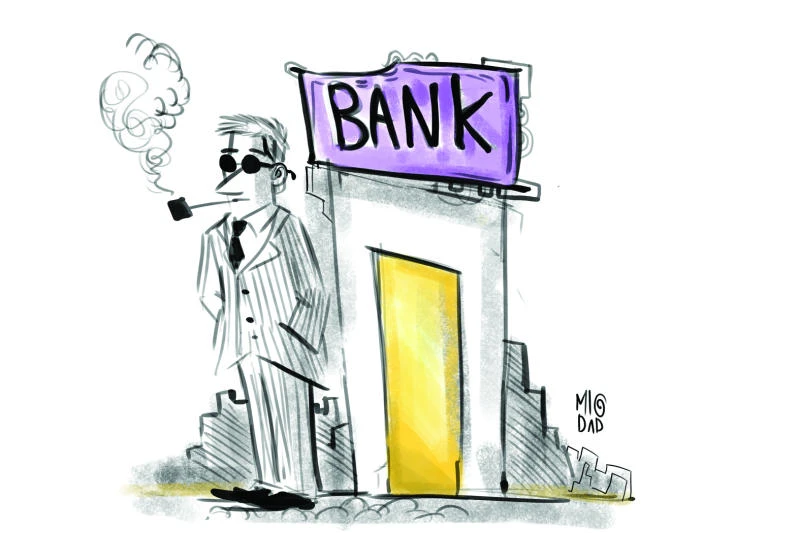

When the resourceful and daring bank robber Willy Sutton was asked by a journalist in the mid-1950s why he robbed banks, he hollered back his now famous, though mock-serous retort, “That’s where the money is!“
So what better place to go to put a scam on the system, in order to extort as much ill-begotten gains as possible, albeit via legal means, than a financial institution? And that’s where roughly 500 Americans, with dual Israeli citizenship, have done — in a class action suit, in federal court in New York, claiming that Arab Bank was liable under the US Anti-Terrorism Act for injuries they, or their relatives, sustained while visiting Israel at the hands of Hamas operatives.
The plaintiffs asserted in their complaint that the bank “financed terrorism” by processing transactions for members of the militant group. As the New York Times court reporter wrote in his news report about the case last Friday, “It is nearly impossible to get individual terrorists to appear in the United States for a civil case, and terrorist groups and members do not generally have much money to pay victims. Banks, however, do, and a number of cases against banks saying they helped to finance terrorism are pending. The Arab Bank case was the first to go to trial.”
The case has taken 11 years to litigate. In September 2014, the court found Arab Bank liable for “knowingly” supporting terrorism relating to 24 different acts, and last Friday the bank’s lawyers opted to reach a settlement with the plaintiffs, though the amount of the settlement, whose framework would be formalized in the next few months, was not disclosed. The case set a precedent: It was the first time ever that that any financial institution faced a jury for alleged violations of the Anti-Terrorism Act’s civil provisions.
Was it all a scam? Unquestionably. The Arab Bank is no a pipsqueak, little financial institution, but the largest in the Middle East, founded in Jerusalem in 1930, long before Zionism formally grafted itself on the whole of Palestine, but today headquartered in Amman, Jordan. It serves clients in more than 600 branches in 30 countries on five continents, and has played a major role as an economic facilitator of the region’s development and trade.
The bank’s ordeal in the US began in 2004. When one Mati Gil, a dual US-Israel citizen, brought claims against the bank, alleging that he was “injured” in a shooting perpetrated by a Hamas operative along the Israel-Gaza border, and that the Arab Bank was thus liable for “aiding and abetting terrorism.” Judge Jack Weinstein, nominated as a federal judge to the Eastern District Court of New York by President Lyndon Johnson in 1967, dismissed the case, essentially for being frivolous (read: Aimed at extorting money from the bank).
He said in his judicial summation: “There’s no proof that anything but routine financial services to the charities alleged to be front organizations were provided, and none of the charities were designated by the US as front groups when the charities received services from the bank.” Judge Weinstein was dismissing the case, he said, because “the plaintiff must establish by a preponderance of evidence that the bank recklessly, knowingly or intentionally caused plaintiff’s injuries, either by the bank’s own actions or in a conspiracy with Hamas or other organizations.”
Mr. Gil failed to do that, he said. “Hamas is not the defendant, the bank is,” he added. “And the evidence does not prove that the bank acted with an improper state of mind ... ” Case closed, right? Wrong. Appeals can drag on for years, 11 in this case.
And yes, like me, you’re wondering why the Arab Bank decided to settle rather fight the case. Search me, but sometimes, after 11 years of litigation, millions of dollars in lawyers’ fees and unnecessary distractions, including bad publicity, my guess is you choose to give the crooks their pound of flesh and move on.


