
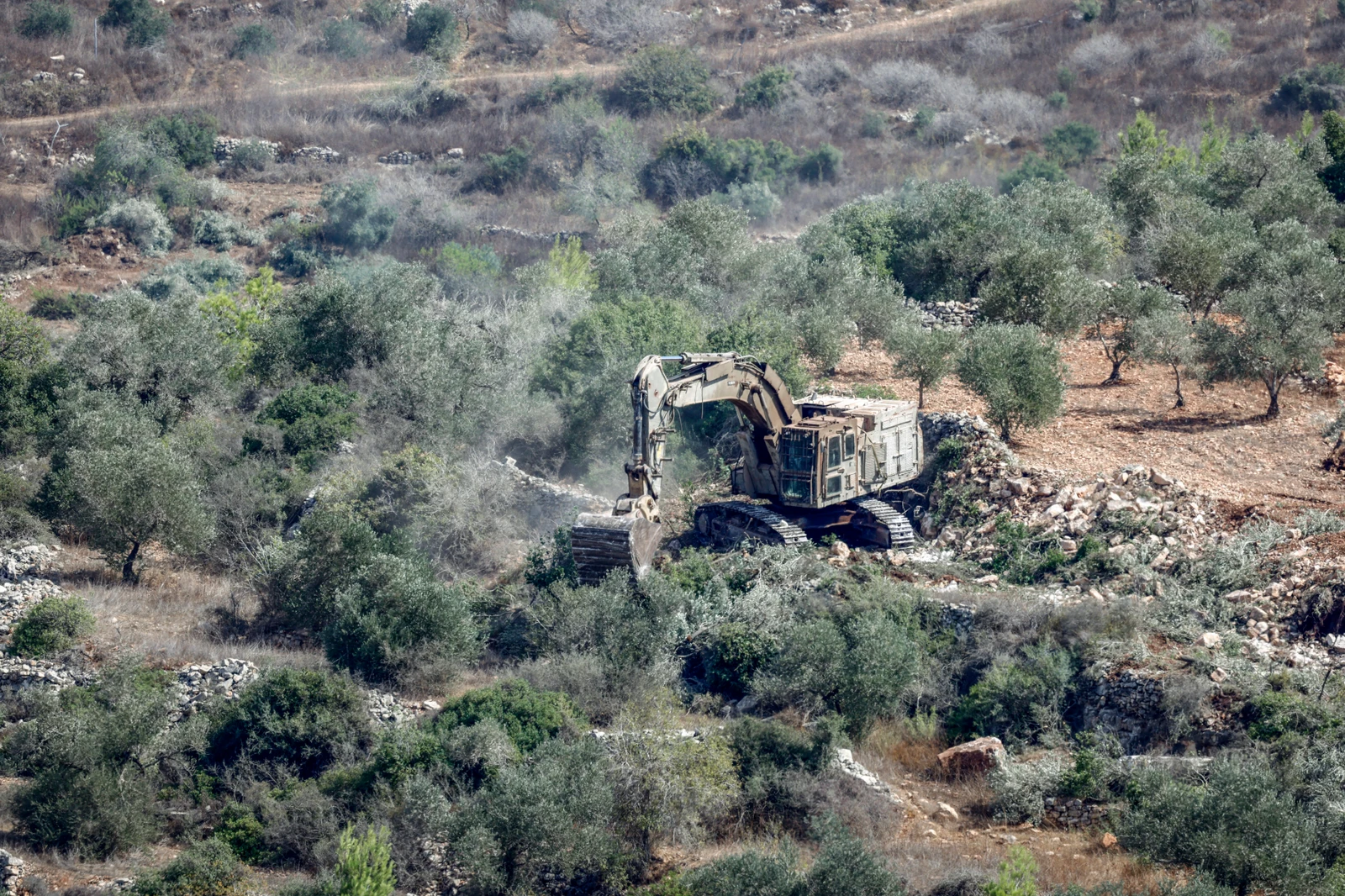

For millennia, the olive tree has been both sustenance and identity for Palestinians and a familiar feature of the ancient land between the Eastern Mediterranean and the Jordan River. For generations, centuries-old olive groves have been a cherished family inheritance and a symbol of Palestinians’ unbreakable bond to their ancestral land.
That is why Israeli settlers’ horrific attacks on Palestinian olive groves are not only a collective war crime aimed at destroying a critical economic lifeline but also a sinister campaign to uproot their indigenous keepers.
Last week, Jewish extremists attacked Palestinians picking olives near the West Bank village of Abu Falah and wounded Heidi Levine, a Washington Post photojournalist who was documenting the assault. The next day, terrorists beat a French mayor traveling with a European delegation. Those who were shocked by the videos documenting such attacks should ask themselves: If diplomats and American reporters can be attacked in broad daylight — and filmed while doing so — imagine what Palestinian farmers face when no cameras are present.
The olive harvest, one of the oldest traditions of Palestinians and a celebration of life, has become one of the most dangerous acts for farmers, their families and volunteers. Across Gaza and the West Bank, Israel’s assault on olive trees has become an attack on a key foundation of Palestinian existence on their land.
For Palestinians, olive trees represent both sustenance and identity. Many groves are centuries old, passed from parent to child along with the stories that come with them. For both Muslims and Christians, olive trees and their precious oil also carry religious significance. An olive tree takes decades to mature. When you uproot one, a family loses not a single year’s income but a generation’s.
Olive groves that outlived centuries of empires and invaders did not survive Israel’s latest war
Osama Al-Sharif
To put it in perspective, before Israel’s war on Gaza, close to 100,000 Palestinian families in Gaza and the West Bank depended on olive cultivation, according to the International Food Policy Research Institute. It estimates that the olive industry produces about 5 percent of the Occupied Territories’ gross domestic product. Olive oil accounts for about a quarter of agricultural income, according to the Palestinian Ministry of Agriculture, and olives cover about 85 percent of the area planted with tree crops, according to the Palestinian Central Bureau of Statistics.
In Gaza, the destruction of olive groves is nearly complete. UN Food and Agriculture Organization satellite analysis found that, by September 2025, about 90 percent of the olive orchard area had been damaged, while the Palestinian Olive Council estimates that nearly 1 million of Gaza’s estimated 1.1 million olive trees have been destroyed. Israel’s war machine directly decimated the majority. But even the most cautious reports describe a landscape stripped of what sustained it. Olive groves that outlived centuries of empires and invaders did not survive Israel’s latest war.
In the West Bank, Israel’s method of destruction is taking a different form but the outcome is the same. Palestinian officials count more than 120,000 olive trees uprooted or destroyed since 2020. During the 2025 harvest, the UN Office for the Coordination of Humanitarian Affairs documented dozens of Israeli settler attacks tied to the harvest and more than 4,000 olive trees and saplings vandalized.
This year promises to be the worst yet for Palestinian farmers. Between January and August, OCHA recorded more than 1,600 settler attacks in the West Bank causing casualties or property damage across 275 Palestinian communities, about 6.7 a day, up from five a day in 2025 and higher than any year on record. More than 1,040 Palestinians were injured. By late August, 23 Palestinians had been killed in the context of settler attacks. The Israeli rights group Yesh Din counts at least 170 attacks since the olive harvest began in late September.
Many Palestinians have been forced to abandon their fields, with some villages emptied of families
Osama Al-Sharif
But these numbers point to another dismal reality. As a result of the sustained Israeli-backed terror and intimidation campaign, Palestinians are now unable to reach their fields. In fact, many persecuted Palestinians have been forced to abandon their fields, with some villages emptied of families. The choice is painful: farmers must choose between their harvest and their safety.
Part of the rise in settler terror this year has to do with the Israeli elections on Oct. 27. Benjamin Netanyahu’s far-right coalition is slipping in the polls, while Itamar Ben-Gvir, the ultranationalist minister who oversees the police, is gaining popularity. Netanyahu needs Ben-Gvir and Bezalel Smotrich, who shape and enforce West Bank policy, to keep his job.
In the midst of a heated and consequential election campaign, Smotrich recently said Israel should “do there (the West Bank) what we did in Gaza.” Israeli Defense Minister Yisrael Katz has boasted of approving 104 settlements and some 160 settlement farms in the West Bank since 2022.
Ignoring or even supporting Jewish settler violence by gaslighting the world has become part of Netanyahu’s bid for reelection. When settlers attacked the French mayor in the West Bank last week, Netanyahu pointed to a “smear” campaign against settlers. When they wounded Levine, his office said “serious questions remain,” even as the US ambassador to Israel described the attack as “terror.”
This series of attacks has shifted the spotlight back to Israel’s occupation of the West Bank and the illegal practices, especially regarding settlements. In May, the EU agreed to a new package of sanctions on violent settlers and settler organizations after Hungary’s new government dropped the veto that had stalled the move for months. The Netherlands, Ireland and Spain have legislated bans on goods imported from the settlements, Belgium has approved its own, and the UK, France and Canada have said they will follow.
Under public pressure in the US and amid outrage after the Levine attack, Secretary of State Marco Rubio said Washington wants Israel to crack down on the attacks. Ambassador Mike Huckabee, hardly a critic of Israel, demanded the attackers be prosecuted.
But these reactions and decisions are far too little. Sanctions on a handful of individuals and import bans by a few countries will not reverse what has become an official Israeli policy that aims to annex the West Bank and displace its people.
The UN human rights office has warned that settler violence in the Occupied Territories takes place with the acquiescence, support and, in some cases, participation of Israeli security forces. In 2024, the International Court of Justice found Israel’s occupation, including its settlements, unlawful. Transferring a civilian population in an occupied territory is a war crime under the Rome Statute. The laws of war also protect objects indispensable to civilian survival, such as farmland.
In simple and legal terms, attacks on civilians under occupation, carried out by settlers shielded by the army, must force the international community to move collectively to carry out an independent investigation that would lead to the prosecution of those who commit these acts and those who protect them.
The onslaught against olive trees, a form of ecocide, and against Palestinians trying to harvest them as they have for generations, points to one clear goal: uprooting a people from their land. Only those with no true bond with the land would try to erase and destroy its ancient features while claiming it is theirs.
Osama Al-Sharif is a journalist and a political commentator based in Amman. X: @plato010


