
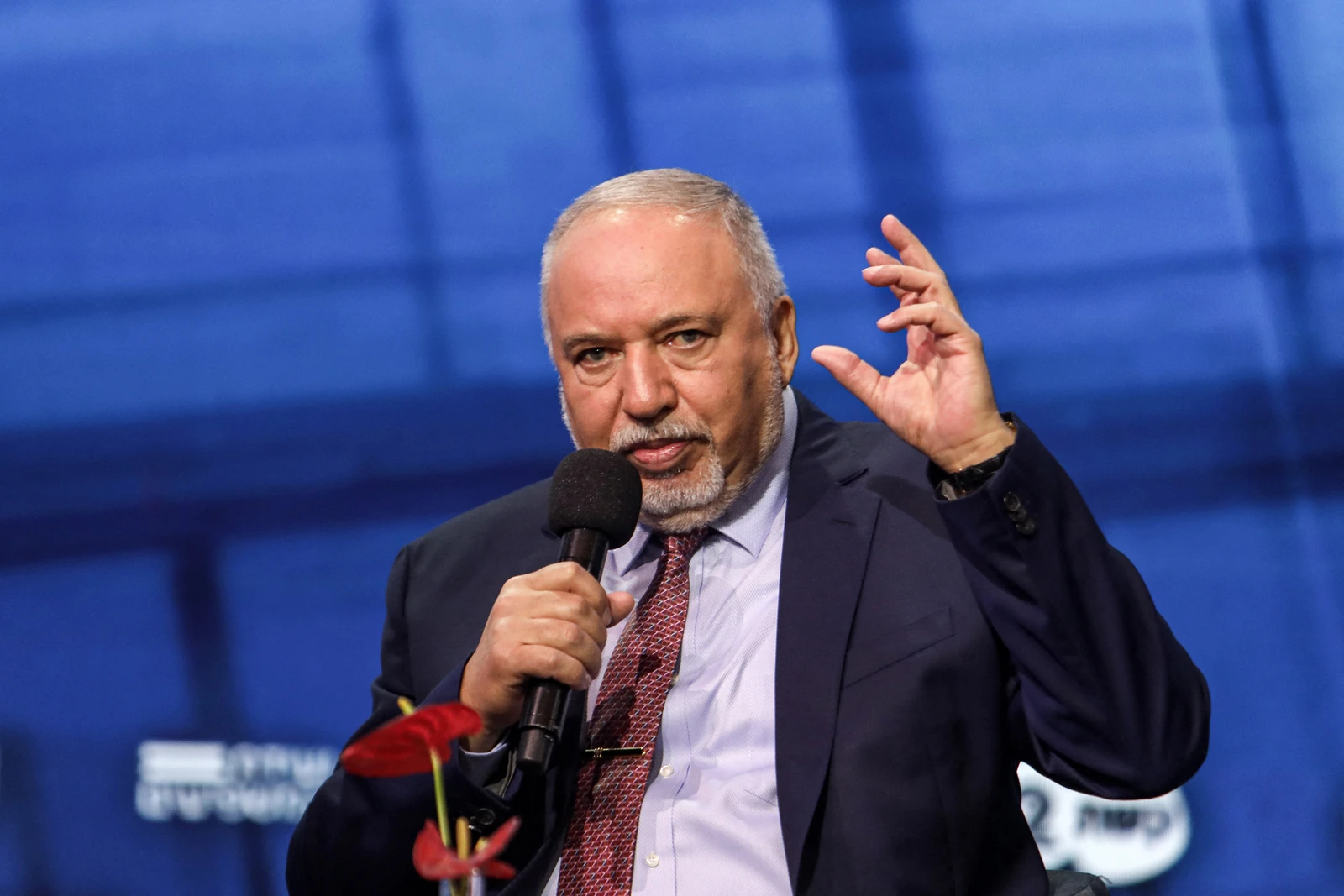

Avigdor Liberman, the head of Israel’s Yisrael Beiteinu party, last month told a Hebrew-language podcast that Jordan should take security and administrative responsibility for the West Bank’s Palestinian areas because Amman, he said, has “no choice.” He later explained that Jordan should run Areas A and B, where the majority of Palestinians live, and described the framework as an “Israeli-Jordanian confederation.”
His logic is that, without an alternative to the Palestinian Authority, Hamas and other militants fill the vacuum, even as the PA has lived up to its commitments to coordinate with Israeli security and suppress dissidents. In 2024, Liberman floated giving Gaza to Egypt and the West Bank to Jordan.
On Oct. 4, Liberman’s party presented his idea as a formal plan. It proposes that Jordan would police Areas A and B and run the daily lives of the Palestinians there. At the same time, Israel would retain security responsibility and territorial contiguity over the entire West Bank. It also called for the dismantling of the PA and the abrogation of the Oslo Accords.
No official Jordanian reaction has been reported since then. But Amman’s response to such ideas is not hard to predict, simply because it has made its position on them public, emphatically, many times before.
The contrast between Liberman’s offer and Allon’s is stark: no sovereignty, no land and Israeli security control over everything
Osama Al-Sharif
Liberman’s party, founded in the 1990s, is secular, hawkish and right wing. It sits within an opposition bloc seeking to unseat Prime Minister Benjamin Netanyahu and his Likud-led coalition. The most recent polls suggest it could win up to 10 seats in the Oct. 27 election. That could make him a kingmaker in the cumbersome coalition negotiations. His party’s plan could become a bargaining chip in such talks. It is interesting that, while Netanyahu and his partners condemned the plan as expected, Gadi Eisenkot, Naftali Bennett and Yair Lapid, the opposition leaders Liberman might serve alongside, have not publicly reacted.
In actuality, Liberman’s plan resurrects an old idea that has become known as the “Jordan option,” which is nearly as old as the occupation. The West Bank was part of Jordan from 1950 until the 1967 war. Weeks after the war, Israeli military commander and Labor Party politician Yigal Allon proposed a plan, which Israel’s Labor government never formally adopted, under which Jordan would be given noncontiguous parts of the West Bank. At the same time, Israel would keep the Jordan Valley and a corridor to Jerusalem. The late King Hussein rejected it as an infringement on Jordanian sovereignty.
After the historic Likud election victory in 1977, the Allon Plan was dropped for good as the right-wing government of Menachem Begin implemented the Likud policy that the West Bank is part of the land of Israel, backed by settlements across the entire occupied territory. The so-called Jordan option disappeared from the Israeli political lexicon. Jordan ended its claims to the West Bank after the Arab League recognized the Palestine Liberation Organization as the sole legitimate representative of the Palestinians in 1974.
The contrast between Liberman’s offer and Allon’s is stark: no sovereignty, no land and Israeli security control over everything. The Palestinian areas are to be run by Jordan, relieving Israel of its responsibilities as an occupying power. Such a proposal has sinister motives: the arrangement would be transitional, since it cannot be sustainable for several reasons.
While the settlement building spikes, Israel is adopting measures to defund the PA by withholding tax revenues
Osama Al-Sharif
For starters, both the Jordanians and the Palestinians would never accept it. Second, it would, if implemented, conveniently transfer the demographic burden of ruling over 3 million Palestinians to the Jordanians, while rewarding Israel’s occupation with de facto sovereignty. Third, Israel would eventually want the entire land, so the transfer scenario would still be on the table.
The Oslo II Accord created Areas A, B, and C in 1995 as an interim arrangement. Areas A and B, about 40 percent of the West Bank, were drawn around Palestinian population centers and hold some 2.8 million people. Area C, about 60 percent, contains most settlements and the Jordan Valley. Israel is already in control of all of Area C and is now encroaching on areas run by the PA. Under Oslo, Area C would eventually be transferred to Palestinian jurisdiction. But we now know that no Israeli contender for the premiership would honor that commitment.
Liberman’s plan would augment the Netanyahu government’s achievements in the West Bank. Since late 2024, the Higher Planning Council, which approves settlement construction in the West Bank, has met weekly to approve new building permits. As of early September, the council had advanced nearly 10,000 housing units, after approving tens of thousands in 2025. Under international law, all these settlements are illegal and the entire West Bank, including East Jerusalem and the Gaza Strip, is to make up the future Palestinian state.
The most consequential of Israel’s settlement schemes is the so-called E1, a tract between East Jerusalem and the Ma’ale Adumim settlement that was long frozen under American pressure. Recently, Israel has approved plans to expand settlement building in E1 that would effectively cut the West Bank in two, thus breaking the contiguity of a future Palestinian state. Finance Minister Bezalel Smotrich openly stated that the project aims to bury the idea of a Palestinian state.
While the settlement building spikes, Israel is adopting measures to defund the PA by withholding tax revenues it collects on the authority’s behalf. As a result, the PA has been unable to pay its employees in full for months.
Liberman’s plan aims to capitalize politically on what previous Israeli governments have already achieved, which is to expand settlement building so that a Palestinian state becomes impossible, defund the PA and ask Jordan to administer the people who are left.
King Abdullah has publicly made his position clear on many occasions. In short, Jordan rejects any plan that displaces Palestinians and refuses the concept of resettlement of Palestinian refugees, all while being determined to protect Jordan’s custodianship of Muslim and Christian holy sites in Jerusalem.
For Jordan, the two-state solution is the only acceptable option, with an independent Palestinian state on the 1967 lines and East Jerusalem as its capital. In 2018, when Palestinian President Mahmoud Abbas said the Trump team had suggested a confederation with Jordan, the Jordanian government said it was not open to discussing a link between Jordan and the West Bank.
Palestinian leaders have not been opposed to some form of confederation with Jordan, especially in the 1980s after the PLO was expelled from Beirut. But they made a distinction: a confederation would be between two sovereign states, after Palestinian statehood, and could be subject to a referendum.
The concern in Amman is that a future Israeli coalition could adopt Liberman’s plan as policy with the stated aim of ending the PA, discarding the Oslo Accords and burying the prospect of statehood. Even more worrying would be the possibility that Washington might adopt this new line and put pressure on Jordan to go along with it. In early 2025, President Donald Trump floated the idea of relocating Gazans to Jordan and Egypt, which King Abdullah categorically refused.
But Jordan, which severed its administrative ties to the West Bank in 1988 to avoid such a scenario, would be well within its rights to refuse again. King Abdullah has made it clear that his position on the matter will not change. Liberman’s plan attempts to revive the Jordan option, albeit in a different form. But Jordan will not bear the cost of Israel’s occupation under any circumstances. Jordanians are united on this principle.
Osama Al-Sharif is a journalist and a political commentator based in Amman. X: @plato010


