
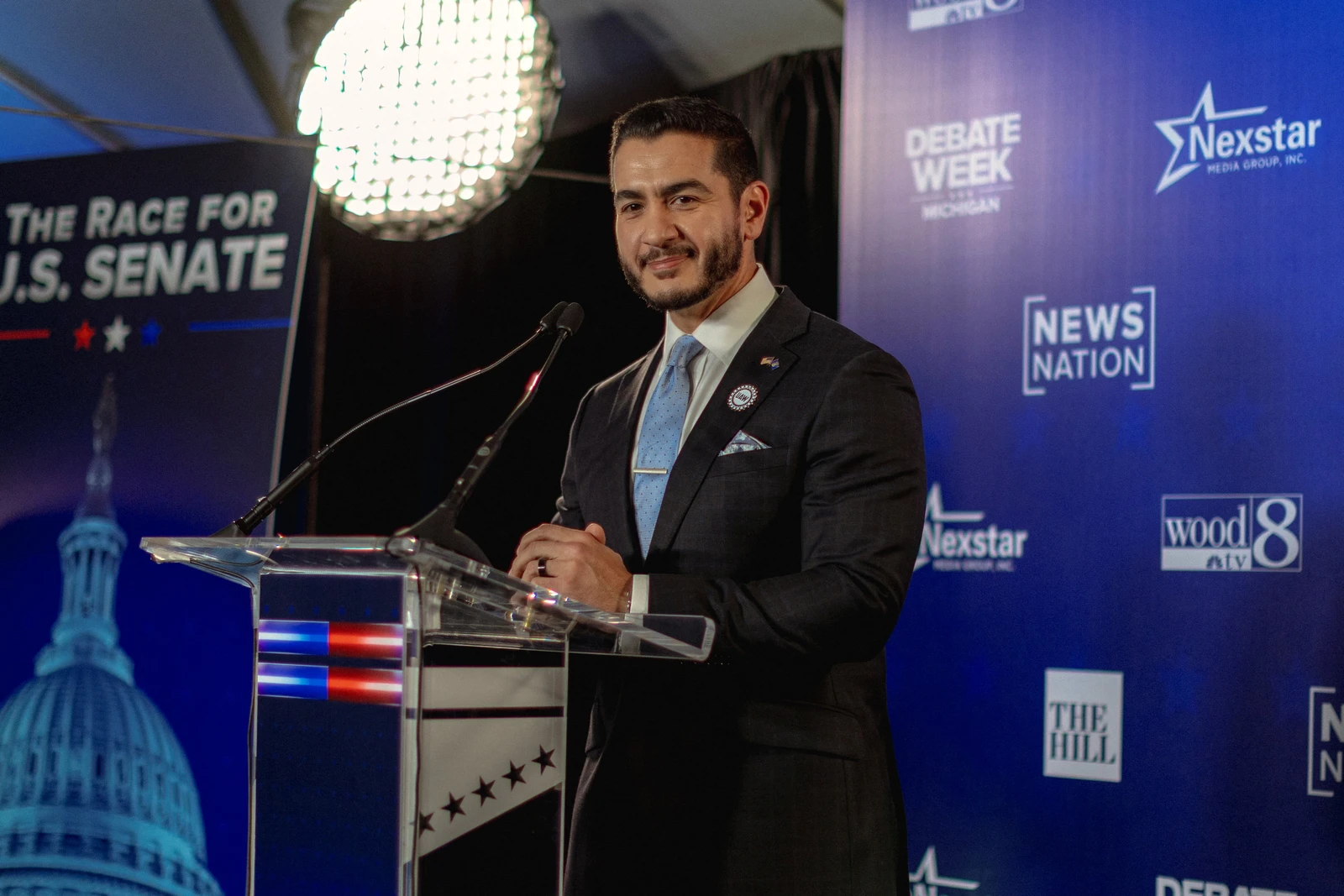

I was in Michigan last week, speaking at an Arab American candidates’ night event. It was an impressive, packed gathering of leaders and activists, along with candidates running in this year’s elections — all of whom had been endorsed by the Arab American community. There were candidates for local offices (city councils, school boards and judgeships) and statewide positions (governor, secretary of state, attorney general, state senate and the house of representatives). The star of the evening was, of course, Dr. Abdul El-Sayed, the Democratic nominee for the US Senate.
In my remarks to the gathering, I focused on three observations.
We began our political work in Dearborn, Michigan, more than four decades ago, in response to an appeal from an Arab American woman who was running for city council. She told us that the leading candidate for mayor had sent a tabloid to every household in the city featuring the headline, “What to do about the Arab problem?” He defined the problem in this way: “There are too many of them. They don’t speak our language or share our values and they’re ruining our darned good way of life.”
I immediately went to Dearborn and addressed a gathering of shocked community members, telling them: “You aren’t the problem of Dearborn. You are its promise and future.” At that point, the Arab community numbered about 17,000 in a city of 93,000. They were mostly new to the US and fewer than 1,000 were registered to vote. Working with local groups, we hired staff and began the task of registering Arab Americans to vote.
At an event we organized in 1996, that same mayor spoke, referring to the community as “my dear brothers and sisters.” His speech included a passage from the Qur’an and he gave me the key to the city. By then, we had more than 7,000 registered Arab American voters — a number he could not ignore.
Today, Dearborn is majority Arab American. The mayor is Arab, as are the president of the city council and the majority of its members, the area’s two state representatives, its state senator and many of its elected judges. Because of this expanding growth and political power, Arab Americans are now courted and not shunned by candidates for high office.
This brought me to my second set of observations — about this year’s election for US senator from Michigan between El-Sayed and his Republican opponent, Mike Rogers. Without exaggeration, it is the most important election in my lifetime.
It is significant on a number of levels, including that El-Sayed is an Arab American Muslim of Egyptian descent. Prior to this, we have had five Arab Americans elected to the US Senate, none of them Muslim.
If elected, El-Sayed would become the first Muslim senator — a breakthrough not lost on Republicans.
Dr. James J. Zogby
If elected, El-Sayed would become the first — a breakthrough not lost on Republicans and President Donald Trump, who are determined to exploit it at every turn. They have done TV ads smearing him, calling him a terrorist supporter and even alleging that, because of his faith, he is not truly committed to America. The Grand Old Party has even sent paid hecklers to El-Sayed’s campaign events. A recent exchange of this sort backfired on the Republican instigators.
At a town hall, a young man asked whether El-Sayed would denounce the Muslim Brotherhood. El-Sayed shot back, “Yes, absolutely,” then pivoted, asking the questioner, “Why are you asking me this?” Was it because of his name or how he prayed? El-Sayed made clear that the document to which he had take an oath was the US Constitution and smartly compared the attacks against him with those leveled against President John Kennedy — that Kennedy would be more loyal to the Catholic Pope than to the Constitution. El-Sayed concluded by noting that he was not running to be a Muslim senator but a senator who happened to be a Muslim.
That exchange went viral on social media, drawing more than 50 million views the first night. The next day, it was revealed that the heckler was a former staffer for a very conservative anti-Muslim senator who had been hired to disrupt El-Sayed events.
This illustrates another reason why this election is so important: the role of dark money in American politics. Dark money refers to money raised by “super PACs (political action committees)” and independent expenditure funds that are not required to report donors before elections. It allows interest groups to amass and spend large sums defaming candidates who oppose their agendas. Increasingly, these dark money sources are raising and spending more on campaigns than the candidates themselves.
In the Democratic primary, El-Sayed was confronted by dark money expenditures of $70 million ($31 million of which came from pro-Israel groups). Despite being outspent 11 to one, El-Sayed won. In the general election, an estimated $100 million in dark money will be spent against him. His victory would demonstrate dark money’s limits and advance the argument that it should be banned for its corrosive role in US democracy.
From the campaign’s beginning, El-Sayed has clearly and consistently criticized US support for the Israeli genocide in Gaza — explaining why so much pro-Israel super PAC money was spent in an effort to defeat him. His Democratic primary opponent made support for Israel central to her campaign. Pro-Israel organizations denounced El-Sayed and did their best to tarnish him, labeling him antisemitic. While this succeeded in costing El-Sayed some support from Jewish American Democratic voters, he won the primary.
In the general vote, El-Sayed is being confronted by the same attacks and organized efforts by the same pro-Israel groups. El-Sayed has stated that instead of spending billions to buy bombs to kill Palestinians, America’s wealth should be spent building better schools and providing healthcare. Once a taboo topic, it has resonated with Democrats and independent voters.
An El-Sayed victory would also succeed in advancing a progressive agenda. Despite being attacked as a socialist, he maintains that he wants capitalism to work for the people. His arguments are simple: It should not be easier for a billionaire to make another billion than for a family to be lifted out of poverty. Healthcare should be a human right, not a privilege only affordable for some. Instead of spending billions on wars, we should invest in schools and the quality of life at home.
These are the challenges El-Sayed presents to US politics. If he wins, he will have succeeded in shattering taboos and raising issues that will have a lasting impact. Even if he loses, US politics will never be the same. On so many levels, it is a historic, transformative campaign.
The final observation is how all this has impacted Arab American voters in Michigan and nationwide.
We have been polling Arab American voters for more than three decades and in all that time the community has favored Democrats, if only by a small margin. The Iraq war and the Bush administration’s widespread repressive policies against Arab and Muslim Americans and immigrants so significantly changed attitudes toward the two parties and their candidates that, for more than a decade and a half, Arab Americans ended up voting for Democrats by a two-to-one margin.
This changed in 2024 as a result of the Biden administration’s acquiescence to and, at times, overt support for Israel’s genocidal war on Gaza. The community was so angered by Democrats’ complicity in that war that support for the party’s candidates declined, while Republican numbers rose. Democrats still had the edge but, in that November’s presidential election, a significant number of Arab Americans voted for third-party candidates, while many did not vote at all.
What our most recent poll found is that Arab Americans will overwhelmingly vote for Democrats over Republicans running in Senate and congressional campaigns across the country. The margin is 59 percent for Democrats versus just 26 percent for Republicans.
What accounts for the flip back toward the Democrats? The recent poll points to a number of factors. Chief among them are the policies and behaviors of Trump. Eighty-two percent of Arab Americans say they have personally experienced economic hardship due to the rising costs of healthcare, utilities, groceries or gas prices. Ninety percent say that the war in Gaza is still important in determining their vote (and will remain so as they choose a presidential candidate in 2028).
More than two-thirds say they have experienced discrimination because of their heritage and an even greater percentage fear this may increase in the future. In this context, Trump’s assault on El-Sayed has only added fuel to the dangerous fires of hate.
What is especially fascinating about the results of this poll is the extent of the convergence in the views of the diverse component groups within the Arab American community. While there are some understandable variations in the responses given to a few questions, the most important demographic subgroups (Christian, Muslim; country of origin; immigrant or native US-born) all express concern about the economic situation, the war in Gaza and the fear of discrimination resulting from this election’s anti-Muslim, anti-Arab hate speech.
Sectarian and national conflicts may afflict countries and regions across the Middle East, but Arab Americans have found a way to coalesce around their shared heritage and issues of concern. It is this convergence that is the cornerstone of the community-building exercise we began four decades ago.
Dr. James J. Zogby is president of the Arab American Institute.


