

It is no longer a secret that the world is experiencing what might be called a political earthquake.
Political parties, particularly those in Europe that analysts regarded as the “parties of government” throughout the Cold War era, are now struggling for survival.
Assumptions of political identity, some of which predate the very concept of the nation state, which emerged in the 19th century, can no longer be taken for granted. Before our eyes, they are faltering under the pressure of populist movements that, until recently, were little more than fringe groups.
Likewise, broad national consensuses, underpinned by the legitimacy of the ballot box, the rule of law and the principles of responsible freedom, have become little more than appealing illusions. They have collapsed beneath the weight of vested interests, deep contradictions, hollow slogans and double standards.
At the same time, racial prejudice and the scourge of populism have shattered the assumption that the principles of liberty, democracy, the separation of powers and peaceful transfers of authority are sufficient to protect diversity in political entities whose borders are the product of historical accumulations.
Traditional parties are faltering under the pressure of populist movements that, until recently, were little more than fringe groups
Eyad Abu Shakra
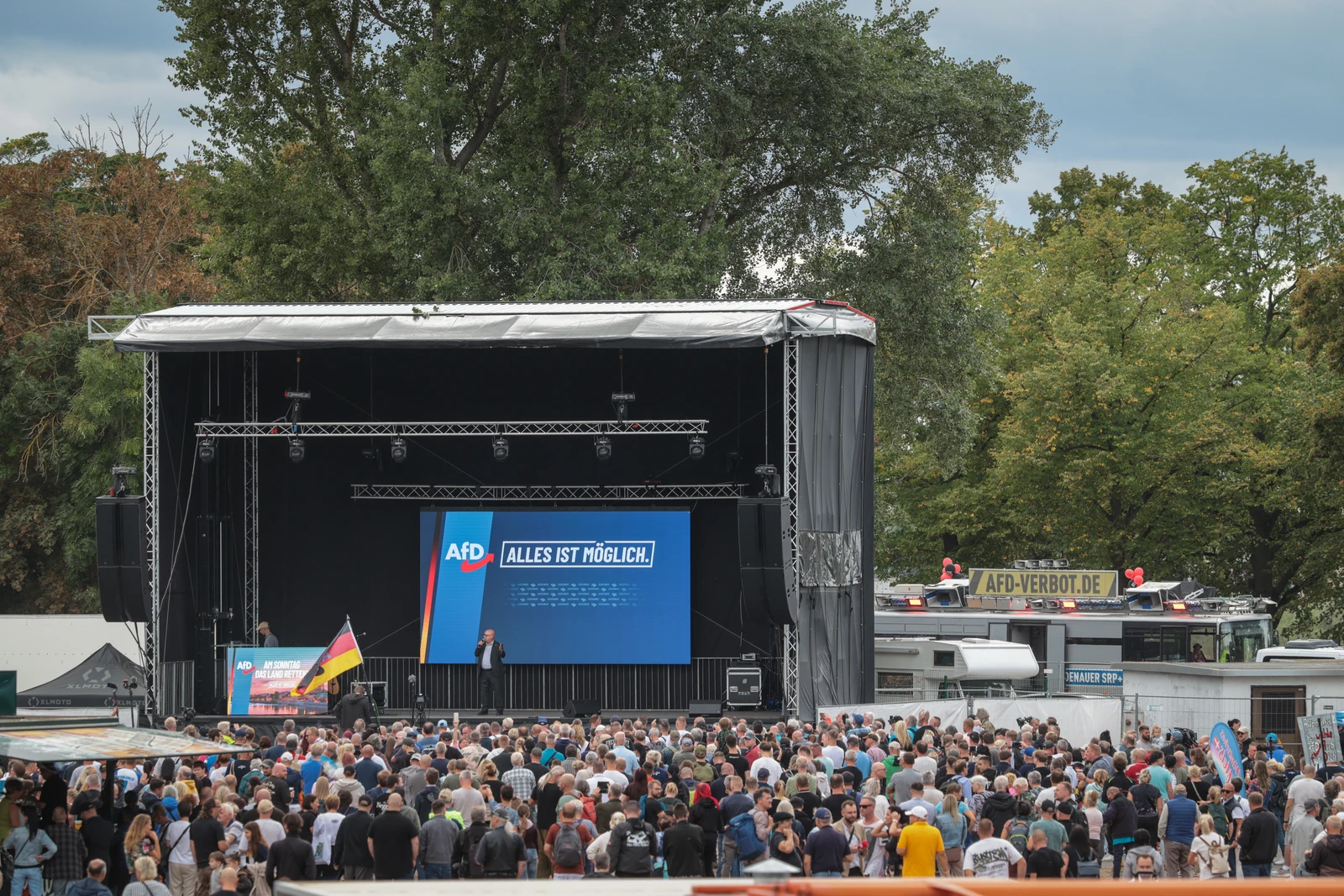
Germany, for instance, recently held elections in the state of Saxony-Anhalt, a region that formed part of East Germany between 1949 and 1990. Remarkably, more than four decades of communist and police state rule have now led more than 40 percent of the state’s residents to view nostalgia for Nazism more favorably than either Eastern communism or Western democracy.
Many observers argued that the strong showing of the far-right Alternative for Germany party in this relatively sparsely populated state might not necessarily reflect broader German trends and that another eastern state, Mecklenburg-Vorpommern, would soon provide a different test. Yet Sunday’s vote there also saw Alternative for Germany emerge as the largest single party with about 38 percent of the vote.
France’s situation is no less troubling. Most polls predict that Marine Le Pen’s far-right movement will win the next presidential and parliamentary elections, followed at a considerable distance by Jean-Luc Melenchon's far-left camp. Between these two poles stand the remnants of Gaullism, Mitterrandism and Macronism, uncertain about their priorities and as bewildered, one might say, as someone choosing from 246 varieties of cheese, to borrow from Charles de Gaulle’s famous remark.
Across the English Channel, Britain presents a somewhat different picture. Unlike France’s increasingly fragmented political landscape, the UK maintained for decades a relatively stable system dominated by the established governing parties.
British national unity can no longer be taken for granted amid renewed demands for Scottish independence and Irish reunification
Eyad Abu Shakra
Although the constituent nations of the UK have long exhibited strong political and emotional attachments to their distinct identities, British politics throughout the Victorian era benefited from the ethnic and linguistic diversity between Anglo-Saxon England and the Celtic regions of Scotland, Wales and Northern Ireland.
Indeed, members of these Celtic communities rose to prominent positions as leaders, statesmen and Cabinet ministers within the British Empire. This arrangement endured even after the Cold War. Yet what the Cold War failed to disrupt, Brexit ultimately did. Britain’s departure from the EU emerged from political pressures centered primarily in England, the demographic and political heart of the UK.
At the same time, changing party dynamics intensified tensions both in England and in the three Celtic nations. For decades, nationalist hard-liners in those regions viewed England as an occupying power. The years of Conservative dominance under Margaret Thatcher (1979 to 1990) reinforced among non-English minorities the perception that they lived under English rule.
Gradually, nationalist parties in Scotland, Wales and Northern Ireland, all of which opposed the Conservatives’ stance on Europe, gained strength. Today, Britain finds itself in an unprecedented situation.
I am reminded here of a story told to me years ago by an Arab physician friend who was working in a hospital in southeastern England shortly before a general election. One quiet night in the emergency ward, he prepared coffee for himself and a nurse and struck up a conversation. Curious about the upcoming election, he asked her how she intended to vote. Given her modest salary, he assumed she would support Labour. To his surprise, she replied, “For the Conservatives, of course.”
When he asked why, her answer sounded so self-evident, as she replied: “Because Labour is the party of the Scots, the Welsh and the Irish.”
This helps explain why, despite the fact that Britain is currently governed by Labour, the recent meeting of the leaders of Scotland, Wales and Northern Ireland was described by the media as a “Celtic summit.” It suggests that British national unity can no longer be taken for granted amid renewed demands for Scottish independence and Irish reunification, or at the very least a return to Europe.
The same dynamics apply to Spain, France and Italy, just as they once did to the Soviet Union, Yugoslavia and Czechoslovakia. Similar developments could emerge elsewhere if Washington chooses to treat other countries as it has treated, and continues to treat, Canada and Denmark.
Today, we are living in a world increasingly defined by black and white, far removed from the coexistence that once existed in shades of gray.
Eyad Abu Shakra is managing editor of Asharq Al-Awsat, where this article was originally published.
X: @eyad1949


