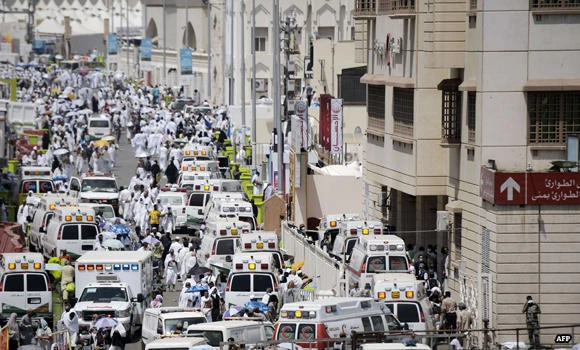
RIYADH: More than 400,000 Haj pilgrims received medical treatment in various health facilities at Haj sites and 1.3 million pilgrims were under health surveillance at the 15 entry points to the Kingdom, Health Minister Khalid Al-Falih said.
The minister was presiding over a meeting of the Haj Health Committee in Madinah on Sunday to review the ministry’s performance during the last pilgrimage. Deputy Health Minister Hamad Al-Dhuwaila was also present.
Al-Falih also bid farewell to the last batch of Haj pilgrims who left from Madinah on the same day. The minister also presented souvenirs to the departing pilgrims.
During the review, it was revealed that 22 open heart surgeries were performed, 668 catheterizations were conducted. Besides this, 2,213 dialysis treatments and 36 endoscopies were also performed on pilgrims.
For the fourth year in succession during this Haj, there was no incidence of Middle East Respiratory Syndrome (MERS)-coronavirus.
During the meeting, members of the committee reviewed the emergency and curative health services and the efforts made by the ministry during the pilgrimage season in general to offer the best services to the guests of Allah.
The members discussed a detailed report dealing with the stampede of pilgrims on the first day of Eid Al-Adha in Mina. The working paper was presented by Dr. Mustafa Balijon, director general of health affairs in the Makkah region.
The committee also reviewed a media survey about the last Haj and took note of the suggestions made by the media for future purposes.
This year, the ministry deployed more than 22,000 health officials from various medical, technical, administrative categories for the Haj season. The officials also included some 400 medics in rare medical disciplines including intensive care, pulmonary intubation, as well as nursing intensive care and emergencies.
In addition to the hospitals, there were 80 primary health care centers in Arafat, Mina and Muzdalifah to receive pilgrims during the Haj.
The centers include 28 in Mina, 46 in Arafat and six in Muzdalifah.
The spokesman said that there was an integrated health plan to cover all areas of health in places frequented by pilgrims.
Health officials were deployed at 15 ports of entry, via land, sea and air, to monitor the entry of Haj pilgrims during this season. They were expected to take preventive and curative measures to keep infections under control.
The health officials detailed at the ports of entry ensured pilgrims had already taken vaccinations from their ports of origin as advised. If they had not received their vaccinations relevant doses were given to them at the ports of entry so that they would be fortified with immunity against the respective diseases.
400,000 Haj pilgrims got med treatment