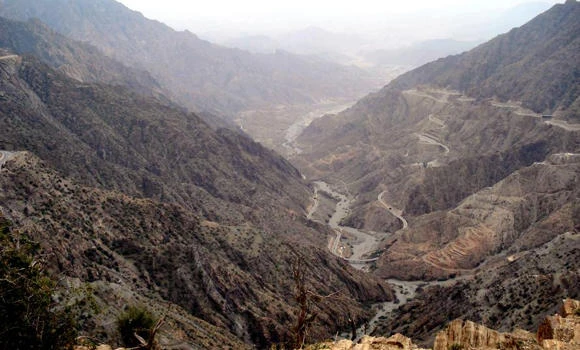
AL-BAHA: Forty three percent of Al-Baha cannot be developed easily because of the region’s mountainous terrain.
This is the view of Khaled Al-Sayegh, undersecretary for construction at the municipality, who was speaking at an event held at the College of Culture and Arts to discuss the region’s development.
Those present included several government directors, university professors, members of the advisory committee developing Al-Baha, members of the municipal council, and intellectuals, a local publication reported recently.
Al-Sayegh said the municipality wants to construct additional side roads to reduce pressure on the two main roads in the area.
Abdulaziz Al-Malki, undersecretary for projects, said the municipality is preparing a development company for Al-Baha, rather than deal with contractors, and aims to implement several service projects.
Ahmed Al-Qurashi, vice president of the National Water Company in the region, said nearly 12 out of the region’s 44 dams are used for drinking water, while the others are for farming. He said a 25-year strategic plan is in place for the development of a sewage system to cover the Al-Baha and surrounding provinces.
Meanwhile, the Director of Health Affairs Azam Allah Sadran said the delays in completing several health projects were “due to shortcomings on the part of contractors and amendments made to projects by officials.”
He said there were no problems to get land for health centers in Al-Baha and its provinces, but citizens were divided over the location of these centers. “We have projects that are 90 percent complete, such as Al-Mekhwa Hospital and the dialysis centers in Al-Ateeq and Al-Mondaq,” he said.
According Zaher Al-Shehri, the director of the Saudi Commission for Tourism and National Heritage, an agreement has been signed with a South African company to study and implement 16 projects for middle-income people and youth.
He said SR20 million had been allocated for the archaeological village of Dhi Ain with hopes of transforming Al-Baha into a top tourism destination. This is one of the ancient villages that are part of a national plan being formulated with the World Bank to encourage private investment in heritage sites.
Al-Baha mountains ‘blocking development’