- The hospital reports a 41 percent rise in fetal procedures, reflecting advances in prenatal diagnosis and treatment
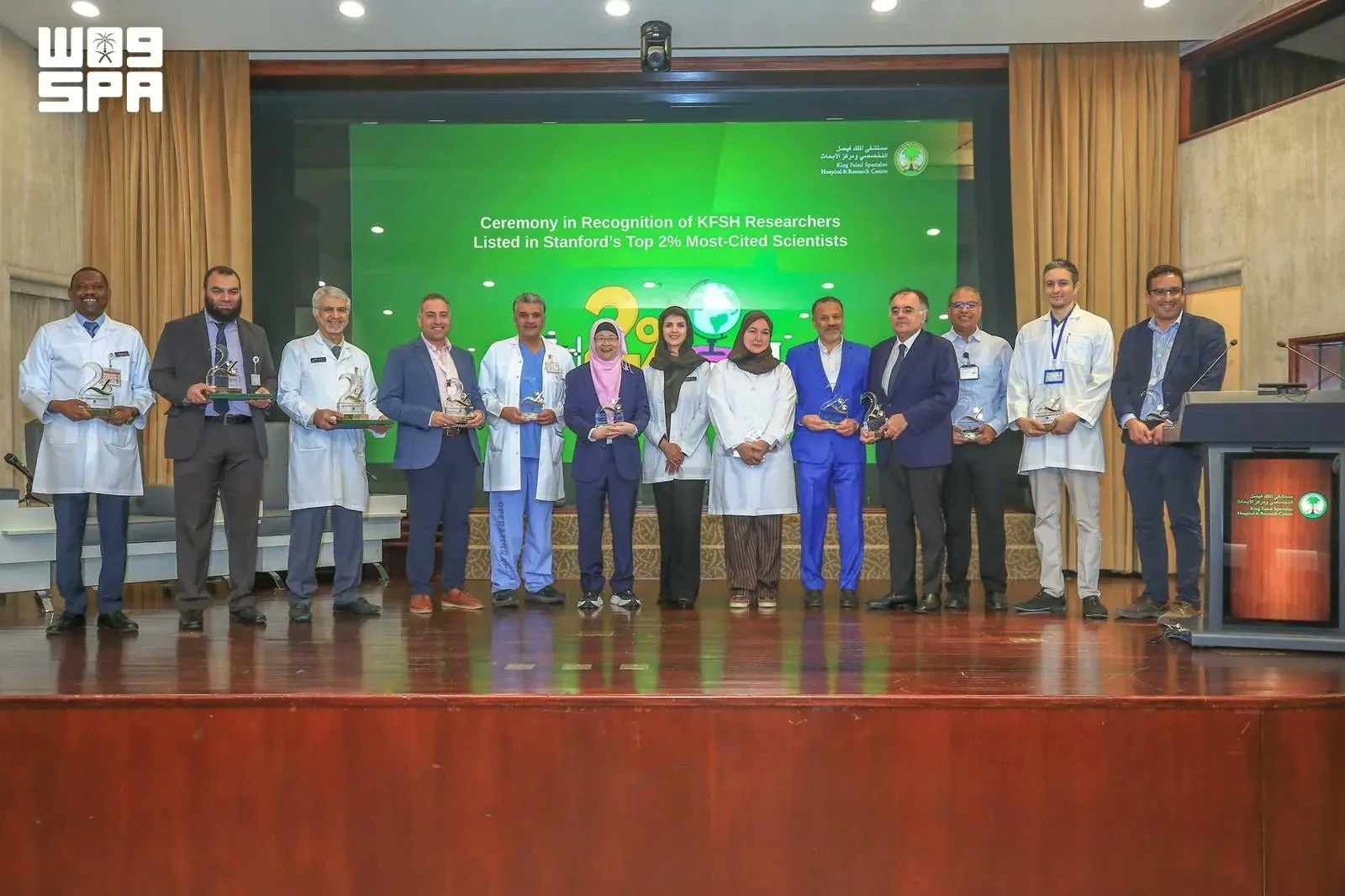
RIYADH: Dozens of researchers at King Faisal Specialist Hospital and Research Centre have been named among the world’s most-cited researchers in the Stanford/Elsevier Top 2 Percent Scientists list, further strengthening the center’s global research standing.
“This represents a significant increase of six from the 35 scientists named in the 2025 list. We are delighted that more of our researchers and clinician-scientists are being recognized for their impact through publications,” said Jackie Y. Ying, the center’s chief research and innovation officer.
The center honored 41 researchers who made the list, it said on Tuesday.
According to the center, this marks its seventh consecutive year on the list, highlighting its growing contribution to scientific research and its influence on global medical research and literature.
Stanford’s list uses various citation-based indicators to assess the impact of researchers’ work throughout their careers and in a single year. These measures reflect the influence of their research and its role in advancing knowledge in their respective fields.
The center ranked first among healthcare institutions in Saudi Arabia in the 2025 Nature Index, which tracks research published in 145 leading journals across the natural and health sciences. It also ranked first in the Middle East and Africa and 12th globally among the world’s top 250 academic medical centers for 2026.
The hospital was also included in Newsweek’s World’s Best Hospitals 2026 ranking, as well as its World’s Best Smart Hospitals and World’s Best Specialized Hospitals rankings for 2027.
Meanwhile, the hospital recorded 41 percent growth in fetal diagnostic and therapeutic procedures over two years, rising from 1,460 in 2023 to 2,055 in 2025, it said on Tuesday.
The procedures are performed through the hospital’s fetal diagnosis and therapy program, established nearly two decades ago. The program combines early detection of fetal disorders and anomalies with case assessments, treatment planning and, when necessary, interventions inside the womb. This allows some conditions to be treated before complications develop.
In early 2008, the hospital performed its first laser procedure to treat twin-to-twin transfusion syndrome, a condition caused by an imbalance in blood flow between twins sharing a placenta.
The program has since expanded to include intrauterine blood transfusions for fetuses with anemia, treatment of rare blood-flow disorders and interventions for certain congenital anomalies.
In 2024, the hospital performed the first procedure of its kind in the Middle East to repair a spinal cord birth defect in a fetus at 26 weeks of pregnancy. The procedure used fetoscopic surgery, involving small incisions in the uterus.
The baby was born in good health at 36 weeks. The procedure brought together teams from maternal-fetal medicine, pediatric surgery, neurosurgery and neonatology.