All journalists who participated in an official media trip to China have not only returned with a memorable experience but also changed their perception of a country that is witnessing rapid development and progress in all sectors, including technology, renewable energy and the real estate market.
The weeklong trip organized by China's Ministry of Foreign Affairs took us to the political and historical capital Beijing, as well as Wuxi, Suzhou and Shanghai, where high-profile meetings and visits were held, including press interviews with China’s Vice Foreign Minister Zhai Jun, Deputy Director General for West Asian and African Affairs at the Ministry of Commerce Cao Jiachang and Deputy Director General of the Ministry of Foreign Affairs’ Information Department Ma Jisheng.
All these officials reaffirmed the excellent and historical relations with Arab countries in all aspects with special reference to their political support to the just cause of the Arabs and the promising economic and trade ties with the Middle East.
In a banquet organized by the Deputy Director General at Information Department at the Ministry of Foreign Affairs, Jisheng had requested his guests from the Arab media to convey the real picture of China. "Chinese people have a very good impression of Arab people," Jisheng said, adding that China stands with the Arabs on a matter of principle.
He said in the information era, the media is playing a vital role in strengthening relations between countries. He added China will never change its principle on the Arab cause under any circumstances.
From the old wonders of the world to the modern wonders in the frontiers of science, technology and economic development, China has now become not only a tourist destination but also a competitive world-class investment hub for many big name global companies. Jiachang, while accepting that traffic jams in Beijing is still a problem, said the new Chinese economic reforms in terms of expansion and developing cities and provinces have improved business flow and movement in the country.
He also admitted certain illegal Chinese products have tarnished the name of his country, but he explained that they are working seriously to stop such operations.
"We know that there are so many complaints against Chinese products, but our government is giving close attention to these matters. It tarnishes the image of China in general and the image of Chinese companies in particular," he said, adding that China is monitoring products being exported. However, because of the growing demand for Chinese products, quality control was sometimes posing problems on the supply side.
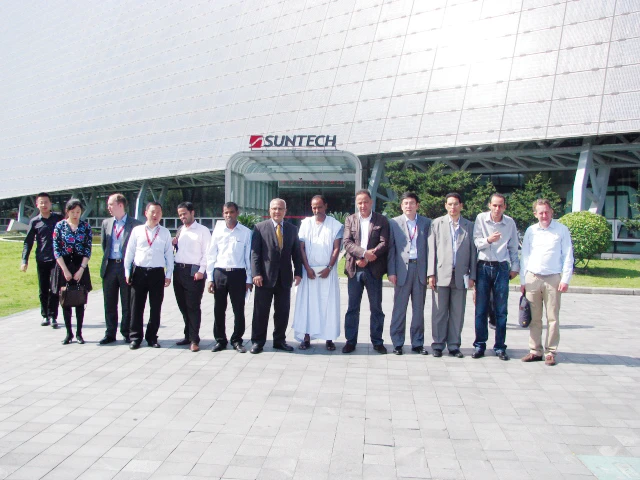
Speaking on the investment opportunities, Jiachang said Wuxi city, home to Suntech, Wuxi Longer SensingNet Technology and Cynovo, is located in the central region of Yangtze Delta with a population of 6.4 million and, therefore, has huge investment potential. It is a cradle of modern China in terms of economy and commerce. Wuxi, the rich area of rice and fishes in the southern Yangtze, has become a modern settlement city where classical tradition is blended with modern trends in fashion to produce a new culture of innovation, said Fang Wei, deputy mayor of Wuxi Municipal People's Government. Suntech is the world's largest producer of solar panels.
He said during a reception in honor of the Arab media on Wednesday that there were factories all over the area and the economy is so prosperous that it has become one of six main economic cities in China along with Shanghai, Guangzhou. It is called "Little Shanghai,” he added.
The city's GDP in 2011 was 688 billion Yuan and its GDP per capita is 107,437 Yuan. The official said that it has become an "eco-city, tourist service city and hi-tech city."
Our third destination was Suzhou, one of the key cities in the Yangtze Delta with a history of over 4,000 years. It is located in the south of Jiangsu province, bordering Shanghai on the east, the Taihu Lake on the West, Zhejiang province on the south and the Yangtze River on the north. The city's roads are clean and have a very systematic traffic control system. Foreign international companies are operating in the city.
According to the 2012 Suzhou Report, 141 of the Fortune 500 corporations had established their branches in Suzhou. In 2011, 138 overseas investment projects with total investment value of $700 million were approved. Private overseas investment reached $524 million.
Our last destination was Shanghai with a 23 million population and described by many of the participating journalists as the most advanced city in the world. Facing both opportunities and challenges in the 21st century, Shanghai, according to the Chinese government, will have basically built itself into an international economic, financial, trade and shipping center by 2020, which can match up to the country's economic development and international status and have a say in resources allocation in global markets.
The city will also have built itself into a socialist modern international metropolis with economic prosperity, social harmony and the beautiful environment by then contributing to the construction of a competitive, world-class city cluster in the Yangtze Delta region.
Pudong is on the eastern bank of Shanghai's mother river and has been playing an exemplary and spearheading role in industrial upgrading, service expanding and system reforming. In 2010, the city reported 2,318 major scientific and technological achievements. The same year, as many as 906 foreign direct investment projects brought Pudong $5.63 billion in contracted funds. The area also had 13,177 overseas funded companies, of which 666 have registered capital of more than $10 million each.
Arab journalists get first-hand accounts of China’s progress