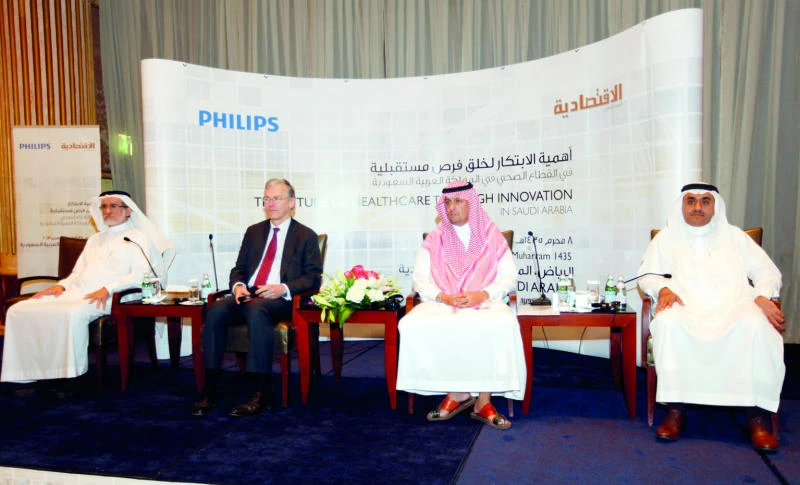
The Ministry of Health (MoH) should adopt measures to provide medical insurance to cover the entire local population, asserted an expert at a panel discussion on “Creating the Future of Healthcare through Innovation in Saudi Arabia” held in the capital on Monday.
Sattam Lingawi, CEO of First Scan Co. and member of the Shoura Council, said it is the Ministry of Health’s responsibility to provide insurance coverage through a phased program to cover the local population.
The panel discussions also included Prince Mohammed Al-Faisal, president and CEO of Al-Faisaliah Group Holding; Frans van Houten, chief executive officer of Royal Philips; and Salah Al-Mazrou, deputy minister of health for medical supplies and engineering affairs.
Prince Mohammed Al-Faisal discussed the challenges facing the health sector, touching upon the possibility of delays in completing health projects due to the shortage of foreign labor.
He pointed out that the Labor Department has licensed nine new employment agencies to outsource foreign workers, which would help private contractors to complete their projects in time with the new manpower supplied by these agencies.
Meanwhile, Al-Mazrou highlighted the fact that the Ministry of Health (MoH) has launched an ambitious program to build 42 new hospitals with 13,645 beds in the next five years. He said the MoH is covering 60 percent of the medical services in the Kingdom, while the private sector and government departments such as the security forces hospital and military hospitals owned by the Ministry of Defense, share the remaining services equally.
This year, the deputy minister said, five new hospitals with 1,865 beds and 14 renovated hospitals with 1,565 beds will be completed and ready for operation.
At present, he added the ministry has 259 hospitals and seven medical cities throughout the Kingdom with a total capacity of 38,000 beds.
At the beginning of the panel discussions, Philips presented an in-depth report on how innovation can support the future of health care in Saudi Arabia.
The report compiled by the economist intelligence unit is expected to gather evidence through in-depth interviews with local and international leaders taking part in chalking out the Kingdom’s future health care plans. It will also examine employment opportunities for nationals and the policies that could attract more citizens into the sector.
The report commissioned by Philips seeks to bring together the Saudi government, players in the private health care sector and academics to co-create innovative solutions to the challenges facing the health care system. Some of the prime challenges that require addressing include increasing patient capacity, the constraints in local clinical resources and continuing education, in addition to the need for public-private partnerships.
The report comes at a time when the government plans to launch a number of new health care projects at a cost of $3.3 billion to increase state-run beds from 20,000 to 60,000 in the next few years. This represents a unique opportunity to introduce innovation into the health care system.
“Our ultimate goal is to create the future of health care by delivering innovative solutions that enhance clinical capabilities and improve patient outcomes,” said Frans van Houten.
“Strong local understanding and deep insights into Saudi needs are the key drivers to ensure innovations are truly meaningful,” Houten added.
With over 80 years of history in Saudi Arabia, Philips remains committed to improving the lives of people in the Kingdom, he said.
Govt urged to provide medical insurance to all citizens