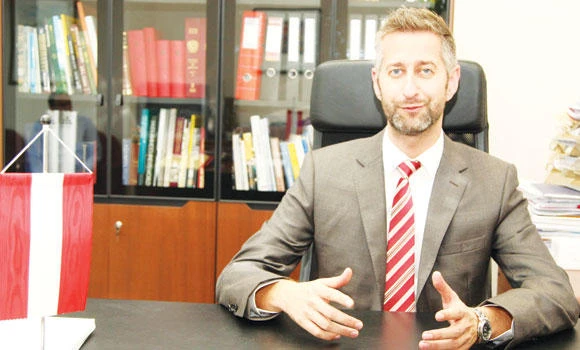
Austria and Saudi Arabia enjoy very cordial relations and bilateral economic and commercial ties between the two countries can be described as traditionally positive and stable with a steady growth of the trade volume, according to Pierre Prunis, commercial counsellor at the Austrian Embassy.
Austria-Saudi trade relations are traditionally positive and stable, he pointed out.
Speaking to Arab News, Prunis maintained that Austria has played a long-term role as a high-tech trade partner of the Kingdom for many years. The ties have been successful due to the reliability of small and medium enterprises as well as industrial holdings.
Outlining the distinct characteristics of Saudi business partners, he asserted that the structure of Austrian companies, who are dealing with Saudi trade partners, is very diversified.
“Nevertheless Austria shows a trend for mainly SMEs who are very often world market leader in their fields and specialized in high-technological niche-market products. The reliability is proved through on-time-delivery of the highest quality with excellent after-sales services including training,” Prunis affirmed.
He says more than 30 Austrian investments are registered in Saudi Arabia, from joint-ventures to 100 percent Austrian-owned companies.
“We estimate that around 300 Austrian companies are regularly active directly or with a representation in the Kingdom,” said Prunis.
“The main strategy of Austrian business is to start with a relatively flexible business structure, like direct sales or through an agent or a distributor. Once the companies are settling down and intensifying their activities, may be
through involvement in big projects, they take the initiative of direct investment. This is the case in business including all kind of infrastructures related to government projects,” he added.
Commenting on total volume of trade between the two countries and the nature of trade, he said: “Last year’s trade volume between both country was more than a billion euro. The trade balance was slightly in favor of Austria. The Saudi exports to Austria consisted mainly in hydrocarbon and plastic related products. Austria’s exports to the Kingdom were very much diversified and included building and construction materials, fire fighting vehicles, health products, food and drinks as well as industrial machinery, just to mention few sectors.”
He added: “This year’s trade figures are looking very promising. In the first half of 2013, Austria’s export data showed a 40 percent growth.”
Furthermore, Austrian companies mostly realize big projects as subcontractors.
Due to the specializations in niche-markets, it is quite seldom that Austrian companies are the head of a consortium.
One of the exceptions is the construction field, where big Austrian players have recently been very successful, he said.
Responding to a query, he said the top five product group of Austrian sectors are: Specialized vehicles, industrial machinery, steel products, pharmaceuticals and lightings.
He said the bilateral trade ties between both countries had shown steady growth. Massive investments in the Kingdom open up huge opportunities to the foreign business community.
“Austrian companies are definitely willing to take part in this development and are keen to be the leaders as high-tech providers in order to support a sustainable development of the Kingdom,” he opined. Moreover, Saudi-Arabia’s strategy of industrialization shows interest of foreign direct investment as well as diversification through Saudi investment abroad.
Austria is one of the strategic countries when it comes to industrial diversification through top-quality research and development, he stated.
Austria’s strategic geographic location in the center of Europe also strengthens its status.
Prunis also said: “The Austrian Federal Economic Chamber organizes annual trade missions to Jeddah, Riyadh and Dammam with around 25 to 30 Austrian companies. This event in March is mainly based on business-to-business talks and is strongly supported through various Saudi business organizations.”
A Saudi business delegation is planned in the near future in order to inaugurate the Saudi-Austrian Joint Business Council, representing Saudi-Austrian business interests, said Prunis.
He also exuded confidence that the cordial trade relations between the two countries would further strengthen cultural ties among them and pave the way for even stronger relationship.
“Culture and business can be easily combined in order to increase the bilateral ties between two countries. It would be a great opportunity for Austria, which is one of the world cultural centers, to use these strengths to support bilateral business ties,” he said.
When asked about cooperation in the energy industry, he said solar power is a very promising field in Saudi Arabia.
Austria is one of the solar technology leaders and has already delivered big projects to the Kingdom. Alternative energy is one of the key factors in Austria and its use is increasing every year. It has become a traditional business factor of the country.
Austria’s imports of hydrocarbons from Saudi Arabia have also shown considerable increase in recent years.
Austria’s trade relations with Saudi Arabia are reaching new heights.
Saudi Arabia is an important market for Austria in the Middle East and trade and investments between the two countries have recorded a significant increase over the years.
High-tech trade fuels solid relationship