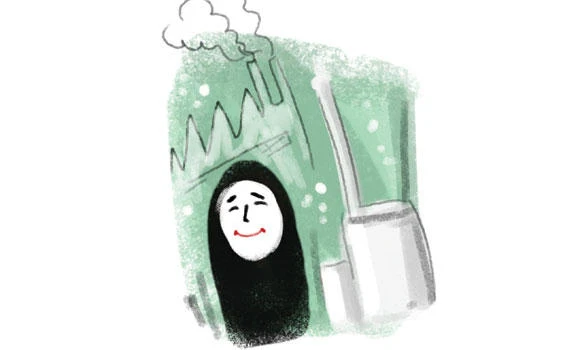
More should be done to ensure the participation of Saudi women in the country’s industries as workers and investors, said several government officials and private sector entrepreneurs here recently.
Saud Al-Ghorabi, director of Al-Ghorabi Office for Industrial and Economic Studies, said Saudi women have the potential to prove their talent in several industries.
This includes dress-designing, manufacture of ready-made clothing, jewelry, assembling computers and other electronic devices, chocolates, sweetmeats, perfumes and cosmetics. He said Saudi businesswomen have plenty of places to invest but only a few have done so.
Fahd Al-Takhifi, assistant undersecretary for development at the Ministry of Labor, said a royal decree reserving certain industrial jobs for women needs to be implemented. The ministry has devised a strategy to do so.
He said there is a ban on jobs that are not suitable for women, but this does not prevent women from investing in businesses with these professions. They do not need special licenses for this, he said. Women can work in certain factories but must not be at work before six in the morning or after five in the evening.
Women are permitted to work on a factory’s production lines and in its offices, but must stick to the stipulated working hours and not be discriminated against in terms of salary scales and training.
Nawal Hadi, chairperson of the council of businesswomen at the Yanbu Chamber of Commerce and Industry, said a woman can work in factories manufacturing cosmetics and medicine, small and medium plastic industries, home appliances and packaging that have commercial potential in the Kingdom and abroad.
“Women are partners in various large industries and projects particularly in family-owned companies such as Al-Hamrani Fuchs, Olayan and Xenel. Gulf businesswomen, mostly women from Saudi Arabia, control 40 percent of the capital in the region.”
Hadi said attempts are being made to establish women’s industrial companies to bring back the capital investments made by Saudi women outside the country.
Abdul Munim Addas, director of the financial consultation department at the Islamic Development Bank in Jeddah, said Saudi women make up only 1 percent of investors in the industrial sector, and only 5 percent overall.
Addas said that Custodian of the Two Holy Mosques King Abdullah has issued orders to ensure that women are given financial and other support so that they can participate without hindrance in the economy.
He said there would likely be more women investing in beauty salons, dress designing, boutiques and hospitals because Saudi women are already working in such sectors. He urged banks to support businesswomen with financing, project studies, costing and training. There should also be support for them to find raw materials and Saudi staff. Women could work in marketing, services, tourism and education, he said.
Ruqayyah Al-Abdullah, assistant director for development at the Labor Ministry, said the female Saudization of certain factories would be implemented in a few months. In such factories, which have been identified with the help of Saudi Council of Chambers, trained Saudi women could operate production lines, she said.
“Female Saudization of factories will be mandatory. The General Organization for Technical and Vocational Training has been asked to provide more seats for women in its higher technical institutes,” Al-Abdullah said, adding that currently women are given training in electronic and food industries.
She said the ministry has taken action because while women make up 49.1 percent of the population, their participation in the job market is negligible.
Industry needs more Saudi women