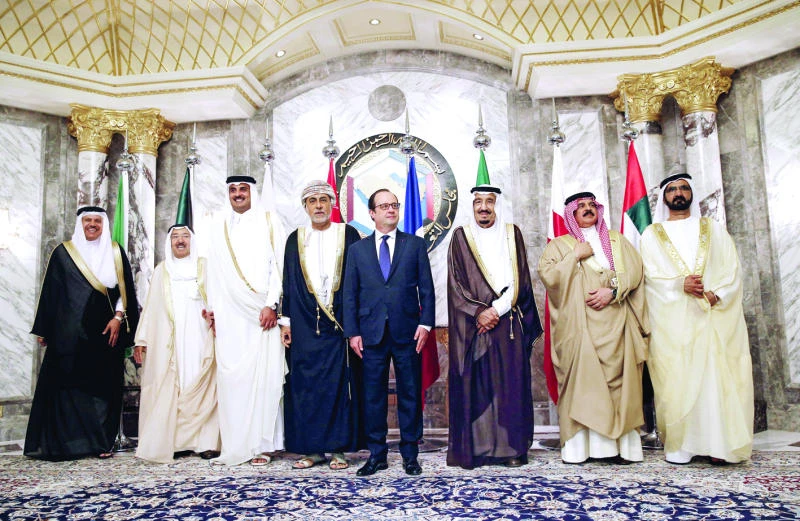
Custodian of the Two Holy Mosques King Salman has definitely played a vital role in promoting unity among members of the Gulf Cooperation Council (GCC).
This is shown by the Saudi capital’s playing host to the 15th consultative meeting of the GCC states on Tuesday.
Issues discussed included the conflict in Yemen and Iran’s nuclear program with King Salman warning that a nuclear deal with Iran that does not have clauses to safeguard other nations would spark a nuclear arms race in the Middle East.
“Seeking nuclear weapons represents a very serious threat,” he said as he addressed the consultative summit of the six-nation GCC.
He urged Gulf leaders to stand up to Iran and called on the international community, especially the Group 5+1 negotiating with Iran, “to set stricter rules that guarantee the region’s security and prevent it from plunging into an arms race.”
French President Francois Hollande attended the meeting and thus became the first Western leader to attend a GCC summit. The Riyadh summit brought together leaders from Bahrain, Kuwait, Oman, Qatar, Saudi Arabia and the United Arab Emirates.
The only other foreign leader invited to a GCC summit was Iran’s then President Mahmoud Ahmadinejad in 2007.
Hollande told the summit that France supported the coalition’s effort “to ensure the stability of Yemen.” His visit came as Paris strengthened its political and economic relations with GCC countries.
Gulf leaders wanted Hollande to visit before the Washington summit to show they have a faithful ally in France, “and they ask the same thing from US President Barack Obama,” a French official said.
Moreover, the important role of King Salman in preserving GCC unity was plainly shown by the formation of a Saudi-led coalition of ten countries to restore the legitimate government in Yemen.
The Saudi-led coalition began military action in Yemen against the Houthi rebels who ousted President Abed Rabbo Mansour Hadi.
Saudi Arabia has deployed some 100 fighter jets, 150,000 soldiers, and navy units for the operation.
The UAE has dispatched its fighter jets in strikes targeting Scud missiles in Yemen, as well as Houthi camps, air defense systems, and other military targets.
The news agency has said 30 jets from the UAE were taking part in the airstrikes.
Kuwait has offered 15 fighter jets for the operation, the state-run Kuwait News Agency has reported.
Bahrain sent 12 fighter jets from the Royal Bahraini Air Force, the state-run Bahrain News Agency also reported.
Qatar has contributed 10 fighter jets to the operation, according to the UAE state news agency WAM.
Sudan has put four fighter jets at the disposal of Saudi Arabia, Sudanese Information Minister Ahmed Bilal Osman told the private, pro-government Ashorooq television station.
Sudan has also offered to dispatch 6,000 soldiers for ground operations for the coalition as well, Osman said.
Egypt was believed to be offering both aircraft and naval vessels for the operation, though officials have not offered any breakdown of their contribution nor said whether they had launched any strikes.
The United States also expressed support, with President Barack Obama authorizing logistical and intelligence support for the airstrikes.
As the coalition’s campaign progressed, the Senegalese government pledged to send troops to help support the coalition.
Senegal’s Foreign Minister Mankeur Ndiaye confirmed that the West African nation would be sending a detachment of 2,100 soldiers.
Senegal is the first Sub-Saharan country to join the Saudi-led alliance against the rebels.
Brig. Gen. Ahmed Al-Assiri, coalition spokesman and a consultant at the Ministry of Defense, has reported the coalition’s success, claiming that the Houthis and their cohorts had used the media to claim advantage.
As in any war, casualties — collateral or otherwise — are inevitable. The United Nations has announced that at least 1,200 people have been killed in Yemen, and has repeatedly warned that the impoverished Arabian Peninsula country faces a major humanitarian crisis.
This is exacerbated by the Houthis and their allies who have not only taken civilians as human shields but have also blocked the delivery of food and medical supplies.
King Salman — the GCC unifier