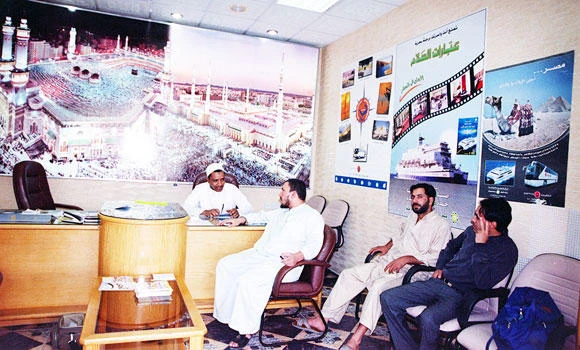
Bandar Hajjar, minister of Haj has recently announced that his ministry is in the process of restructuring internal Haj service providers.
“Custodian of the Two Holy Mosques gave directives for the establishment of a committee headed by Ministry of Haj and members of related government bodies to draft a comprehensive strategy to achieve the objectives of Haj over the next 25 years,” said Hajjar.
“The ministry formed a scientific team comprising members from several parties to outline the technical specifications of the study,” he pointed out.
He said that the strategy would take into account the steady increase in the number of Haj and Umrah pilgrims, adding: “Custodian of the Two Holy Mosques Institute for Haj Research was appointed to supervise the study.”
Hajjar noted that there would be no increase in the number of Haj service providers in the time being, unless the capacity of the holy sites, Mina in particular, is increased.
“A comprehensive assessment of the last Haj season was carried out through a series of workshops with the participation of government officials, Tawafa institutions and the concerned parties to learn from past mistakes and avoid repeating them,” he said.
The minister said that undocumented pilgrims would be prevented from boarding the Mashaer Train this season.
He pointed out that the campaign against undocumented pilgrims resulted in the detection of 27 unlicensed companies providing services to illegal pilgrims. Accordingly, the ministry imposed fines ranging from SR15,000 to SR100,000 on the unlicensed companies.
“Another 68 firms were fined as well for breaching the terms of contract signed with pilgrims. We have vowed to compensate the pilgrims between 15-60 percent of the original value of the contract,” he said.
Explaining the mechanisms of managing Haj, the minister said, “There are around 20 governmental bodies that the partake in the management of the Haj season, in addition to Haj service providers in the private sector. Each of these bodies prepares an operational plan to implement the tasks it has been allocated, within an integrated framework and coordinated system.”
Commenting on the management of Haj season this year he said: “There are about 20 government bodies participating in the management of the pilgrimage in addition to Haj service providers in the private sector,” said Hajjar, adding: “Every one of these bodies prepared an operational plan for implementing the tasks charged to it within the framework of an integrated system and mutual coordination.”
The Ministry of Haj organizes, oversees and monitors more than 5,000 companies and institutions involved in Haj. In addition, there are nine institutions with more than 500 field service offices and 3,000 external service providers working in the field of Haj services. For internal pilgrims there are around 240 companies and institutions with more than 700 branches throughout the Kingdom, Hajjar explained.
“Also, there are 54 Umrah companies with 1,600 outside agents as well as 19 transport companies that own more than 20,000 buses,” said Hajjar, noting that the integrated Haj system employs more than 40,000 employees on a permanent and seasonal basis.
Local Haj firms assessment under way