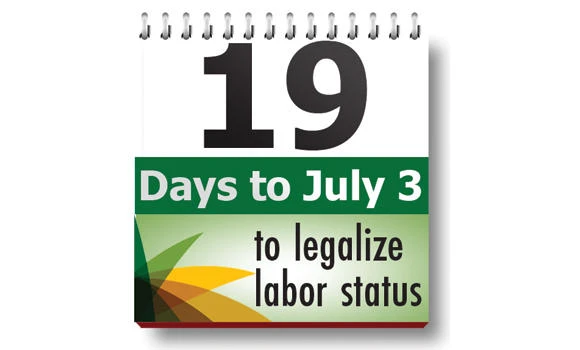
The Ministry of Labor has urged hundreds of thousands of undocumented private drivers and housemaids to use the labor concessions announced by the government that allows them to change their sponsors without the approval of their current sponsors. Mufrej S. Al-Haqbani, deputy labor minister, in a statement emphasized that they should do this before the grace period ends on July 3.
The concessions will benefit an estimated 450,000 domestic helpers, who have either run away from their sponsors or violated residency and labor laws.
According to a report, more than 1.5 million maids are currently employed in Saudi Arabia. Some 20,000 run away from their sponsors every year. In monetary terms, the total market for maids, including recruitment, deployment, salaries, heath care, perks and facilities is estimated at SR 41 billion a year.
Al-Haqbani also called on expatriates to “update their biometrics as the only condition for final exit.” All those workers willing to go on final exit “will be exempted from iqama or iqama violation fees, labor permit fees and other penalties related to violations” during their stay in the Kingdom, he said.
Al-Haqbani said expatriates who opt to stay and rectify their status would also have the advantage of transferring their sponsorship online through www.mol.gov.sa. But those intending to change engineering, medical and other professions, will be required to show certificates and personally report to a labor office, he said.
On the question of huroob, or runaway cases, the deputy minister said the ministry has granted a further concession allowing them to either work for their previous sponsors or for new sponsors. “For runaway workers facing huroob charges, there are two options — to go back and work for their current sponsors, if they reach an agreement, or transfer to other sponsors without the consent of their current sponsors,” he said.
He said huroob workers facing financial or criminal charges would be required to settle the cases in court before they are allowed to travel to their home countries.
“These are major concessions,” said Arif Naqvi, a recruiting agent. Naqvi, who is involved in two huroob cases, said Saudi courts are trying to resolve these cases quickly.
Al-Haqbani said the concessions limit a family to four domestic helpers. In addition, the new foreign employees must not result in an employer's small company mov ing into the Red Zone of the Nitaqat system.
Maids, drivers told to make use of concessions