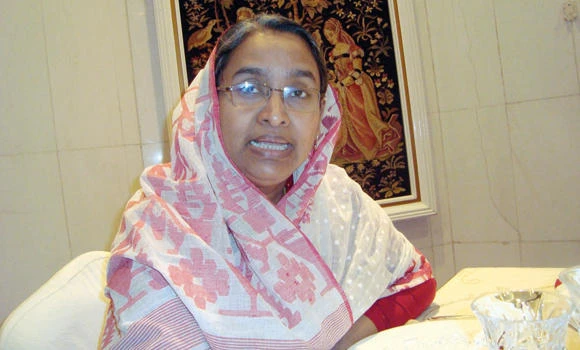
The visiting Bangladesh Foreign Minister Dipu Moni is hopeful that the amnesty granted by Custodian of the Two Holy Mosques King Abdullah will be extended for a further period to ensure that all the irregular expatriates benefit from the scheme.
In an interview with Arab News yesterday in the capital, Moni, who is on an official visit to the Kingdom, said that the Bangladeshi expatriates began working on transferring their sponsorship six weeks after the proclamation of the amnesty.
The authorities lifted the ban on the transfer of sponsorship among Bangladeshi workers on May 11. The Bangladeshis therefore had only six weeks to complete their obligations, whereas others enjoyed the full three month-period of amnesty.
The foreign minister also noted that the country’s missions in Riyadh and Jeddah have done their best to fulfill the authorities’ requirements. However, she was afraid the missions would not be able to complete all the cases on schedule due to the paucity of time and also due to some delays on the part of Saudi authorities.
She said she put forward her case before the State Minister of Foreign Affairs Iyad Madani and was promised that the matter will be forwarded for favorable consideration to the higher authorities.
Moni said she is to meet Second Deputy Premier Prince Muqren in Riyadh today and would pursue her case for the extension of the amnesty during the meeting. “Such an extension could eventually benefit all expatriates.”
Regarding her government’s contingency plans to rehabilitate returnees to their home country, Moni said preparations to welcome and offer them assistance have already been worked out. “We had a similar experience when some 37,000 refugees came to Dhaka following the war in Libya. We were able to fully rehabilitate them,” she said, adding that some of them chose to go to other countries for employment.
However, she pointed out that the government is hopeful that many returning home from the Kingdom would not only have enough capital but also rich experience from their respective workplaces, which would help them resettle in Bangladesh on their own.
“Our own Bangladesh Overseas Employment and Services Limited (BOESL) will find suitable foreign jobs for returnees who want to go for foreign employment again,” she noted.
BOESL, which is owned and operated by the Bangladesh government, is a manpower-exporting company founded in 1984 to ensure the supply of qualified Bangladeshi manpower abroad. It is responsible for supervising and providing assistance to Bangladeshi workers under government-to-government protocol.
Commenting on regional political developments, Moni said that with the formation of the new Pakistani government under the leadership of Nawaz Sharif, there is hope for democracy in the neighborhood, which means stability in the SAARC region. “The elections were free and fair; democracy has taken root in Pakistan,” she stressed.
Moni said the International Crimes Tribunal trying people suspected of involvement in genocide, crimes against humanity and war crimes during the country's war of liberation in 1971 was set up following consultations with UN bodies and are absolutely independent.
The tribunal convicts have the right to appeal their convictions, she added.
She said the Awami League always came to office with people’s mandate, and therefore, it was committed to ensure a free, fair and inclusive parliamentary election.
She pointed out that the Prime Minister Sheikh Hasina had already invited the opposition political parties to a dialogue to give their views on the modality of the interim government during the general elections.
Moni stressed that the people of Bangladesh have rejected the violence, vandalism and outdated demands incited by Jamaat-e-Islami and Islami Chhatra Shibir.
Speaking about the tragedy of losing more than 1,100 workers due to the collapse of a garments factory in Dhaka, Moni said that her government’s cabinet committee has embarked on a wide range of programs to ensure safety measures in garments factories.
In consultations with the International Labor Organization, (ILO), the government has paved the way for a tripartite agreement among the employer, employee and the state to provide safety measures, ensure rights of workers and provide freedom of associations among workers.
“We have appointed factory inspectors to visit factories regularly to ensure that the government’s requirements are met according to its specifications,” she concluded.