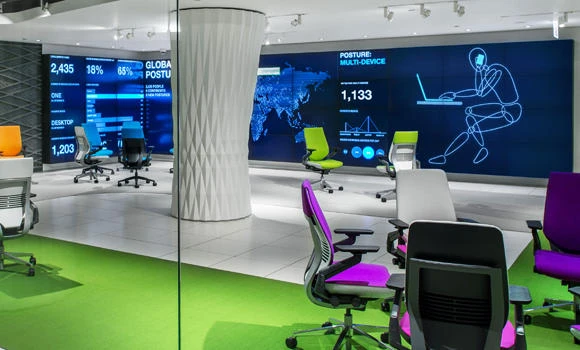
DAMMAM: Intelligent Office concept products introduced by Steelcase present a future vision of a workplace that integrates cutting-edge technology into the work environment to enhance performance, human interaction and worker satisfaction.
These innovative concept products are a result of detailed research into how work environments can evolve to address workers’ issues in order to enhance productivity, creativity and quality of life at work.
While the recent research by IPSOS-Steelcase reports that over a third of KSA workers face a range of obstacles that leave them feeling overwhelmed, stressed and less productive in the workplace, Steelcase’s concept products give workers increased control over distractions that can affect performance such as noise, interruptions, lighting and temperature control.
During the NeoCon 2015 international industry event in Chicago, Steelcase demonstrated its concepts for the Intelligent Office vision, which integrates sensing devices into the work environment to learn what people want and need through gathering and aggregating data over time. Using embedded technologies, the products help to mitigate distractions and boost productive interactions at work.
The IPSOS-Steelcase research indicates that a majority of KSA workers are facing a number of issues in terms of stress and level of concentration in the workplace, with the quality of life in local workplaces perceived as simply mediocre and well below their international contemporaries. A mere 40 percent of workers agree that they feel relaxed and calm at work, well below the global average of 59 percent, and only 46 percent stated that they were satisfied with the ambient noise level, in comparison to 63 percent globally. While 70 percent of KSA-based workers report that they can concentrate easily, slightly higher than the international average of 66 percent, the survey also revealed that globally an average of 35 percent of workers rated their office as being stressful, however KSA workplaces ranked higher with 41 percent of local workers stating that they felt stressed at work, a concern which negatively impacts overall employee satisfaction.
Allan Smith, global vice president of marketing at Steelcase, commented on the company’s research into worker behaviors, stating: “Steelcase gained new insights by analyzing the findings of recent neuroscience research which, combined with our years of research about the changing nature of work, the workplace and emerging technologies, enables us to explore concepts for an intelligent office that supports the cognitive, emotional and physical wellbeing of people.
“By identifying these three levels of well-being at work, Steelcase’s design teams are able to incorporate this research into office solutions that improve employee productivity and comfort, thereby creating a workplace that actually helps people think and feel better at work,” Smith continued.
Andy Morris, head of sales, Middle East at Steelcase, said, “When workplaces are designed as an ecosystem of differentiated zones and settings, workers can appropriately select spaces that match their brain modes and activities as they move through their day. This understanding of neuroscience helps us integrate technology into the workplace in a way that helps people cognitively offload information into the physical environment and help them feel less overwhelmed.”
New research shows ways to boost workers’ performance