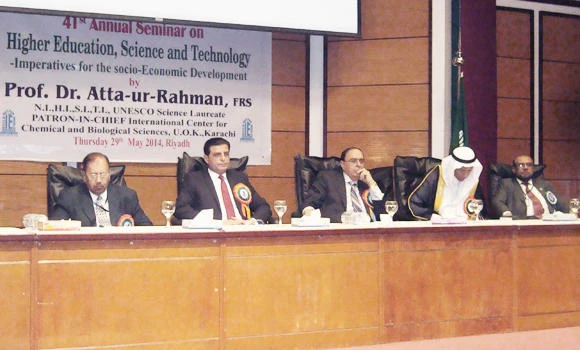
Pakistani expatriates in the Kingdom should invest in faculty-building at institutes of higher education back home, said a UNESCO science laureate here.
“Knowledge is the key to socio-economic development,” said Atta-Ur-Rahman, patron-in-chief of the International Center for Chemical and Biological Sciences in Karachi.
The event was organized by the Institution of Engineers Pakistan-Saudi Arabian Center (IEP-SAC) to mark its 41st technical seminar on higher education, science and technology, all imperative components for socio-economic development.
The meeting was chaired by IEP Chairman Jaleel Hassan and its Secretary-General, T.M.H .Kirmani, presented an overview of the activities of the organization.
Pakistani Ambassador Naeem Khan, who is also assistant secretary-general of the Jeddah-based Organization of Islamic Cooperation (OIC), addressed the gathering.
Rahman stressed that faculty-building would go a long way in developing collective knowledge, taking any country to new heights of success.
He recalled that Sri Lanka erred when it had invested more on primary education than higher education.
“Malaysia presents another example for us to learn from. In 1980, the country’s GDP was only $26 billion and its economy depended largely on low value agriculture and mining,” he said.
“Under the leadership of Mahathir Mohamed, it gave the highest priority to high-tech manufacturing. By 2013, its GDP had shot up to $312 billion. Today, Malaysia alone contributes about 86.5 percent of the total high-technology exports from the Islamic world.”
“India’s focus on ICT services industry is another example. Within two decades, India’s ICT industry has grown to about $44 billion, and now, huge growth is being witnessed in the biotechnology industry,” said Rahman.
Ambassador Khan commended the efforts the IEP and urged the organization to come up with orientation programs and guidelines for newly arrived architects and engineers and other professionals in the Kingdom to enable them to adapt to the Kingdom’s environment, culture and traditions.
He also told the organization to devise a mechanism to identify and publicize job opportunities in the Kingdom for Pakistani engineers.
“Pakistani engineers, doctors and other professionals in the Kingdom have bridged the gap between the two countries and their services have earned their country a lot of credit and good will,” he said.
“We realize that there is great scope for expanding cooperation between the two countries in the fields of higher education, science and technology. The needs and strengths of the two countries are complementary. Pakistan has a large pool of human capital in these areas, while the Kingdom has the capital and the infrastructure and is looking for scientists, researchers and educationists.”
“We realize that more than 60 percent of the population of both countries is below the age of 30,” he said.
“Greater interaction between youth is therefore of fundamental importance. Pakistan can share its experiences in education, science and technology and other fields with Saudi youth,” said Khan.
Pak expats urged to take part in development back home