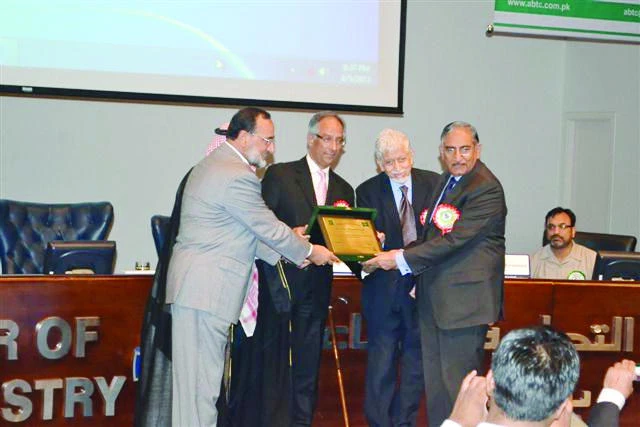
Pakistan’s newly elected government faces many challenges including terrorism, endemic corruption and an energy crisis that require integrated, urgent and concrete measures, said a noted Pakistani scientist famous for his association with the country’s 1998 nuclear tests.
Dr. Samar Mubarakmund was speaking at a workshop on “Energy Production using Natural Resources,” organized in Jeddah by the Engineers Welfare Forum (EWF) and Institute of Engineers Pakistan in collaboration with the Jeddah Chamber of Commerce and Industry (JCCI).
Scientists and technocrats including Dr. Shahid Munir from Pakistan; Talal Samarqandi, head of the JCCI’s engineering committee; Dr. Umer Chappra, a noted scholar and adviser to the Islamic Development Bank (IDB); and Pakistan Consul General Aftab Khokhar were among those who attended the function.
“Almost 90 percent of Pakistan’s wealth lies underground but needs major investments for exploration,” he said.
Referring to the Thar coal and Recodec copper mines projects, which he has been working on since 2007, the scientist said these huge resources could catapult the country from a third world nation to a developed one.
“The Thar coal reserves are worth over $ 12 trillion and if we use them to produce 100,000MW (five times the country’s present demand) the resources can expect to last for at least 500 years,” Mubarakmund said.
“Both projects are managed totally by Pakistani expertise and we will soon be able to resolve the energy crisis,” he said.
Munir, in his presentation on “Fuel staging of sugarcane bagasse,” outlined how sugarcane waste could be used to produce energy.
He said Pakistan was the fifth-largest producer of sugarcane in the world. This raw material was widely available at low cost. If used properly, it could produce over 2,000MW of electricity.
Samarqandi outlined the JCCI’s relationship with the EWF that includes scientific and vocational training, trade, site visits and professional training, which he said would benefit the professionals and engineers of Saudi Arabia and foreign nations.
Presenting his paper on “Green Buildings in Saudi Arabia,” Samarqandi highlighted ways for proper utilization of resources.
The JCCI official said it was important to consider six points for green buildings: proper selection of sites, limiting unplanned construction, public transportation, material usage, water efficiency to avoid leakages and power efficiency.
He cited an example of the 2009 flood in the area of Umm Al-Khair, which sank because the dam near it was built in the wrong location.
He said high-grade insulation and high quality materials used in building construction could save energy for the future. He said that oil dependence should be reduced. Over 25 percent of the oil produced is consumed in the country, he added.
He said Makkah and Jeddah municipalities, King Abdullah University of Science and Technology (KAUST), Saudi Basic Industries Corporation (SABIC), and other companies were already working on ways to control electricity use.
Earlier, EWF President Dr. Abdul Aleem Khan said the forum’s activities include publication of a technical magazine, organizing workshops and seminars to help Pakistani engineers seek jobs and financial assistance for top performing and needy engineering students.
Dr. Khan said that EWF also helped Haj pilgrims last year by providing 400 wheelchairs, and guidance on how to use the facilities.
‘Pakistan’s natural resources can solve energy crisis’