- All 6 Saudi contestants win medals in Kingdom’s debut JBOI participation
- 4 silvers, 2 bronzes add to Saudi Arabia’s strong 2026 informatics record
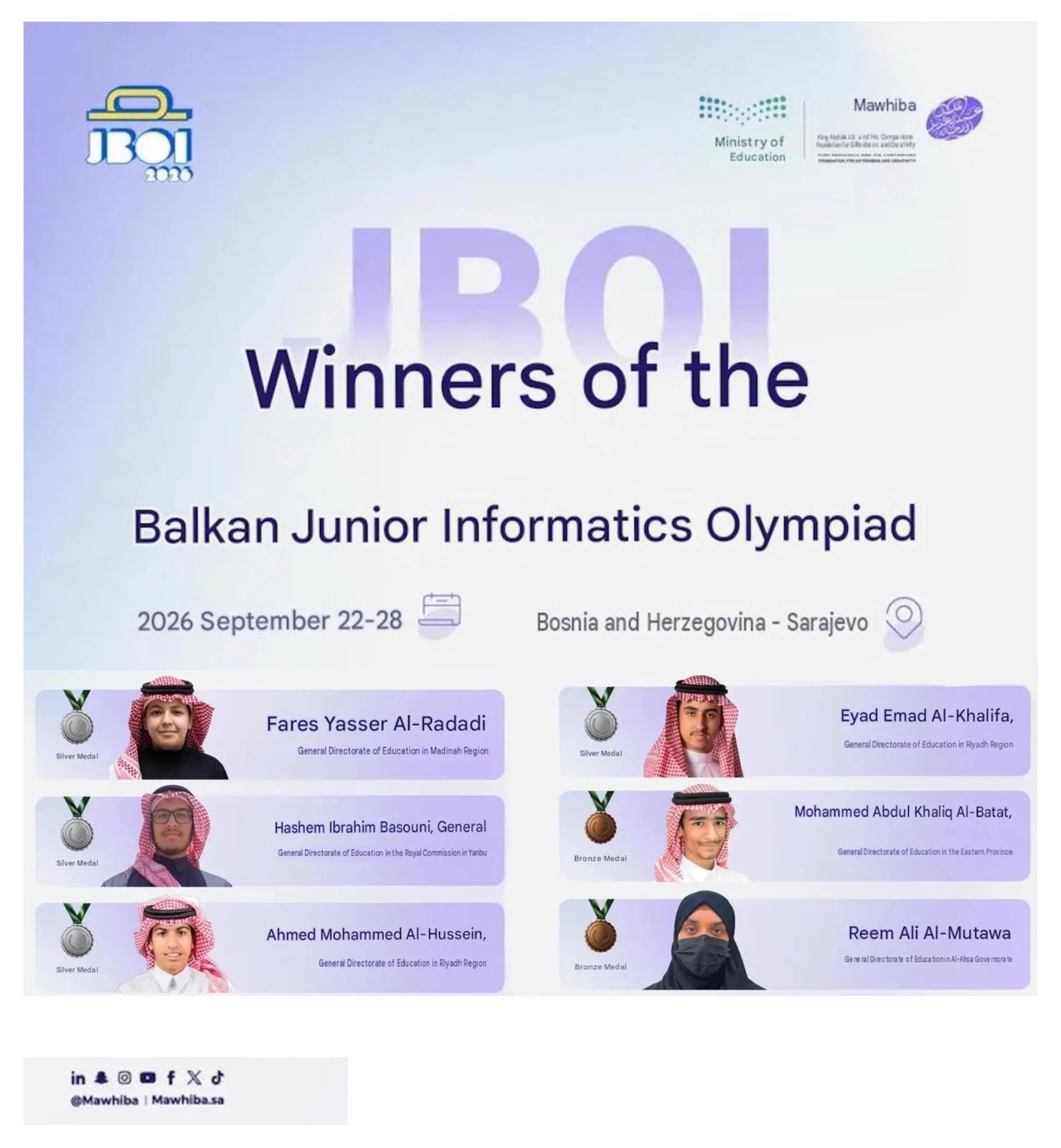
RIYADH: All six members of Saudi Arabia’s team won medals at the 19th Junior Balkan Olympiad in Informatics in Sarajevo, Bosnia and Herzegovina, in the Kingdom’s first participation in the competition.
The Saudi students won four silver and two bronze at the JBOI event, which included 90 participants from 13 countries, including Bulgaria, Cyprus, Greece, Moldova, North Macedonia, Romania, Serbia, Slovenia, Turkiye, Ukraine, the UK and host Bosnia and Herzegovina.
The silver medals went to Fares Yasser Al-Radadi from Madinah, Hashem Ibrahim Basyouni of the Royal Commission for Jubail and Yanbu, and Riyadh-based students Ahmed Mohammed Al-Hussein and Eyad Emad Al-Khalifa.
The bronze medals were won by Mohammed Abdulkhaleq Al-Battat from the Eastern Province and Al-Reem Ali Al-Mutawa from Al-Ahsa.
The achievement, reported by the Saudi Press Agency, represents a 100 percent medal success rate for the Saudi delegation and comes as the Kingdom continues to expand its presence in international informatics competitions.
Building on a strong year in informatics
The JBOI result follows a series of strong performances by Saudi informatics students this year.
In September, the team won four international awards at the 33rd Balkan Olympiad in Informatics in Tirana, Albania, including the Kingdom’s first silver medal in the competition.
Saudi Arabia also secured two bronze medals and a certificate of appreciation, taking its overall BOI tally to 17 awards from four participations.
In August, the Saudi team won three awards at the 38th International Olympiad in Informatics in Tashkent, Uzbekistan. Mohammed Nasser Al-Asmari won the Kingdom’s first silver medal in IOI history, while Sultan Abdulrahman Al-Aiban won bronze and Saad Bandar Al-Arifi received a certificate of appreciation.
The IOI result raised Saudi Arabia’s total in the competition to 14 international awards, comprising one silver, eight bronze and five certificates of appreciation.
The students competing at the JBOI underwent an extensive preparation and qualification process under the Mawhiba International Olympiad Program.
Their training included specialized camps, selection competitions and simulation contests designed to assess their abilities, strengthen problem-solving skills and develop algorithmic thinking strategies.
The preparation journey can span two to four years, gradually developing students’ abilities before they compete at regional and international levels.
Mawhiba develops gifted students
The program has been implemented by the King Abdulaziz and His Companions Foundation for Giftedness and Creativity, or Mawhiba, in partnership with the Ministry of Education.
Mawhiba is a nonprofit foundation dedicated to identifying, nurturing and empowering gifted students in Saudi Arabia and preparing them for advanced academic and scientific opportunities at the local and international levels.
Its programs cover talent identification, academic enrichment, research and specialized preparation for international scientific competitions.
In 2025, more than 31,000 students benefited from Mawhiba programs, with over 14,000 enrolled in academic and research initiatives. The foundation also reported that gifted students won 129 international awards across 26 Olympiads and the International Science and Engineering Fair that year.
The Junior Balkan Olympiad in Informatics is an annual competition focused on programming and algorithms for younger students.
Launched in 2007 in Belgrade, Serbia, it brings together talented students from Balkan countries and invites participants from outside the region to develop their skills in computer science, logical thinking and problem-solving.