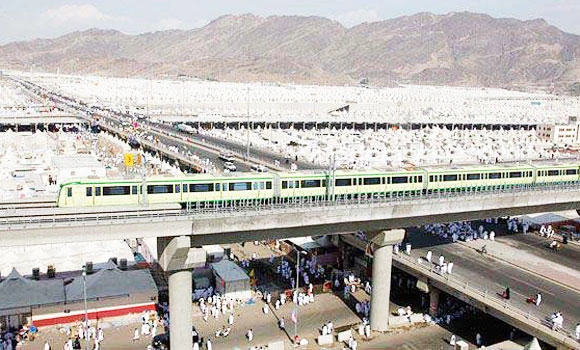
The journey to and from the Jamarat and Mina used to be the most difficult part of Haj, but now with the induction of the metro train connecting the holy sites, there has been a radical change in this regard. Most pilgrims now opt to use the train for transportation, thereby reducing vehicle congestion as well as noise and air pollution.
According to an official, pilgrims from South Asian countries account for the majority of Mashaer train users. However, compared with the previous year, there are fewer crowds at train stations in the holy sites. The initial plan for the metro train service was to carry 500,000 passengers but this figure was later reduced to 377,000.
“By Tuesday, a total of 359,000 pilgrims had availed of the train’s services. About 241,000 pilgrims were from Pakistan, India and Bangladesh and about 181,000 passengers were from within the Kingdom,” Farid Al-Ghamdi, a senior official of Al-Mashaer Al-Mugaddasah Metro Project (MMMP) told Arab News on Tuesday night.
He said elaborate security arrangements have been made at the train stations, with security forces overseeing the entrance and exit of passengers.
Train tickets cost SR250 for seven days and SR100 for four days. The ticket is in the form of a colored bracelet given to the pilgrim prior to Haj. There are five different colors of bracelets for the five different categories of passengers.
The metro train has 12 cars with a capacity of 250 pilgrims each. The train can transport a total of 80,000 passengers in an hour.
Passengers board from nine tent-shaped stations: Three in Arafat and three in Muzdalifah and Mina. Each station can accommodate up to 12,000 passengers.
Upon disembarking from the metro, pilgrims proceed to the station based on the colored bracelet given to them.
The China Railway Construction Corp., part of the Saudi-French-Chinese consortium, maintains the trains.
Earlier, Haj operators used over 75,000 buses to transport pilgrims. But now there are less than 20,000 and the figure is expected to further decrease in the years ahead.
The ambitious metro train project began three years ago at a cost of SR6.7 million and is gradually expanding to service all pilgrims.
South Asia pilgrims comprise the biggest clientele of Mashaer train