The National Water Company (NWC) is set to launch the first of the six Strategic Water Storage Projects in Jeddah during the second quarter of 2014 at a cost of SR500 million.
NWC CEO Loay Al-Musallam said the first project would come up in Briman area and the company had accorded top priority to it since it was vital in case of water shortage or during periodic maintenance of saline-water desalination plants.
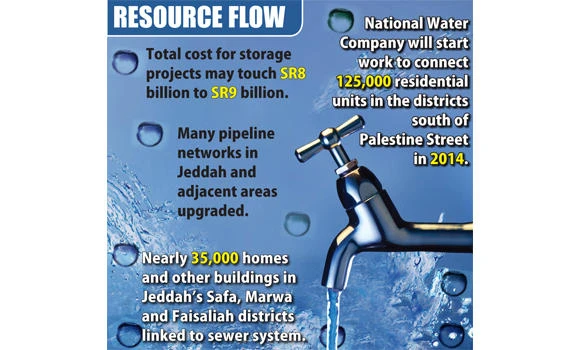
The NWC has completed connecting nearly 35,000 homes and other buildings in Al-Safa, Al-Marwa and Al-Faisaliah districts to the city’s sewer system, he told Arab News in an exclusive interview,
The company will start work to connect 125,000 residential units to the sewage system in the districts south of Palestine Street beginning 2014.
He said strategic storage of water was essential in Jeddah given Makkah Region’s dependence on desalinated water.
“We just have to avoid shortage of water supply to the public during desalination plants’ maintenance periods and in case of emergency disruption of water pumping.”
He said the second and third water storage projects in Jeddah will be implemented in Briman and Al-Faisaliah districts with a capacity of two million cubic meters.
“When completed, these projects would have the capacity to supply Jeddah with water for seven to ten days. The aim is for the residents not to feel any shortage in case of increase in demand or other emergencies.”
He said the company has plans to implement water storage projects in Makkah and Taif in phases over a period of three years.
“The total cost for these projects, including the ones in Jeddah, could touch SR8 billion to SR9 billion.”
Al-Musallam said that with the Jeddah Desalination Station 3 having a capacity of 240,000 cubic meters starting operations, the company was executing new water desalination plants and expanding the existing ones in the Makkah region.
Stating that many pipe networks in Jeddah and adjacent areas had been replaced, he said: “The NWC and the Saline Water Conversion Corporation (SWCC) have expanded their inspection efforts and largely reduced water leakage from the city’s pipeline network.”
On the sewage project, he said it began with the establishment of the NWC, but the main problem was completion of infrastructure, which involves a maze of tunnels at over 18 km and at a depth of 80 meters.
He said the implementation of this project in a city like Jeddah which has densely populated buildings is very difficult. However, the works were completed, including sub-networks and treatment plants, which include “Al-Khumra 4.”
All the old stations that operate through dual treatment have been shut down, and a station at the airport with a capacity of 250, 000 cubic meters was implemented.
Regarding obstacles and difficulties in providing connections to domestic and business units, particularly since they are located in densely populated neighborhoods, he said: “A major project of this size will face challenges and difficulties. There are 17 contractors working simultaneously to provide connections to residential and commercial units at a cost of over SR 1.7 billion”.
He said the NWC bears 80 percent of the total cost for providing connections while citizens or unit owners are burdened only with 20 percent which is minimal.
“Moreover, the SR 3000 that owners of housing units bear is paid in installments over a period of 3 years, while the company pays about SR 9,000 to provide connection to each household,” he said.