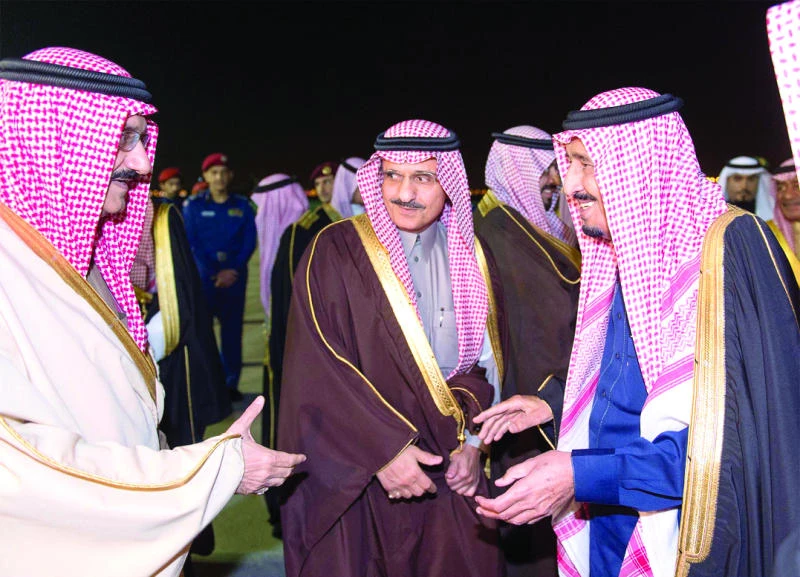
Crown Prince Salman, deputy premier and minister of defense, said the Gulf Cooperation Council summit in Doha embodied the cohesion among the GCC states, and confirmed their determination to move forward together to achieve their common objectives.
The summit commended Oman’s efforts to facilitate an agreement between the P 5 +1 and Iran on the latter’s nuclear program, hoping that the extension of negotiations would lead to a solution ensuring the peaceful nature Iran’s nuclear program, taking into account the environmental concerns of GCC states.
Regarding the proposal made by Custodian of the Two Holy Mosques King Abdullah on transforming the GCC into the Gulf Union, the summit leaders instructed the Ministerial Council to continue consultations and complete studying the matter with the participation of the chairman of the specialized committee.
The summit leaders reviewed the report on water linkage and water security in the GCC states and quickly completed a long-term comprehensive strategy for GCC. It also considered the report on the functioning of the GCC railway project as the project of great importance in facilitating trade and movement of people between the member states, and stressed the importance of completing this vital project by 2018 with best specifications available globally.
“The Supreme Council was informed about the functioning of the GCC Monetary Union, and the steps taken by states to implement the Gulf common market in order to activate and expand the access of nationals of the Gulf common market,” said Abdullatif Al-Zayani, secretary-general of GCC.
The Supreme Council adopted the updated GCC plan on prevention and control of non-communicable diseases (2014 2025). It also approved the provision of medical treatment services with respect to incurable diseases for the employees of the GCC armed forces through military hospitals and specialized centers in the GCC member states.
Regarding the fight against terrorism, the summit reiterated the firm positions of the GCC countries that renounce terrorism and extremism in all its forms and manifestations whatever its motives and justifications and whatever its source as well as on draining its financial sources. It stressed the commitment of the GCC countries to combating the ideology upon which terrorist groups are founded.
“The GCC states’ policy is based on tolerance and coexistence among nations and peoples, and stressing that GCC countries stand firm against terrorist threats facing the region and the world in order to ensure security, stability and peace,” Al-Zayani said.
The Supreme Council reviewed the international efforts made at all levels to confront terrorism and extremism, and praised the statement issued at the conclusion of the Regional Meeting for Counter-terrorism held in Jeddah in September in 2014, and hailed the statement’s content that affirmed a shared commitment to stand in the face of terrorist threats to the region and the world.
The Supreme Council also welcomed the outcome of the International Conference on Combating the Financing of Terrorism, which was held in Manama in November 2014, and deemed Manama Declaration as a point of reference in determining ways and means to curb the phenomenon of terrorism fully and comprehensively.
The summit leaders welcomed the UN Security Council resolution No 2170 in August in 2014, which condemned the spread of serious human rights violations by terrorist groups, including terrorist groups in Iraq and Syria, in particular the ISIS and Al Nusra Front, and the sanctions imposed on individuals associated with these groups.
Regarding Syria, the Supreme Council expressed deep concern and dismay at the deterioration in human conditions of the Syrian people as a result of Assad regime’s war crimes. The council urged a political solution to the Syrian crisis, in accordance with the Geneva 1 Resolutions to ensure Syria’s security, stability and territorial integrity and meet the aspirations of the Syrian people.
It expressed hope for the success of the efforts of the UN envoy to Syria Staffan de Mistura.
The Supreme Council condemned the repeated brutal attacks carried out by the Israeli occupation authorities and extremist Israelis against the unarmed Palestinian citizens, religious sanctities and places of worship, particularly Al-Aqsa Mosque, considering that to be a violation all relevant laws and international treaties, and holding the Israeli occupation authorities responsible for the violence resulting thereof.
The Council called on the international community to take the necessary measures for the protection of Palestinian civilians and religious sanctities.
On Egypt, the Supreme Council reiterated its firm position in support of President Abdel Fattah El-Sissi’s roadmap, stressing the GCC’s full support and stand with the people and government of Egypt in achieving stability and prosperity. The summit underscored the role of Egypt at Arab and regional levels for the benefit of both the Arab and Islamic countries.
Summit embodies Gulf cohesion