- Her brother, Youssef Oweida, said the family had been in contact with her shortly before the attack
- ‘When she moved to Saudi Arabia, she was so happy,’ victim’s sister tells Arab News
RIYADH: After escaping Syria’s civil war and rebuilding her life in Saudi Arabia, Buthaina Ahmad Oweida was preparing for Umrah when tragedy struck.
The 56-year-old Syrian mother of four, who had spent the past four years living in the Kingdom after fleeing the conflict in her homeland, was among those killed in the Houthi attack on King Khalid International Airport on Oct. 10.
Oweida, originally from Syria’s northern Idlib province, was returning to her home in Makkah after visiting her sister in Riyadh, where she had travelled to help care for her injured nephew. According to her sister, Hayat Oweida, she had intended to perform Umrah upon her return.
Speaking to Arab News from Idlib, Hayat said her sister had insisted on traveling despite her family’s concerns following an earlier attack on the airport.
“She told us, ‘I have made my intention to perform Umrah, and I am leaving’,” Hayat said.
“Before leaving, she said goodbye to everyone so dearly and hugged them tightly, as if she knew she was leaving. She asked everyone to forgive her.”
Her nephew had been speaking to her on the phone while she was at the airport, but the call was suddenly cut off.
“We assumed she was boarding the plane,” Hayat told Arab News.
What followed was a night of uncertainty for relatives spread across Saudi Arabia, Syria and Qatar.
The human toll of the airport attack is the subject of a new series by Arab News that seeks to tell the stories behind the names of the victims.
Through daily profiles, the series remembers victims as they lived: parents, students, workers and community members whose lives touched countless others. By sharing their journeys, hopes and contributions, Arab News aims to honor their memory and provide a fuller picture of the human impact of the attack.
In Idlib, where Oweida’s family members anxiously awaited news, Hayat recalled how relatives grew increasingly concerned when she stopped answering her phone.
Her family initially assumed she had either boarded her flight or reached Makkah to perform Umrah. However, as the hours passed without a response, they began contacting her neighbours in Makkah, where she lived alone, and reached out to emergency services.
By early morning, the family had reported her missing. Relatives in Doha also contacted the Syrian Consulate and provided her identification documents to help locate her.
At about 10 a.m., the family received confirmation of her death.
According to Hayat, Oweida had been seated in the airport when she was struck in the head by debris. Her phone had been displaced during the attack, leaving authorities unable to connect with her relatives immediately.
For relatives, the news was particularly painful given the hardship Oweida had already endured during Syria’s war.
Hayat recalled how her sister had raised her four children alone after losing her husband before the outbreak of the conflict in Syria.
She had lived in Aleppo with her children during the war, before escalating attacks by the Syrian regime and Iranian-backed forces forced the family to seek refuge in Idlib. After spending a year and a half there, she moved to Turkiye and eventually Saudi Arabia, where one of her daughters lives in Abha.
Her four children now live in Abha, Aleppo, Germany and Qatar.
One memory that remains especially vivid for Hayat was her sister’s attachment to Makkah, where she had found peace after years of displacement.
“When she moved to Saudi Arabia, she was so happy. We would ask her to come back to Idlib, but she would say, ‘I would never leave Makkah. I want to live and die in Makkah’.”
Oweida frequently performed Umrah, often on behalf of deceased loved ones at relatives’ request, and devoted much of her time to praying for her family.
“Whenever someone passed away, she would pray for them. Whenever someone was sick, she would pray for them. She would call us from in front of the Kaaba and ask us to join her in prayer,” Hayat said.
She added that her brother and Oweida’s son, who were in Doha, had their travel documents and visas arranged within half an hour with help from consular officials, allowing them to fly to Riyadh.
When they received Oweida’s body at the hospital, Hayat said the family took comfort in her peaceful appearance.
“She looked more beautiful than she had in life, like a bride. She was smiling,” she said. “Our sister is a martyr, God willing.’’
In a statement, the Syrian Embassy in Riyadh mourned Oweida’s death and extended condolences to her family. The embassy also expressed sympathy to Saudi Arabia and the families of other victims, while wishing those injured a swift recovery.
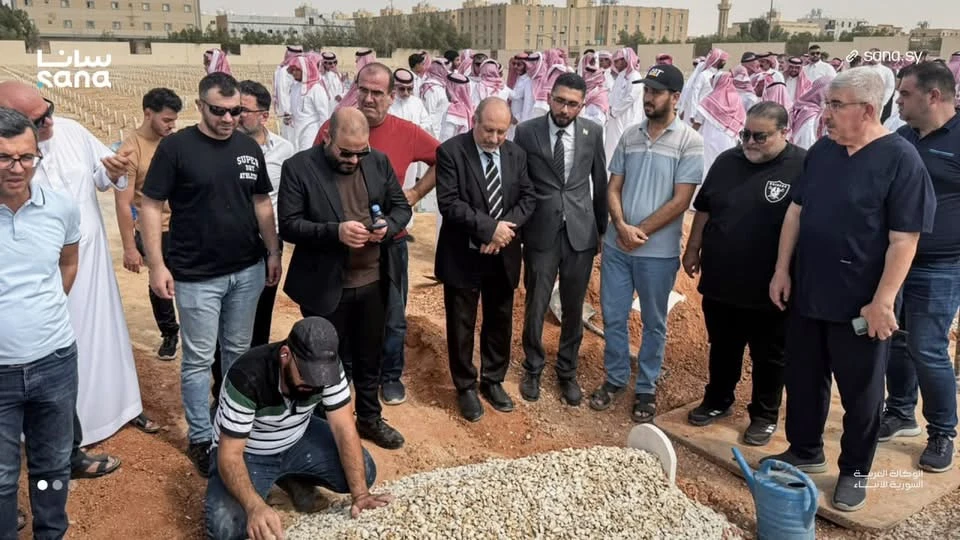
Oweida was laid to rest at Al-Naseem Cemetery in eastern Riyadh on Oct. 12 following funeral prayers at Al-Rajhi Mosque.
Hayat said her sister had always wished to be buried in Makkah, but travel restrictions and administrative procedures following her death meant the family ultimately arranged her burial in Riyadh.
According to Hayat, more than 2,000 mourners, including members of the Syrian community in Riyadh, attended her funeral.
For relatives in both Saudi Arabia and Syria, she is remembered not as a victim of a single attack, but as a woman who survived years of war, displacement and loss while remaining devoted to her family and faith.
“We were exhausted by the Iranian bombings in Syria,” Hayat recalled, reflecting on the violence that had driven her sister from her homeland. “And now, the world continues to suffer from Iranian brutality.”