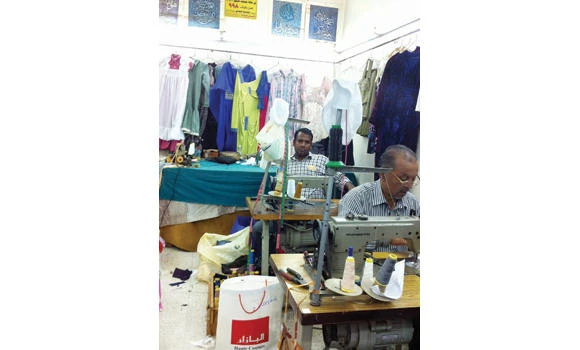
The expatriate-dominated tailoring sector is facing several challenges ranging from the heavy influx of Chinese-made garments to the Ministry of Labor’s ban on female tailors to the ongoing campaign of employment legalization.
The challenges threaten the very existence of the tailoring profession in the Kingdom.
Tailors are attempting to retain their clientele base, especially during Ramadan and the summer wedding season. The extension of grace period for illegal workers has been seen as helpful to some thousands of expatriate workers who found seasonal jobs during the holy month of Ramadan.
The tailoring sector, which is dominated by South Asian expatriates, is one of the sectors where there are abundant opportunities for seasonal jobs with summer and Ramadan, yet it is perhaps the most affected by the legalization campaign across Saudi Arabia.
Most tailors are working contrary to visa rules. Many are not working with their original sponsors.
There are three types of tailors: One serves the Saudi male client, the second tailors garments for South Asian expatriate men, and the third caters to Saudi female customers.
The Saudi male tailors are known as thobe tailors. The majority of the thobe tailors are from Egypt, Yemen, Pakistan and India. They stitch thobe and sell fabric to Saudi customers from cheapest textiles produced in Indonesia to expensive material from Japan. Due to design and collar style, this sector is mainly dominated by Arab expatriate tailors, who run shops owned by Saudi sponsors.
The expatriate tailors have limited presence mainly in Asian expatriate areas such Batha in Riyadh, the Seiko Building in Dammam and Balad in Jeddah where mainly expatriates are customers.
Situated in prime locations these tailoring shops are merely cutting cloth according to body measurements of customers and outsourcing stitching to tailors, who are mostly part-time or illegal workers. These tailors are working on a per-piece basis and receivie job orders from many tailoring shops.
The female tailoring shops have a strong presence in every corner of cities and small towns. Unlike male tailor shops, these female shops are having space for bargaining for stitching charges, but it depends upon communication skills in Arabic dress design.
Now authorities are focusing on women’s tailor shops to achieve Saudi female employment. The issuance of new visas for women tailoring profession has been halted. Ending expatriate recruitment in ladies tailoring filed is adversely affecting the business.
The extension of grace period has generated hope among tailors to correct their status and work in Ramadan to earn some money to meet charges to sponsors or flight to back home.
Before the end of the grace period, tailors of female garments had charged SR400 to SR600 for a wedding gown, which is now costs SR600 to SR800. “Dress charges have risen up to 30 percent now, as tailors have paid sponsors for visa transfer charges and shop transfer charges,” one tailor told Arab News.
Mohammed Ashfaque, an Indian tailor, who manages a women’s tailoring shop, said he has five employees in Safa district.
“Despite several challenges in last few years, professional tailors are still in good demand,” said Ashfaque. “Growth of ready-made garments has customers leaving tailors. Only Saudi women prefer to have new designs are now approaching us.”
Gulam Baksh, a Pakistani tailor with women’s tailoring specialty in Salamah district told Arab News that, “unlike in the past, women’s tailors are now focusing upon creativity and stitching according to designs since most of casual wear bought from garment stores are by Saudi women.
Tailors face tough challenges as tastes change, legalization sets in