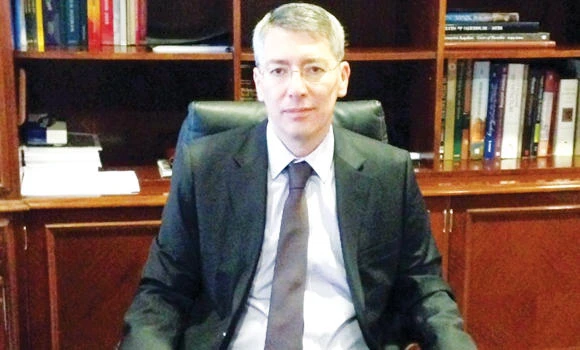
There is a genuine opportunity to establish a long-term partnership between Turkish and Saudi business communities, says Turkish Ambassador Yunus Demirer.
Saudi visitors also feel at ease in Turkey, says the envoy.
He also points out that Turkey is among the world’s top 12 producers of building materials such as cement, glass, steel and ceramic tiles.
Saudi Arabia and Turkey have forged closer ties in different sectors. How do you evaluate the relationship between Saudi Arabia and Turkey?
Turkey and Saudi Arabia enjoy a deep-rooted relationship.
Turkish-Saudi relations date back for centuries. We have a lot in common. We are two brotherly countries bound by strong historical, social and cultural ties.
In recent years, our relations have developed in many areas and evolved into a strategic level.
The depth and diversity of our relations, our joint commitment to stability and well-being of the region, intertwined interests lead our countries to foster the existing relationship to higher and new levels of cooperation.
On the other hand, Turkey and Saudi Arabia are the main pillars for stability in the region.
Deepening our relations in all fields would not only be beneficial to our people, but also to the entire region.
Do you think that the commercial component of the bilateral relationship has been one of the main factors that prompt the two countries to join forces in politics and culture?
Economic relations between Turkey and Saudi Arabia are intensifying.
Economic relations are in fact not separate from the deep and strong ties between our two people.
The two-day trade between Turkey and Saudi Arabia had shown a very dynamic trend in the last decade. The volume of bilateral trade has considerably increased.
During this period, both exports and imports have tripled, and in fact, the trade volume between Turkey and Saudi Arabia reached to $8 billion in 2013.
Turkish imports from Saudi Arabia have been traditionally dominated by mineral fuels.
Petrochemical products are the second largest category of Saudi exports to Turkey.
Turkish exports to Saudi Arabia are much more diversified.
Steel and iron products tend to dominate Turkish exports, followed by machinery and transport equipment, agricultural and textile products.
However, I believe that this volume is not reflecting the real potential.
There is scope to further boost bilateral commerce.
Please elaborate on the current state of investment climate in Turkey? What are the incentives provided by the Turkish government to foreign investors?
The structural reforms carried out by the Turkish government in the last decade have improved the investment climate, which in turn attracted Foreign Direct Investment (FDI).
Legislation on investment was streamlined along global standards.
At present Turkey has a foreign capital-friendly legislation and transparent regulatory system.
FDI legislation is based on the principle of equal treatment for domestic and foreign investors.
Turkey grants all rights, incentives, exemptions, and privileges available to national businesses to foreign investors.
Turkish law accepts binding international arbitration of investment disputes between foreign investors and the state.
Foreign investors are free to repatriate their capital and profits.
Turkey’s legal system protects and facilitates acquisition and disposal of property rights, including land, buildings and mortgages.
Also, generous tax privileges for free zones and technology development zones have provided a stimulus to the investment therein.
As a result, Turkey has become the commercial/investment hub of the region.
Foreign companies have been using free zones as well as Turkish partners to access the EU market as well as looking for business opportunities throughout the Balkans, Central Asia, the Caucasus and the Middle East. More than 400 Saudi firms operate in Turkey at present.
Saudi companies mainly invest in industrial sector in Turkey.
They can also increase their investments in agricultural, finance, tourism and communications sectors.
Please give an idea about Turkish investments here in the Kingdom. In fact, many Turkish companies have of late evinced keen interest to do business in Saudi Arabia. Your comments please.
Saudi Arabia is the largest economy in the Middle East.
The Saudi government has ambitious infrastructure plans for the next years. Turkish firms, now increasingly internationally oriented, cannot ignore these facts.
On the other hand, Turkish private sector proved its expertise and proficiency worldwide and earned a sound reputation in Saudi Arabia and the Middle East.
I believe there is a genuine opportunity to establish a long-term partnership between Turkish and Saudi business communities.
Indeed, the Turkish private sector has made progress to open up to world markets.
Turkish contractors proved themselves quite prolific throughout the world.
Turkish contractors have undertaken 6,700 projects in 102 countries with a total value of $274 billion.
At present 38 Turkish companies are included among the “Top 250 International Contractors List” with an annual turnover of $31,5 billion in 2013.
With this figure, Turkey ranked second in the world. On the other hand Turkey is among the world’s top 12 producers of building materials such as cement, glass, steel and ceramic tiles.
In 2013, Turkish contractors have undertaken 374 projects in 45 countries.
As of 2013, more than 4,000 Turkish companies have invested around $30 billion abroad.
Total investments made by 200 Turkish firms in Saudi Arabia reached $1 billion as against the total value of its investment in entire Middle East, which stands at $4 billion.
The total value of projects undertaken by Turkish firms exceeded $13 billion in the Kingdom by the end of 2013.
What is your perception about the economic situation of Turkey at the moment, keeping in view the fact that a large number of countries around the world are facing recession?
The Turkish economy has achieved an outstanding performance with its steady growth over the last 10 years.
Sound macroeconomic strategies, prudent fiscal and monetary policies, structural reforms that the Turkish government has been pursuing in the last decade resulted in high rates of growth and increased confidence in the Turkish economy.
As structural reforms have strengthened the macroeconomic fundamentals of the country, the economy grew with an average annual real GDP growth rate of 5 percent between 2002 and 2013.
Accordingly, while Turkish GDP stood at $231 billion in 2002, it rose to $820 billion at the end of 2013.
Concurrently, GDP per capita soared to $10,800 from $3,500 in 2002. As such, the Turkish economy is the 17th largest in the world and the 6th largest in Europe.
While many economies have been unable to recover from the recent global financial recession, the Turkish economy expanded by 9.2 percent in 2010, and 8.5 percent in 2011, thus standing out as the fastest growing economy in Europe, and one of the fastest growing economies in the world.
Taking into account the deteriorating economic outlook engulfing our trade partners especially in Europe, economic growth was 2.2 percent in 2012.
However, as a result of prudential macroeconomic measures the Turkish economy expanded by 4 percent in 2013.
According to the OECD, Turkey is expected to be the fastest growing economy among the OECD members during 2012-2017 and 2018-2030 with 5.1 percent and 4.3 percent respectively.
What about relations in tourism sector? Please give us an idea about tourism potential of your country for Saudis?
A total of 39 million tourists visited Turkey in 2013 and, hence the tourism revenue reached $32 billion.
Turkish tourism sector’s target is to be among the top five countries in the world in terms of attracting the highest number of tourists and receiving the highest amount of tourism revenue by 2023.
Indeed, tourism is a dynamic and resilient sector in Turkey.
As of today, Turkey ranks 6th in the most-visited global destinations list.
Tourism relations between our countries are developing quite well. Last year we attracted almost 250,000 Saudi tourists to Turkey.
According to the figures of the first six months, we expect this number to increase by more than 40 in 2014.
The Saudi visitors feel at ease in Turkey, which is a majority Muslim country.
Our values, history, art, food and way of life easily reach our Saudi brothers.
On the other hand, more than 500,000 Turks visit Saudi Arabia each year, mainly for Haj and Umrah.
People-to-people contacts have always increased familiarity and understanding between people and communities.
I think, each and every step taken in this direction, will contribute to further enhance and deepen our relations.
Culture and tourism have a more vital role to play in international relations.
What is Turkish position on a range of regional issues especially on Syria, ISIS and Kobani?
In Syria, the objective must be to make the regime understand that there can be no military solution to the conflict.
The regime must engage in serious negotiations for a genuine and inclusive political transition that will lead to a real political change as envisaged by the Geneva Conference of 2012. In the meantime Turkey will remain attentive to the needs of the Syrian people.
Turkey hosts more than 1.5 million Syrian refugees as part of a historical humanitarian effort, and helps many more in Iraq.
The humanitarian assistance of Turkey to those refugees has reached $4 billion.
Turkey has the longest land border with Syria among all its neighbors.
Together with Iraq, the length of the border is 1,295 km.
This is a danger felt far more acutely by Turkey than any other country.
ISIL, which constitutes a direct threat to Turkey’s national security, being priority, any threat coming out of this geography is first directed against Turkey.
Turkey is and will always be on the frontline in combating terror.
On the other side, we cannot solve the current problems as long as we don’t address the root cause of the problem.
ISIL has been able to dig in thanks to the air support of the regime in Damascus.
Therefore, the strategy against ISIL should include elements against the re-deployment of regime elements or various terrorist structures to the areas where ISIL would be eliminated from.
Resolute and comprehensive action is required to achieve this, involving the establishment of a no-fly zone with safe areas in Syria to protect its citizens.
Without it, any operation will be insufficient to eradicate the current threats.
As for Ayn Al Arab/Kobani, Turkey handled this issue with utmost sensitivity and in full cooperation with the international coalition.
The recent developments regarding Kobani is part of the developments in entire Syria.
There are now almost 200 thousand people in Turkey from only Kobani region.
They fled to Turkey within one week.
Despite the risks, Turkey, through mobilizing its resources, continues to maintain an open door policy for people coming to its borders, regardless of their ethnic identity. Humanitarian aid is also being sent to Kobani region.
We are also facilitating the passage of Kurdish peshmerga forces to Kobani.
We will continue our contribution to saving the town so its residents can go back to their homes.
Turkish enterprises keen to build on strong Saudi ties